Global Site
Displaying present location in the site.
Vol.19 No.1 Special Issue on NEC BluStellar: NEC BluStellar Driving the Future of Digital Transformation — A Value Creation Model Pioneered by AI, Security, Data Management, and Modernization
Vol.19 No.1 (May 2026)
-
- DX Value Creation Strategy with NEC BluStellar
- AI at the Forefront: The Value Creation Engine of the DX Era
- Cybersecurity in the Age of AI: Approaches and Biometric Authentication Use Cases
- Data Management & Governance: The Path to Data-Driven Management
- Modernization and AI-Enabled Intelligent Cloud
- Co-Creation-Driven Problem Solving and Value Generation through Human-AI Collaboration
- Creating Empathy in Digital Transformation through NEC’s Client Zero Strategy
- Technologies Shaping the Future of DX
- Thought Leadership Initiatives Shaping the Future
- The Future Pioneered by NEC BluStellar and NEC’s Commitment

Press Esc key for close

[Pictured from top]
KIMURA Norihiko
Corporate Executive Vice President (Executive Officer)
President of Digital Platform Services Business Unit
Norihiko Kimura drives business transformation through NEC BluStellar, leveraging deep expertise and experience rooted in the financial sector.
IWAI Takao
Corporate Executive Vice President (Executive Officer)
President of Digital Delivery Services Business Unit
President, NEC Solution Innovators, Ltd.
With more than 20 years of experience as a systems engineer in the financial sector, Takao Iwai leads the NEC Group’s IT services business.
YAMADA Akio
Corporate Senior Vice President
Managing Director, AI Technology Service Business Division
AI Technology Officer
Drawing on extensive experience overseeing NEC's diverse R&D activities, Akio Yamada enables the rapid market deployment of advanced technologies.
The environment surrounding enterprises is undergoing transformation at an unprecedented pace, driven by rapidly changing global dynamics and the advancement of the AI‑driven industrial revolution. The increasing sophistication of AI and the explosive growth of data are redefining the nature of social and economic activity, requiring companies to demonstrate greater flexibility and make faster decisions. Furthermore, as challenges related to data sovereignty, security, and governance become more pronounced, the need for enterprises to advance transformation by leveraging technology and developing human capital as two inseparable pillars is growing stronger than ever.
In 2024, NEC announced its value‑creation model, NEC BluStellar, as the culmination of the cultural, organizational, and DX reforms it has pursued since 2018. Built on three core foundations—business model, technology, and organization/human resources—NEC BluStellar integrates four strategic focus areas: AI, security, data management, and modernization. By systematizing the practical expertise NEC has cultivated through its own Client Zero initiatives, together with insights gained through co‑creation with forward‑thinking customers, into the NEC BluStellar Scenario, NEC delivers highly repeatable, end‑to‑end digital transformation. This approach is further strengthened through collaboration with global partners and the continuous development of DX talent.
This special issue presents a structured overview of NEC BluStellar, centered on its four focus areas and the NEC BluStellar Scenario, and examined from the perspectives of strategy, technology, implementation, and future vision. In addition to core themes such as the forefront of AI innovation, advanced cybersecurity, data‑driven management, and intelligent cloud, it also introduces cutting‑edge technologies—including real‑world agents and quantum cryptography—and highlights thought‑leadership initiatives that point to the future direction of digital transformation.
- ※The information posted such as the name of the department to which you belong is as of March 2026.
Special Issue on NEC BluStellar: NEC BluStellar Driving the Future of Digital Transformation — A Value Creation Model Pioneered by AI, Security, Data Management, and Modernization
Remarks for Special Issue on NEC BluStellar
YOSHIZAKI Toshifumi
Corporate Senior Executive Vice President and CDO (Executive Officer)

The Future of Digital Transformation Driven by NEC BluStellar: A Value Creation Model Pioneered by AI, Security, Data Management, and Modernization
YOSHIMOTO Hiroshi
Managing Director
BluStellar Business Promotion Division

DX Value Creation Strategy with NEC BluStellar
Overview: DX Value Creation Strategy with NEC BluStellar
YOSHIZAKI Toshifumi
Corporate Senior Executive Vice President and CDO (Executive Officer)

This paper introduces NEC BluStellar, the value creation model announced in May 2024 that leads our customers into the future. Starting from each customer’s management agenda, NEC BluStellar drives successful digital transformation (DX) for both customers and society through an end‑to‑end business model that spans from value-creation concept design to implementation. By leveraging NEC’s strengths—strategy planning capabilities, AI‑ and security‑driven technologies and expertise, and a robust pool of DX talent and training programs—NEC BluStellar enables rapid, high‑quality system implementation and high‑precision value creation through a business model centered on NEC BluStellar Scenarios, which are developed by extracting, analyzing, and standardizing best practices and experiential knowledge.
AI at the Forefront: The Value Creation Engine of the DX Era
Advancement of Specialized Business Operations and Safe, Secure AI Utilization
SAKAI Junji, CHIBA Yuki

The advancement of generative AI is driving transformation across business and society, yet companies remain concerned about how to effectively utilize AI in practical operations and the risks it may pose. This paper introduces case studies where autonomous Agentic AI has enabled business process automation, such as in command center operations and craft beer development, along with the latest supporting AI technologies. Furthermore, it discusses international legal trends and risk management technologies aimed at ensuring the safe and secure use of AI.
Advancing Critical Sector Operations and Contact Center Operations through Situation Awareness and Automated Response
SZTYLER Timo, IWAI Takanori, MORIBE Shoujirou, OKABE Koji, YAMAMOTO Hitoshi, HUNG Chia-Chien
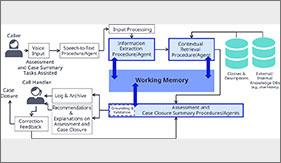
This paper introduces a generative AI solution designed to enhance operational efficiency and effectiveness for contact centers for enterprises and organizations. This solution functions as a partner for operators. It automates critical tasks for operators receiving calls, such as urgency assessment, case classification, and report generation. It also provides call takers with recommended actions. Furthermore, in the contact center domain, it offers operators real-time call content classification, compliance violation detection, and guided troubleshooting support. This solution, once realized, will reduce manual workload, minimize human error, and enable rapid, high-precision responses to various cases and customer interactions, driving business growth and improving operational outcomes.
Co-Creation Between Brewers and AI: The Development of "The taste of life created by brewers and AI—Agentic AI × Craft Beer"
WASHIDA Azusa, SHIMURA Noritaka, ASAMI Ryuta

NEC positions AI as a collaborative partner for humans. In this initiative, brewers and AI worked together in the product development process to create “The taste of life created by brewers and AI—Agentic AI × Craft Beer.” NEC’s core AI technology “NEC cotomi” was used to analyze the lifestyles and standards of Japanese people across different generations. Building on this, brewers engaged in interactive dialogue with an Agentic AI based on NEC cotomi to formulate recipe ideas tailored to each generation. As a result, the efficiency of the product development process improved by 40%, and by leveraging the creativity of both brewers and AI, the collaboration led to the creation of an innovative product that would not have been possible through conventional methods. This paper introduces new possibilities for product development arising from human–AI collaboration, detailing specific initiatives undertaken in this project.
Explaining GenAI Output with the LLM Explainer
SYED Shahbaz, LAWRENCE Carolin, GASHTEOVSKI Kiril, IWAI Takanori, ITO Kunihiro, ARAKI Toshinori
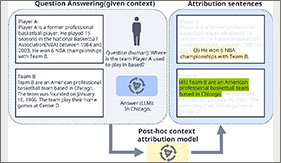
Enterprises increasingly would like to use Large Language Models (LLMs) to enhance operational efficiency, yet verifying their accuracy remains a critical challenge. Our LLM Explainer helps build trust and transparency by linking AI-generated answers to their exact source sentences. This allows fast and efficient verification of AI output, particularly suitable for high-risk domains. LLM Explainer achieves this through automated data generation and the training of efficient attribution models. Evaluation shows it obtains superior accuracy while operating at 1/70th of the computational cost of larger models with lower accuracy. For decision-makers, it transforms the use of LLMs from a potential vulnerability into a strategic capability that strengthens confidence in mission-critical intelligent systems.
AI Utilization within NEC: Advancing DX and AX through the Client Zero Strategy
SEKI Noriaki
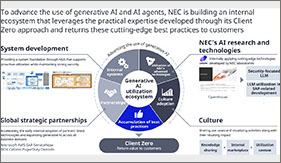
NEC is accelerating internal digital transformation (DX) through the implementation of its Client Zero strategy. This strategy is a cyclical model in which NEC itself becomes the first customer to utilize digital solutions, accumulating practical expertise that is then shared externally. Under the Mid-term Management Plan 2025, NEC is thoroughly promoting DX and has achieved certain results, such as advancing data-driven management. Furthermore, since the emergence of generative AI in 2023, NEC has been driving AI transformation (AX), leveraging its core AI technology “NEC cotomi,” as well as solutions like OpenAI and Copilot, to achieve improvements in operational efficiency, decision-making support, and knowledge utilization across various domains. Rules and guidelines for AI utilization are also being established, and a group-wide AI utilization platform is being constructed within the NEC Group. These initiatives demonstrate NEC’s commitment to proving the value of its own DX efforts and to driving transformation for its customers and society as a whole.
Cybersecurity in the Age of AI: Approaches and Biometric Authentication Use Cases
NEC’s AI-Driven Cybersecurity Strategy and Initiatives
AOKI Satoshi, FUJITA Norihito
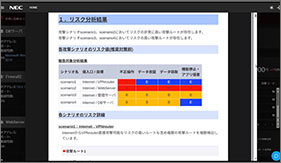
This paper provides an overview of NEC’s strategy and initiatives for leveraging AI in its cybersecurity services. To address the increasing scale and sophistication of cyberattacks, NEC emphasizes the rigorous implementation of security by design, ensuring that security is integrated throughout every stage of system planning, development, operation, and maintenance. By incorporating the expertise of security professionals into Agentic AI, NEC delivers highly reliable and efficient cybersecurity solutions. The paper also introduces key internal initiatives and showcases examples of customer-facing services that embody these approaches.
Sophistication of Security Audit Activities Leveraging Generative AI
IKEMATSU Miho, TOMIOKA Taiga
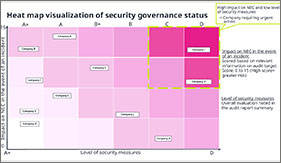
NEC has developed a tool that leverages generative AI to automatically generate security audit reports with the aim of enhancing security governance. This tool uses generative AI to create and assess recommended actions based on information about the audit target, thereby improving the efficiency and quality of auditing operations. In actual implementation, the tool has been proven effective at reducing workloads and producing consistent quality in reports. Going forward, further improvements in accuracy and its application in other fields are expected. In this paper, an overview of the tool will be provided along with an explanation of the achieved implementation results and innovations used over the course of its development.
Cybersecurity Dashboard Realizing Comprehensive Security Management
KIZUKURI Shota, YUTOKU Takahisa
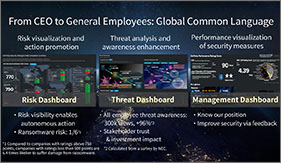
In this paper we introduce a practical example in which NEC has used the company-wide cybersecurity dashboard to address management issues related to governance, accountability, and awareness in a data-driven manner. This dashboard enables visualizing the status of risks, threats, and management, and with actions based on KPIs and automated follow-up, we have been able to more than double the speed of responses to these issues and the risk of ransomware incidents has been reduced to less than one-sixth of what it was. Additionally, visualizing third-party evaluations and investment effects has improved clarity and transparency in explanations and has been utilized to facilitate dialogue with stakeholders. Also, visualizing training results and sharing security news has served to foster a sense of participation among all employees and established a platform for a common language enabling conversations between everyone from the president to general personnel. These initiatives have also received high praise externally, resulting in accolades such as wining the Grand Prize at the Japan Security Awards 2024.
Creating a New Trend in Identity Verification with DID/VC and Biometric Authentication
HIGUCHI Yuya, IWAHORI Yasufumi, MAEDA Hiroshi, ARATA Yuki
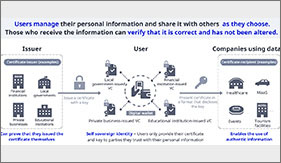
With the advancement of digital transformation (DX) and AI technology, a wide variety of identity information—not only names and basic attributes, but also qualifications, work history, appearance, voice, and health status—is increasingly being digitized, creating a foundation for people to enjoy greater digital convenience. At the same time, the management and handling of data that contains personal information is becoming ever more complex and sophisticated, due to stricter regulations and rising public awareness. This growing complexity poses a burden not only for businesses, but also for users who are asked to provide their personal information, which has become a factor hindering effective data utilization. Against this social backdrop, this paper introduces a new method of identity verification and its applications, achieved by combining decentralized identity and digital certificates with biometric authentication technology.
Data Management & Governance: The Path to Data-Driven Management
NEC’s Perspective on the Future of Data-Driven Social Value Creation
DEJIMA Takashi, KAWABATA Terumasa, YAMAKAWA Satoshi
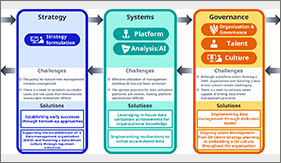
With the advancement of digital transformation (DX), data-driven management is becoming increasingly important in the formulation and execution of corporate growth strategies. To realize this, it is essential to build a data utilization platform that supports the sustainable growth of the enterprise. However, the process of considering and implementing such a platform involves numerous factors, and the complexity itself often becomes a barrier to getting started. This paper introduces NEC’s initiatives to support all phases of realizing data-driven management—from identifying challenges to providing operational support—with a particular focus on consulting for the architecture of data utilization platforms, which is central to these efforts.
Promoting Effective AI and Data Utilization through AI-Ready Enterprise Data: An Approach Using NEC Data-Driven DX Assets & Framework
TOMONAGA Yasuyuki, KINOSHITA Yohei, KOUYAMA Shinya, KAYUGAWA Takanobu
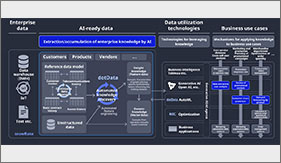
To enhance competitiveness, many enterprises are accelerating digital transformation (DX), with the use of AI as a core technology now essential. Nevertheless, there are still only a limited number of cases where AI has been fully integrated into mission-critical operations and has contributed to business outcomes. This situation arises from several complex factors: the difficulty of defining use cases that are directly linked to business outcomes; challenges with data, such as the lack of AI-ready data that serves as the source of value; and the difficulty of technology selection, as leading solutions change rapidly and it is hard to determine which products and technologies to invest in. This paper introduces specific approaches using the NEC Data-Driven DX Assets & Framework, providing practical guidance for effective enterprise utilization of AI and data.
Implementation of a Data Utilization Platform for Realizing Community-Based Finance (Ogaki Kyoritsu Bank, Ltd.)
YAMAYA Rika, NAKATSUKA Yutaka
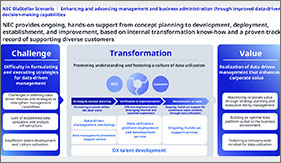
In today’s rapidly changing VUCA era—marked by volatility, uncertainty, complexity, and ambiguity—organizations are placing greater emphasis on data-driven management, using data-based forecasting and analysis to enable more sophisticated decision-making. However, realizing the full value of data remains challenging when information is scattered across multiple systems and media. To deepen customer understanding and advance community-based finance, Ogaki Kyoritsu Bank implemented the NEC BluStellar data utilization platform. Working closely with NEC, the bank evaluated its options and adopted a hybrid architecture that integrates both on-premises and cloud environments, ensuring flexibility and scalability for future growth. This paper presents the background of the implementation, the support provided, the outcomes achieved, and future prospects.
NEC’s Data-Driven Management Initiatives
AMANO Masahiko, KAWASHIMA Aoi
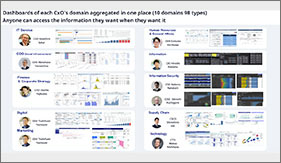
At NEC, we have implemented the Client Zero strategy as part of our Mid-term Management Plan 2025. As part of this initiative, we are promoting an internal transformation towards data-driven management, where we accumulate various types of data and utilize digital technologies to make data-driven decisions in all aspects of our business. The practical, real-world digital transformation (DX) knowledge gained through these efforts is leveraged to provide value to our customers and society. This paper introduces NEC’s data-driven management, centered around our management cockpit and dashboards, including its objectives, current achievements, initiatives for internal deployment, data management to support these efforts, and future initiatives utilizing AI.
Modernization and AI-Enabled Intelligent Cloud
NEC BluStellar Modernization to Realize Customer Value
KODAMA Naohiro, IWAMURA Hisashi, TERADA Kei, NAKADA Yuuko
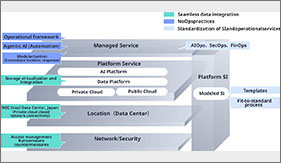
In recent years, amid rapid changes in social structures and technology, enterprises are required to address a wide range of challenges, such as the societal integration of AI, responses to geopolitical risks, and the promotion of carbon neutrality. NEC BluStellar Modernization is an NEC BluStellar Scenario that drives end-to-end, value-creating modernization with an eye toward an AI-native society. By leveraging AI-driven operations management and security capabilities proven through NEC’s Client Zero initiative, as well as consulting and standardized system integration (model-based SI), we deliver modernization optimized for each customer. Through the implementation of advanced IT infrastructure in society, we aim to create new value and contribute to a sustainable society.
Intelligent Hybrid Cloud for Management Support in the AI Era
TAKAGI Kenki, NISHIMURA Takeshi, SAKAI Eiji, TSUJI Atsushi, KOTANI Tetsuro, OIKAWA Toyohide
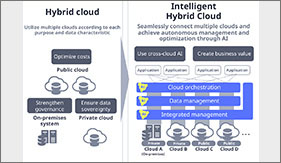
With the advancement of AI, managing ever-increasing volumes of data—including confidential information—has become more critical than ever, alongside the need to strengthen governance, ensure compliance with laws and regulations in each country, and optimize costs. Against this backdrop, hybrid cloud environments that integrate multiple clouds with on-premises systems have become mainstream. As a next-generation platform to support management in the AI era, NEC proposes the Intelligent Hybrid Cloud, which seamlessly connects cloud environments through autonomous operation and optimization enabled by AI. This paper highlights three key points essential to realizing this platform—cloud orchestration, data management, and integrated management—and provides a detailed overview of NEC’s specific initiatives in these areas.
Advanced Incident Management Services and Research and Development of Agentic AI for Autonomous Operations
NATSUMEDA Masanao,KANAMEDA Keij, MIZOGUCHI Takehiko, TAKAHASHI Atsushi, YONEDA Masashi, AJIRO Yasuhiro
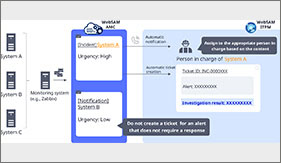
Many companies face the challenge of expending significant effort on the operation and maintenance of existing IT systems, which limits their ability to leverage IT for management strategies and business growth. To address this issue, NEC offers the NEC BluStellar Scenario, "Improving business processes through operational DX in hybrid IT environments," drawing on expertise gained from in-house practice and accumulated knowledge from customer system deployments. This paper introduces part of these efforts, specifically NEC's advanced incident management services and the research and development of autonomous AI agents aimed at streamlining and automating IT system operations.
NEC BluStellar Scenario Case Study: Seven-Eleven Japan
MAEDA Yasuhiro, KAMIYA Akihito, ITO Yoshihiro, YAMASAKI Shinya, MURAKAMI Daisuke, SATO Yoshiyuki
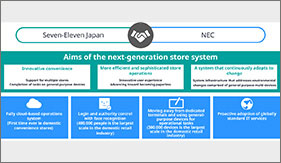
In this paper we introduce a case study of Japan’s first full cloud-based next-generation store system, which was developed jointly by Seven-Eleven Japan and NEC. Transitioning the architecture from the conventional on-premise model to a cloud-based model enabled the implementation of microservices for applications and the usage of general purpose devices, which resulted in more efficient store operations, labor-saving, and improved function scalability. In addition, a balance of safety and convenience was also achieved with an authentication management system that uses both face recognition and an ID platform establishing device management for 310,000 devices through enterprise mobility management (EMM). Furthermore, utilizing information technology service management (ITSM) enabled centralized management of incidents in a multi-vendor environment. Going forward, the plan is to further enhance efficiency through data-driven decision-making by promoting data analysis and the automation of operations using AI and software as a service (SaaS).
Case Studies of NEC BluStellar Scenario for Government Agencies—Government Cloud Operations Support Services
KOMATSU Masami, HOTTA Yoshihiro
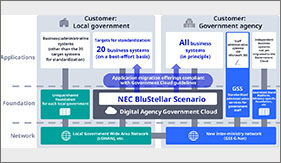
As the Japanese government migrates government information systems and core local government systems to the Government Cloud, NEC offers its Government Cloud Operations Support Services as part of NEC BluStellar Scenario for government agencies. This paper outlines the positioning and overview of this service and also introduces the related Public Cloud Migration and Operations Support.
Promoting Modernization Through the Latest Technology and Next-Generation Models for IT Operations
TAKATSU Masaaki, TSUJIKAWA Yousuke
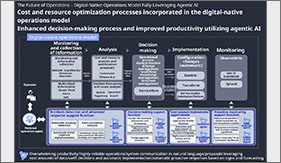
This paper reports on the modernization of internal systems using the latest technologies, such as Google Cloud, as well as the status of the IT operational reforms accompanying this modernization. Through the unification of operational platforms and the automation of business processes, we were able to improve business efficiency and early detection of issues with visualization initiatives utilizing IT dashboards aimed at all employees. Additionally, the implementation of generative AI and agentic AI is paving the way for operational autonomy and a No Operations (NoOps) model. Moving forward, the development of personnel and strengthening governance will be crucial challenges for the sustainable advancement of these initiatives.
Co-Creation-Driven Problem Solving and Value Generation through Human-AI Collaboration
Consulting as a Business in an Era Where AI Is Changing Corporate Activities and Management
ABEKI Takumi
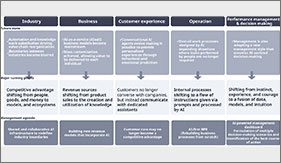
The conventional consulting model, which relies on people and information asymmetry, is reaching its limits amid accelerating environmental changes and advances in generative AI. The model is currently evolving toward an “AI-as-a-Service” type co-creation model that combines AI with expertise, continuously creating value while working in accompaniment with customers. Consultants need to shift toward more strategic and creative roles and transform into partners who support the realization of a sustainable competitive advantage by leveraging industry-specific expertise and data. This paper examines the impact of AI utilization on corporate activities and management, as well as new directions for consulting as a business.
Creating Empathy in Digital Transformation through NEC’s Client Zero Strategy
Creating Empathy in Digital Transformation through NEC’s Client Zero Strategy
KODAMA Hiroshi, KIMURA Yoshitaka
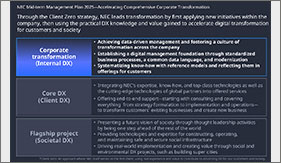
Since 2021, NEC has been advancing its Client Zero strategy, positioning itself as the first customer of its own solutions in order to create genuine customer value. During its internal DX journey, NEC encountered five major challenges: doubts about leadership’s commitment, conflicts of interest between departments, criticism from frontline staff regarding theoretical approaches, cultural differences with global partners, and transformation fatigue. By overcoming these barriers—and by openly sharing not only successes but also setbacks and failures—NEC has fostered deeper empathy with its customers. As a result, NEC has shifted from the traditional systems integration (SI) model to a partnership-based, co-creative approach to problem solving. This transformation forms the foundation of NEC BluStellar, announced in 2024.
[Related papers]
- AI Utilization within NEC: Advancing DX and AX through the Client Zero Strategy
(Category: AI at the Forefront: The Value Creation Engine of the DX Era) - Cybersecurity Dashboard Realizing Comprehensive Security Management
(Category: Cybersecurity in the Age of AI: Approaches and Biometric Authentication Use Cases) - NEC’s Data-Driven Management Initiatives
(Category: Data Management & Governance: The Path to Data-Driven Management) - Promoting Modernization Through the Latest Technology and Next-Generation Models for IT Operations
(Category: Modernization and AI-Enabled Intelligent Cloud)
Technologies Shaping the Future of DX
NEC’s Real-World Agents Enabling Coordination and Optimization of Devices and People
SUZUKI Jun, OHTA Daisuke, WADA Takuma, ICHIEN Masumi
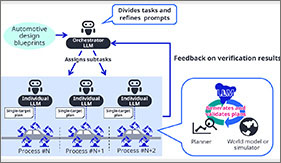
In recent years, technologies related to physical AI and embodied AI have received increasing attention as advancements are made in autonomous driving and bipedal robot autonomy. In addition to AI-driven automation of individual devices, it is becoming ever more important to develop technologies that enable coordination among multiple devices and people, allowing for system-wide optimization. At NEC, we are actively researching and developing real-world agents to achieve such coordination. For real-world agents, it is essential to create technologies that can realistically apply the output of generative AI to actual operations. This paper discusses NEC's work on real-world agents and introduces application examples in the manufacturing and logistics domains.
Latest Developments in NEC Quantum Cryptography Technology
ISHII Naoto, KAWAHARA Hiroki
This paper outlines recent developments in NEC’s quantum cryptography technology. For roughly 20 years, NEC has been a research and development leader in this field and is the only company in Japan working on both the BB84 protocol—already in practical use—and the CV-QKD protocol which is expected to reduce costs. Achievements include demonstration experiments of low-latency, large-volume quantum cryptographic data transmissions in financial transactions and the world’s first successful demonstration of quantum token issuance. These developments are raising expectations that quantum cryptography will become a foundational technology supporting future digital transformation (DX). As a technology that enables secure and reliable data exchange, quantum cryptography is anticipated to be initially adopted in mission‑critical fields such as finance and government, with gradual expansion into a wide range of industrial sectors. This paper outlines the features and advantages of NEC’s quantum cryptography technology, application examples, current challenges and countermeasures, as well as future prospects.
Utilization of Internationally Standardized Hardware Security Technologies for Verifying Device Authenticity
KOBAYASHI Tsukasa, NAGATA Atsushi, TOMITA Toru, TANAKA Junta
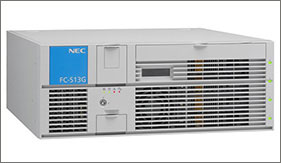
To address issues of economic security and supply chain risk, this paper introduces the use of internationally standardized hardware security technologies that enable assurance and verification of the authenticity of devices used for accessing systems. Globally, North America is leading these efforts, with standardization progressing in coordination with policy initiatives. In particular, the incorporation of standardized technologies is increasingly becoming a requirement for computing devices procured in critical systems. NEC participates in the international standards organization TCG (Trusted Computing Group) and is developing zero trust products such as secure servers and device management and verification software that comply with these standard technologies, promoting their deployment from the defense sector to commercial applications. This paper presents an overview of market and standardization trends, as well as NEC’s initiatives.
Thought Leadership Initiatives Shaping the Future
Thought Leadership Initiative Shaping the Future, Gathering the wisdom of the world and presenting relatable visions for social implementation
FUJISAWA Kumi
Chairperson of the Institute for International Socio-Economic Studies (IISE)

The NEC Group is currently promoting its thought leadership initiative to develop and present relatable future visions and push forward social demonstrations and implementation together with stakeholders. The Institute for International Socio-Economic Studies (IISE), an independent think tank of the NEC Group, is the driving force behind this initiative. With the advent of an artificial intelligence (AI) native society, where AI technology is widespread across the social fabric with people utilizing it organically, upon us, the IISE is driving the NEC BluStellar strategy and thought leadership initiative to help Japan shine on the world stage again. We interviewed Kumi Fujisawa, chairperson of the IISE, to ask about how the company would achieve this goal.
The Future Pioneered by NEC BluStellar and NEC’s Commitment
The Future Pioneered by NEC BluStellar and NEC’s Commitment
KIMURA Norihiko, TAKAGI Takahiro, MIYAGI Haruka
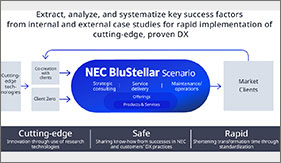
This paper introduces NEC BluStellar, NEC’s DX business brand launched in May 2024, and discusses its future development and outlook. In an era of rapid advances in AI and DX, NEC BluStellar is a value creation model that leverages NEC’s long-cultivated expertise, insights gained from NEC’s own Client Zero approach that places transformation at the core of its management and operations, and cutting-edge technologies to lead customers into the future and contribute to their digital transformation (DX). Through a deep understanding of customers' management challenges and providing comprehensive support from strategy formulation to technology implementation and talent development, NEC aims to drive sustainable growth for customers and create value for society.
General Papers
Adaptive MBS Using Private 5G and Hybrid MIMO for Cable Television IP Broadcasting
KITANO Hikaru, ITO Hiroshi, MATSUMOTO Shuichi
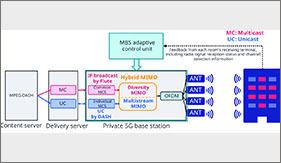
The use of private 5G is being considered as an alternative to wired infrastructure for cable television services in apartment complexes and households in remote areas served by shared reception facilities. However, the 100 MHz bandwidth available in the sub-6 GHz frequency band does not provide sufficient network capacity for multi-channel broadcasting and internet services offered by cable television, raising concerns about efficient spectrum utilization. This paper presents an adaptive multicast and broadcast service (MBS) system, incorporating hybrid MIMO technology, that simultaneously achieves both reliable broadcasting and efficient data communications.