Global Site
Displaying present location in the site.
Implementation of a Data Utilization Platform for Realizing Community-Based Finance (Ogaki Kyoritsu Bank, Ltd.)
Vol.19 No.1 Special Issue on NEC BluStellar: NEC BluStellar Driving the Future of Digital Transformation — A Value Creation Model Pioneered by AI, Security, Data Management, and Modernization
In today’s rapidly changing VUCA era—marked by volatility, uncertainty, complexity, and ambiguity—organizations are placing greater emphasis on data-driven management, using data-based forecasting and analysis to enable more sophisticated decision-making. However, realizing the full value of data remains challenging when information is scattered across multiple systems and media. To deepen customer understanding and advance community-based finance, Ogaki Kyoritsu Bank implemented the NEC BluStellar data utilization platform. Working closely with NEC, the bank evaluated its options and adopted a hybrid architecture that integrates both on-premises and cloud environments, ensuring flexibility and scalability for future growth. This paper presents the background of the implementation, the support provided, the outcomes achieved, and future prospects.
1. Introduction
In recent years, the financial industry has faced increasingly diverse customer needs and rapidly changing market conditions, making advanced decision-making through data utilization essential. The importance of data-driven management—where forecasting and analysis play a central role—has become even more pronounced in today’s VUCA era, characterized by volatility, uncertainty, complexity, and ambiguity.
Ogaki Kyoritsu Bank, headquartered in Ogaki City, Gifu Prefecture, Japan will celebrate its 130th anniversary in 2026. Under its medium-term management plan launched in fiscal year 2024, the bank has established three pillars: growth strategy, human resources strategy, and strengthening the management base. As a cross-functional initiative supporting these pillars, the bank is advancing a comprehensive digital transformation (DX) strategy. This DX strategy focuses on transforming customer touchpoints through personalized, data-driven communication at every interaction, and reforming business processes by placing data-driven decision-making at the core. Effective utilization of customer and management data is a key factor for success in these initiatives.
To deepen customer understanding and realize community-based finance, the bank selected and implemented the NEC BluStellar Scenario data utilization platform. In collaboration with NEC, the bank carefully considered its options and adopted a hybrid architecture that combines on-premises and cloud environments, ensuring flexibility and scalability for future expansion.
This paper presents the process leading to implementation, architectural innovations, transformation of customer engagement, and initiatives contributing to the local community, as illustrated by this case study.
2. Barriers to Data Utilization Initiatives
Ogaki Kyoritsu Bank has been advancing data utilization initiatives to deepen customer understanding and enhance business processes. However, achieving true data-driven management required overcoming several structural challenges inherent in the existing environment. The following section summarizes the main barriers and their impacts.
(1) Data fragmentation and accessibility
Business data was scattered across multiple systems and media, making data collection the first step in any utilization effort. Some information was stored on legacy media such as magnetic tapes, which limited searchability and real-time access. Additionally, during system upgrades, portions of data were lost, resulting in reduced accuracy in decision-making for customer service and product design.
(2) Reduced analytical accuracy due to missing historical data
For example, in the area of home loans, historical data on early repayments was insufficient, making it difficult to analyze customer behavior trends or build predictive models. This directly impacted the bank’s ability to gain accurate insights into its customers for key products and constrained the development of effective product strategies.
(3) Increased operational burden due to inconsistent data formats
Because data formats differed across systems, manual standardization and cleansing were required before data could be integrated and utilized. Routine tasks, such as creating customer attribute lists, demanded significant manual effort for data processing, leading to decreased operational efficiency. As a result, frontline staff found their time for core responsibilities increasingly constrained by these additional burdens.
To address these challenges, Ogaki Kyoritsu Bank worked with NEC to standardize its data and establish a data utilization platform. Through the introduction of NEC BluStellar Scenario, the bank is promoting reforms in business processes and transforming customer engagement.
3. Implementation Details and Innovations
3.1 Support from the initial requirements definition stage
Ogaki Kyoritsu Bank initiated the development of a new data utilization platform to address challenges such as fragmented, missing information, and inconsistent formats, while also ensuring scalability for future needs. The bank selected NEC as its partner, and through the Data Utilization Platform Consulting Service, NEC collaborated closely with the bank from the earliest stages of the project.
During the platform’s development, it was essential to analyze the existing system environment, identify data locations, clarify intended uses, and then design the optimal architecture. Rather than committing to any specific product from the outset, the bank adopted a flexible design approach tailored to its unique use cases and constraints.
3.2 Reliable implementation approach grounded in practical experience
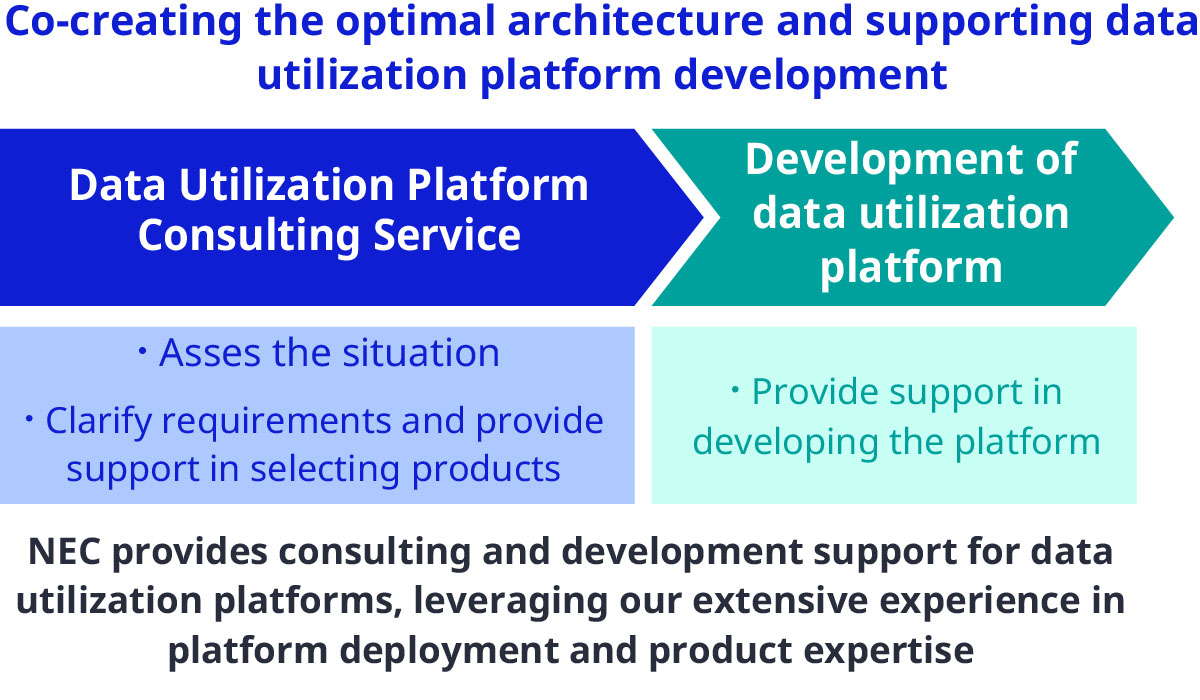
NEC leveraged its hands-on expertise from advancing its own data management initiatives—such as building the One Data Platform—and its track record supporting multiple organizations to guide architectural decisions for Ogaki Kyoritsu Bank. By considering the bank’s current system configuration, the status of data integration, and the specificity of its intended use cases, NEC helped clarify both short-term and long-term requirements, ultimately proposing the most suitable architecture for the bank (Fig. 1).
 Click to Enlarge
Fig. 1 Overview of Data Utilization Platform Consulting.
A key consideration for the bank was whether to build the platform on the cloud or on-premises. When evaluating components like data lakes, data warehouses (DWH), and ETL (extract, transform, load) processes, the bank assessed the functionality and scalability of cloud services, while also factoring in operational costs and future usage scenarios.
To support the bank’s decision-making, NEC organized the features and pricing models of various products and services, presented six different system configuration options, and helped the bank review these options alongside a roadmap for future utilization.
3.3 Flexible platform design through a hybrid architecture
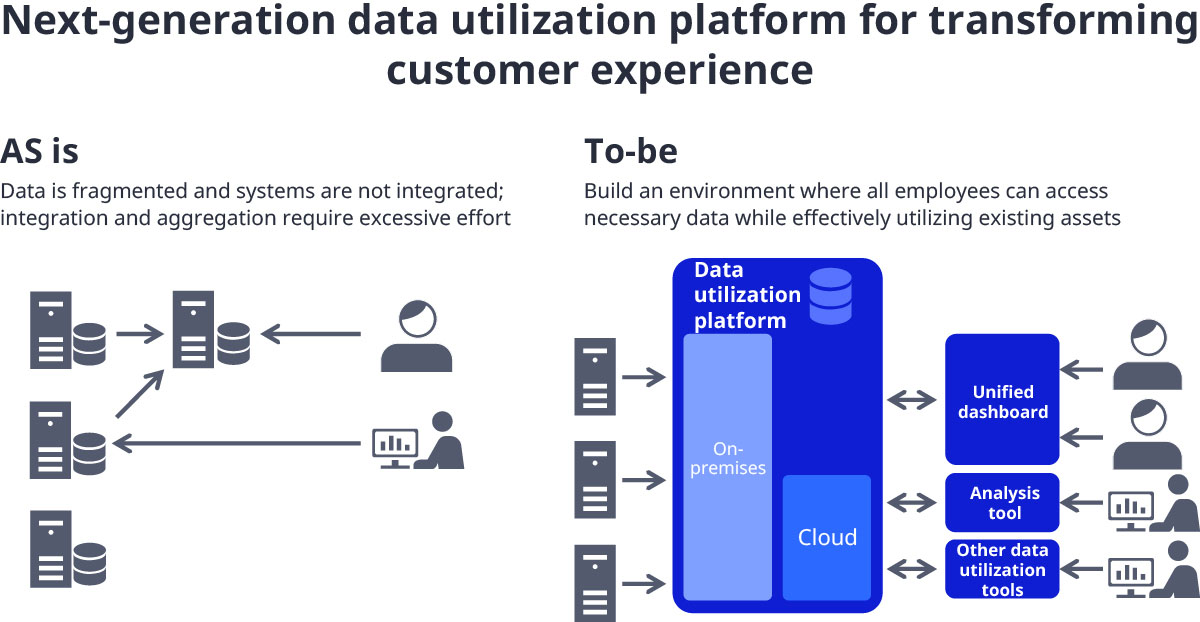
As a result of these extensive discussions, the bank ultimately adopted a hybrid architecture for its data utilization platform, optimally combining on-premises and cloud environments according to their respective strengths (Fig. 2). Specifically, to accommodate the integration of historical data, the addition of new systems, and anticipated increases in data volume, the data lake and the data warehouse (DWH) used by a large number of users are deployed on-premises, considering cost and security considerations. Conversely, for DWH environments accessed by a limited group of users such as data scientists—where advanced analytics and scalability are prioritized—cloud services are utilized. For ETL processes, the bank leverages existing assets while employing multiple products suited to the hybrid environment, thereby achieving both flexibility and operational efficiency.
 Click to Enlarge
Fig. 2 Ogaki Kyoritsu Bank’s next-generation data utilization platform.
4. Achievements to Date and Future Outlook
4.1 Effects of implementing a data utilization platform and future development
Ogaki Kyoritsu Bank has made progress in developing its data utilization platform, creating an environment for the integration, processing, and analysis of operational data. This initiative has successfully reduced the manual labor previously required for data collection and processing.
Furthermore, by visualizing up-to-date operational data on dashboards, the bank expects to further decrease the time spent organizing data and accelerate management decision-making.
4.2 Establishing the foundation for AI utilization
The bank is actively developing an environment for AI utilization, with data scientists playing a central role. By streamlining data preparation, it has become easier to build predictive models and apply them to business operations. Organized data is fed into advanced AI solutions provided by NEC, raising expectations for the development of business forecasting models and the realization of forward-looking operations.
To fully integrate AI-generated predictive results into business operations, further system integration is required. NEC brings deep expertise not only in data platform architecture but also in AI, governance, and security, and will continue to provide support as these initiatives evolve.
4.3 Organizational and operational transformation and expectations for leveraging the data utilization platform
A key focus going forward is strengthening collaboration with frontline staff. To enhance corporate value through digital technologies and digital transformation (DX), the bank has merged its IT Management Division and Systems Development Division to establish a new Digital Management Division. Within this division, a DX center has been created to further reinforce collaboration with the frontline, establishing a robust framework for driving DX initiatives.
To effectively mobilize the frontline, it is essential to accurately identify the challenges and needs of each business unit and to establish mechanisms that support data utilization led by frontline staff. There is growing anticipation for systems that bridge the frontline and management, and NEC plans to provide support tailored to the expanding phases of data utilization.
Starting with the establishment of the data utilization platform, Ogaki Kyoritsu Bank intends to progressively advance AI adoption and business process reform while strengthening collaboration with the frontline. Through continued collaboration with NEC, the bank aims to embed and further enhance data driven management practices.1)
5. Conclusion
Beginning with the development of its data utilization platform, Ogaki Kyoritsu Bank has taken significant steps toward realizing data-driven management. Moving forward, the bank will prioritize strengthening collaboration with frontline teams and fostering autonomous data use within its business units.
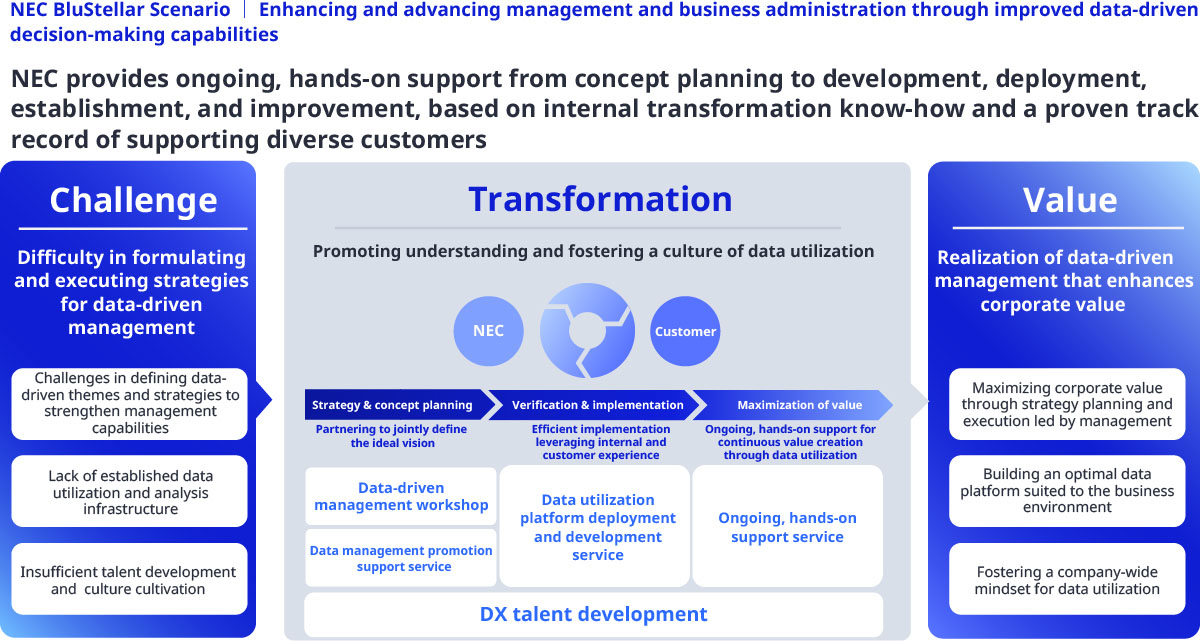
NEC will continue to support these initiatives by working closely with the bank, ensuring that the data utilization platform remains adaptable to changes in the business environment and is effectively leveraged by the bank itself to drive ongoing transformation (Fig. 3).
 Click to Enlarge
Fig. 3 Ongoing, hands-on support model for data-driven management using the NEC BluStellar Scenario.
References
Authors’ Profiles
YAMAYA Rika
Professional
BluStellar Scenario Department
Professional
BluStellar Scenario Department
NAKATSUKA Yutaka
Director
Biometrics and Vision AI Department
Director
Biometrics and Vision AI Department