Global Site
Displaying present location in the site.
NEC’s Data-Driven Management Initiatives
Vol.19 No.1 Special Issue on NEC BluStellar: NEC BluStellar Driving the Future of Digital Transformation — A Value Creation Model Pioneered by AI, Security, Data Management, and ModernizationAt NEC, we have implemented the Client Zero strategy as part of our Mid-term Management Plan 2025. As part of this initiative, we are promoting an internal transformation towards data-driven management, where we accumulate various types of data and utilize digital technologies to make data-driven decisions in all aspects of our business. The practical, real-world digital transformation (DX) knowledge gained through these efforts is leveraged to provide value to our customers and society. This paper introduces NEC’s data-driven management, centered around our management cockpit and dashboards, including its objectives, current achievements, initiatives for internal deployment, data management to support these efforts, and future initiatives utilizing AI.
1. Introduction
Efforts to support enterprises’ management decision-making with computers began with Decision Support Systems (DSS) in the 1970s and 80s. This was followed by the emergence of Business Intelligence (BI) tools, such as BusinessObjects in the 1990s, and the development of Modern BI tools, such as Tableau, in the 2000s.
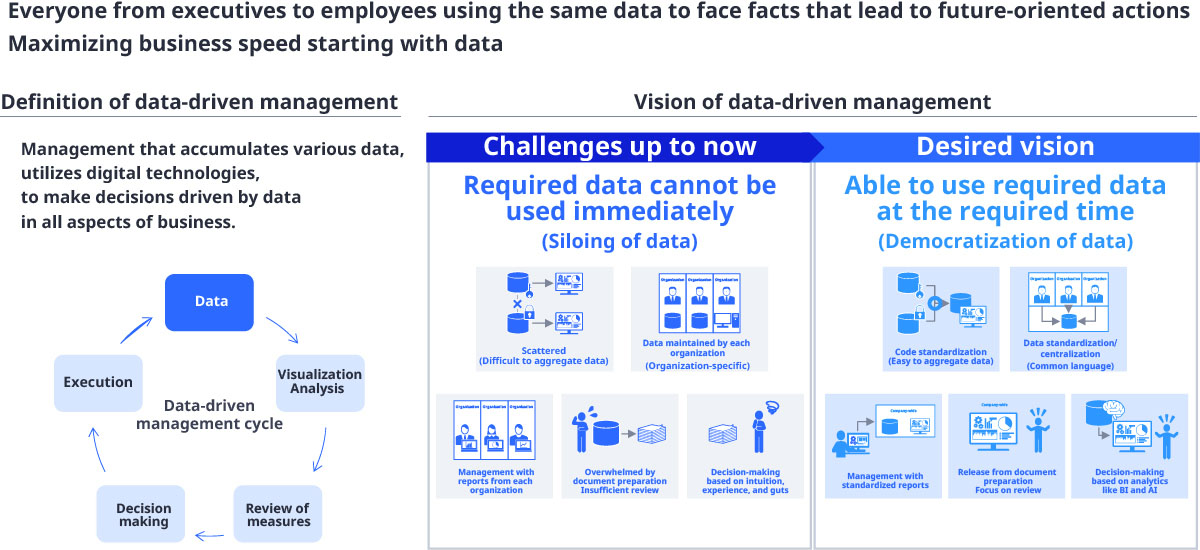
However, most companies have not yet been able to make the transition to management in which decision-making is driven by data. Even in companies with progressive data utilization, in many cases, that is limited to specific operations and has not reached the management level. In some instances, BI tools are deployed within the organization like office automation tools, resulting in an overabundance of dashboards.
NEC has taken on the challenge of data-driven management, and while we are still in the midst of our journey, we have started seeing certain results. In this paper, we offer an introduction with specific examples of NEC’s approach to data-driven management.
2. Overall View of NEC’s Data-Driven Management
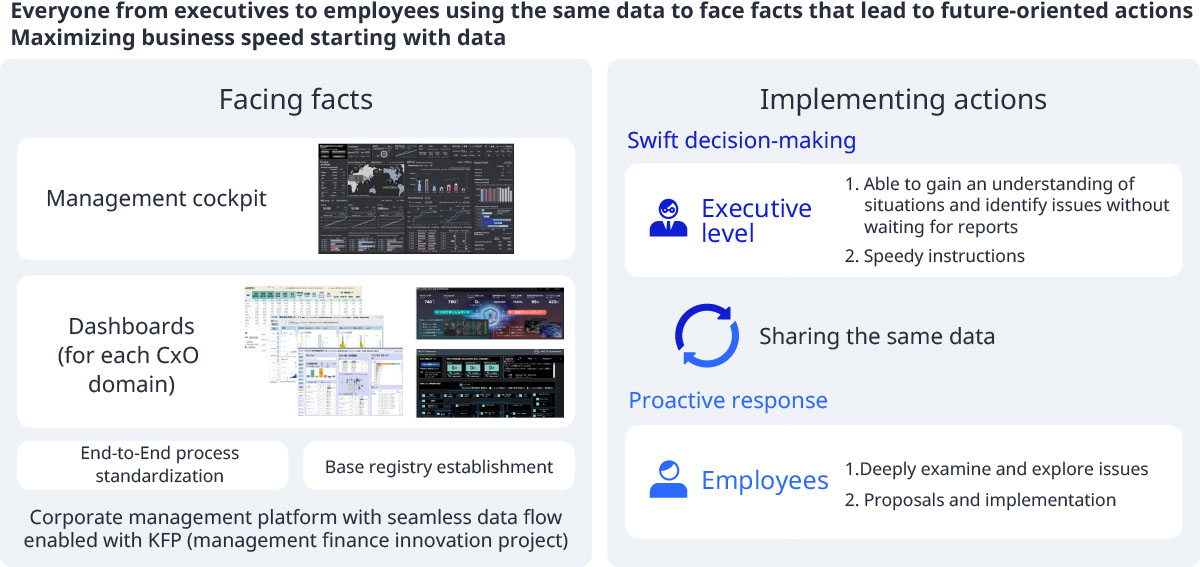
At NEC, in light of the challenges in business management we have faced up to this point, we have established a vision for data-driven management in which everyone from executives to employees uses the same data to face facts that lead to future-oriented actions. Our aim is to maximize business speed, starting with data (Figs. 1 and 2).
 Click to Enlarge
 Click to Enlarge
2.1 Management cockpit and dashboards
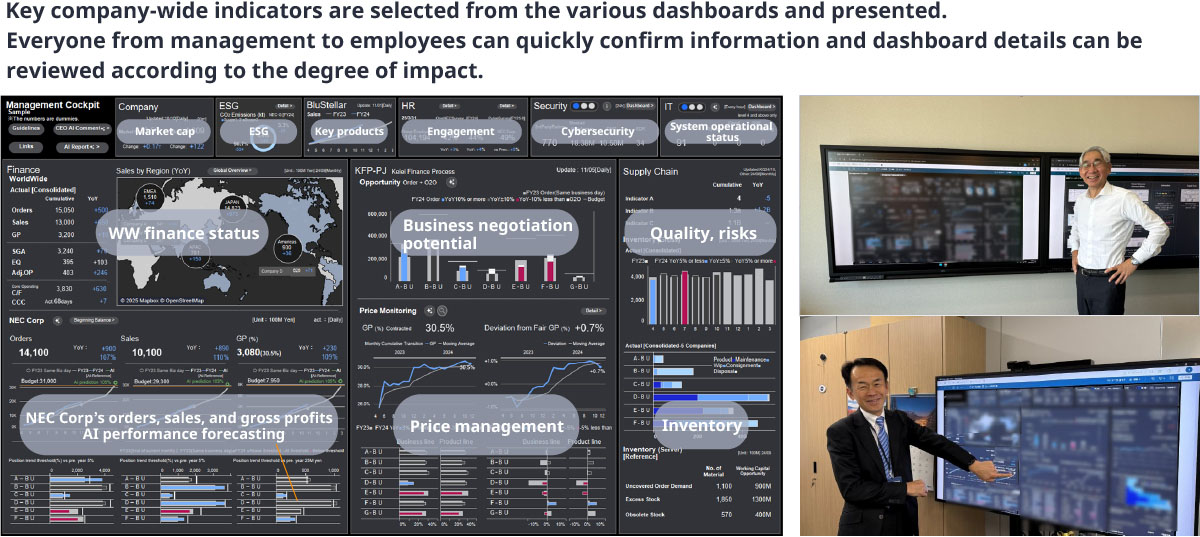
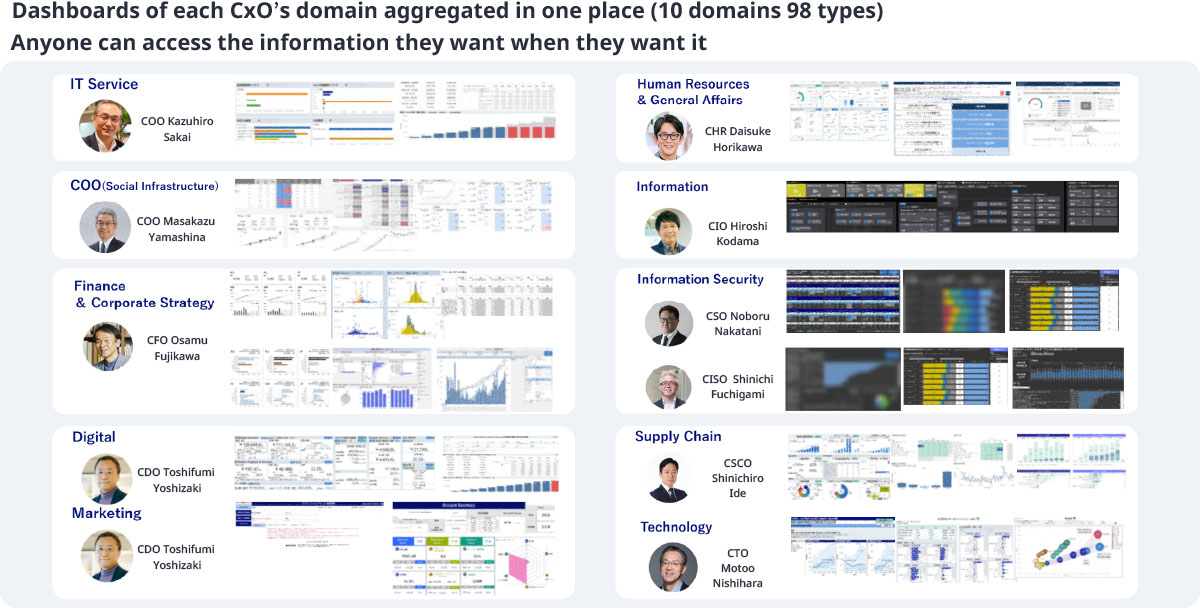
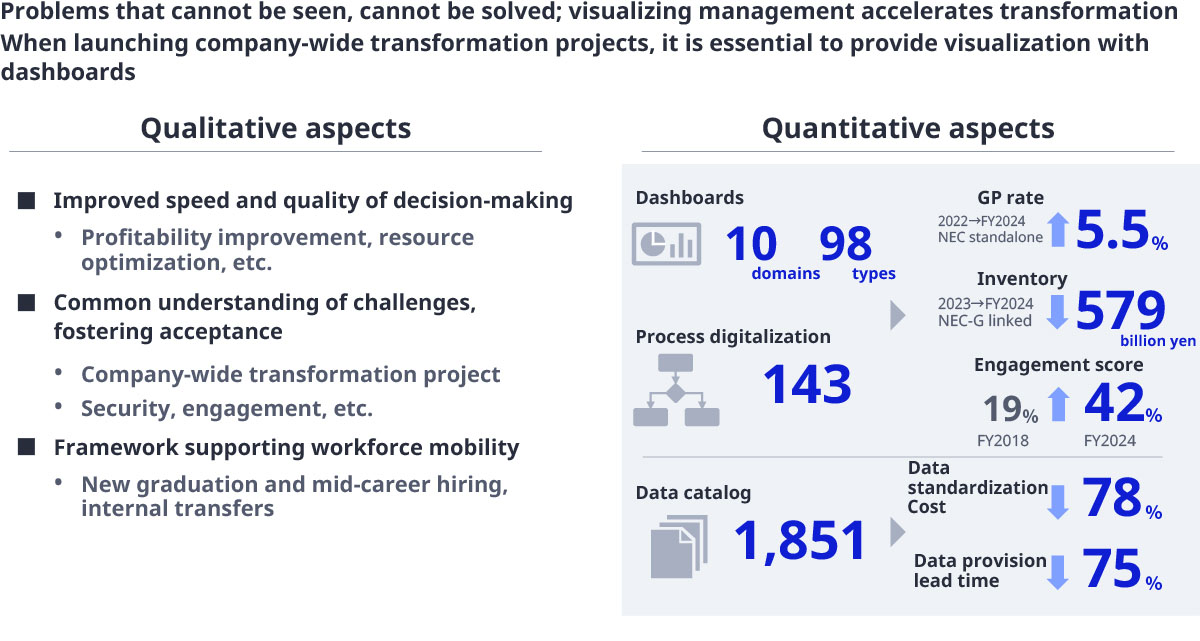
NEC’s data-driven management centers around the management cockpit (Fig. 3) and dashboards (Fig. 4) and is promoted by the company’s Chief Officers (CxO) who take ownership. Dashboards are maintained for each CxO, and currently, there are 98 types across 10 domains in operation and being continuously refined. Additionally, as a higher-level concept, a management cockpit has been developed from the Chief Executive Officer’s (CEO) perspective, where key company-wide indicators are selected from the various dashboards and presented. It should be noted that dashboards are tools for visually displaying data and information, whereas the management cockpit is a tool that emphasizes serving as a control room for linking information to actions.
 Click to Enlarge
 Click to Enlarge
2.2 Data-driven management results
The management cockpit and dashboards achieve what is often called "the visualization of management," and their effectiveness is highly anticipated. Solving management issues requires involvement not just from those directly concerned, but also from a large number of stakeholders. Therefore, a shared understanding of the issues is critical, as issues that are unseen cannot be resolved. The management cockpit and dashboards can thus be considered essential platforms for addressing management issues.
For example, in NEC’s Mid-term Management Plan 2025, two KPIs have been set: (1) an average annual EBITDA growth rate of 9% and (2) an engagement score of 50%. The management cockpit and dashboards are making significant contributions toward achieving these goals.
With regard to financial indicators, a representative case is pricing management that thoroughly utilizes data from the company-wide management and finance innovation project. By analyzing data from various perspectives, such as planned sales price versus actual sales price, and implementing numerous improvement measures, the gross profit margin improved by 5.5% over the course of two years.
In terms of cultural indicators, the results of employee surveys are made open company-wide, and after analyzing this data, organizational leaders engage sincerely with their teams and implement various initiatives for improvement. Additionally, successful measures from certain organizations are rolled out to other departments, and the company as a whole is putting a code of values into practice that emphasizes an open organization where all employees can grow together. As a result, the engagement score has improved from 19% in FY2018 to 42% in FY2024 (Fig. 5).
 Click to Enlarge
These are excellent examples of company-wide data sharing, with CxO ownership, the leadership of business leaders, and frontline initiatives working together effectively. While these are just a few examples, various results have been achieved through the management visualization, and now, whenever a company-wide transformation project begins, visualization through the use of dashboards is always included as part of the process.
3. Internally Deployed Initiatives
This initiative was a transformation that started from scratch and various challenges arose during its rollout within the company. Here, we will introduce the issues we faced—particularly regarding the involvement of management and frontline personnel—and the measures taken to address them.
3.1 Ownership at the management level
NEC has strong business lines and traditionally, data utilization was optimized on an individual business unit basis. In order to achieve company-wide optimization, it was necessary to strengthen overall governance through the CxOs, and in data-driven management, CxOs are leading the initiative with ownership.
To involve CxOs, it was effective to quickly create a tangible example and let them experience the benefits of visualization firsthand. Those in management are extremely busy and requiring too much of their time can cause their interest and enthusiasm to wane, so acting with a sense of speed is essential.
3.2 Involving the frontlines
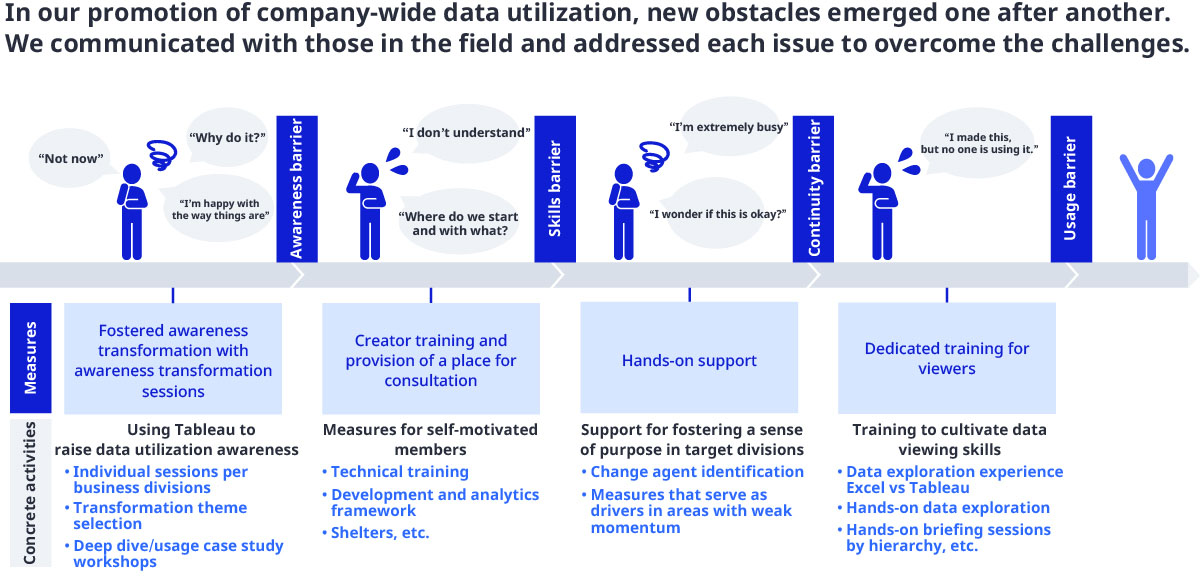
Even after gaining the understanding of those at the management level, rolling out the initiative to frontline teams proved to be extremely challenging. As we progressed with company-wide deployment across divisions and business units under CxOs, we encountered four major barriers and implemented specific measures to address each of them (Fig. 6).
- (1)Mindset barrier: At NEC, there is a common tendency to agree on general principles but raise objections to the specific details. To address this, we conducted mindset shift sessions to foster understanding of our goals and generate momentum for transformation.
- (2)Skills barrier: We provided support for skill development through training and design assistance. In particular, the “support channels” we provided where people could easily seek advice proved to be highly effective.
- (3)Continuity barrier: We provided hands-on support to accompany those who were promoting transformation and worked to energize the initiative by continuously implementing key measures while involving relevant stakeholders.
- (4)Usage barrier: Factors hindering the use of dashboards include not only the quality of reports, but also the skills of users. We hold hands-on training sessions tailored to management, business unit heads, job functions, and key content (62 sessions were held in FY2023), and from FY2024, we have started inviting people who have achieved results through data utilization to give talks, gathering others in similar positions for workshops to facilitate the sharing of successful case studies. As the largest internal event to promote these initiatives, we hold a contest with awards presented by the CxOs, including the CEO and Chief Operating Officer (COO), to further drive engagement.
 Click to Enlarge
4. Data Management
When promoting data-driven management, the challenges related to data are significant, further increasing the importance of data management. This is a steady and ongoing effort that might also be called the infrastructure of management, and we therefore have to be conscientious in how we address it. At NEC, we promote data management by organizing it into the following elements: Strategy, Frameworks (platforms, analytics /AI), and Governance (organizations/controls, personnel, and culture).
4.1 Strategy
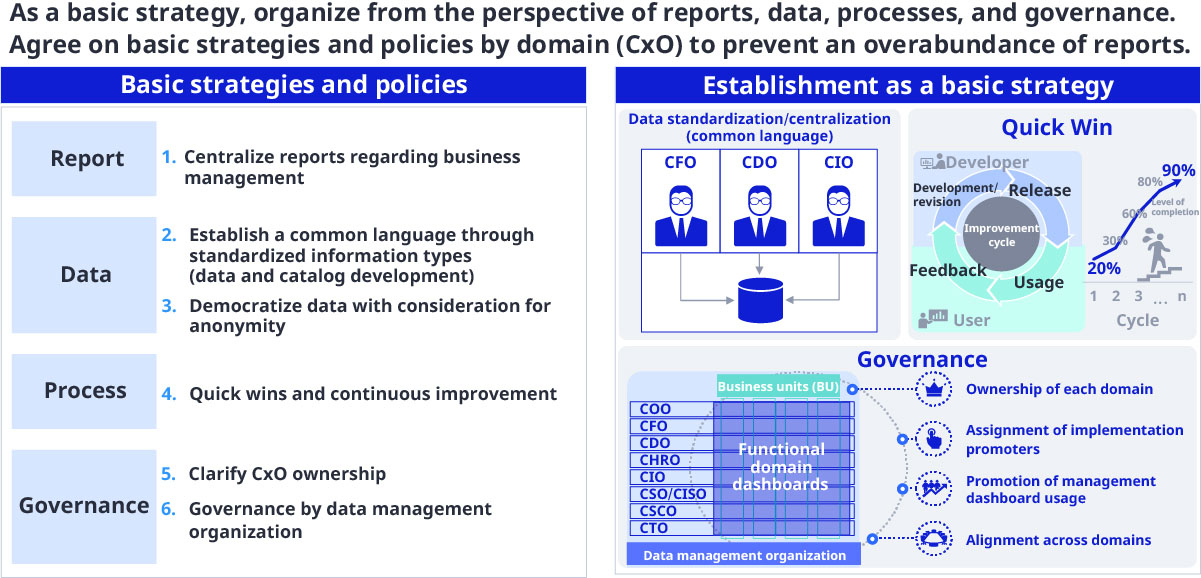
As the vision for data-driven management, we envision a world where everyone from executives to employees utilizes data, and by incorporating AI into BI, people can focus on making and executing important decisions. To realize this vision, we have placed the highest priority on our data strategy, and have defined the following six directions (Fig. 7).
- (1)Centralization of business management reports: Dashboards are built for each CxO domain and centralized on a website accessible to all employees.
- (2)Establishing a common language based on standardized information types: For each CxO domain, standardized data—combined and processed for shared use—will be prepared and centralized along with a data dictionary (catalog) to quickly locate standardized data.
- (3)Democratization of data with consideration for confidentiality: While taking into account legally and ethically required confidentiality, such as personal information and insider data, data will, in principle, be made open.
- (4)Quick wins and continuous improvement: All deliverables will be developed and released quickly and will be continuously refined based on user feedback.
- (5)Clarification of CxO ownership: Company-wide deployment can be achieved by ensuring that each CxO promotes data utilization in their own domain.
- (6)Governance by data management organization: A specialized organization takes the lead in driving data management. By placing particular emphasis on CxO ownership and quick wins and improvement, and promoting data utilization in each domain, the overflooding of reports and data can be prevented, thereby accelerating company-wide deployment.
 Click to Enlarge
4.2 Framework
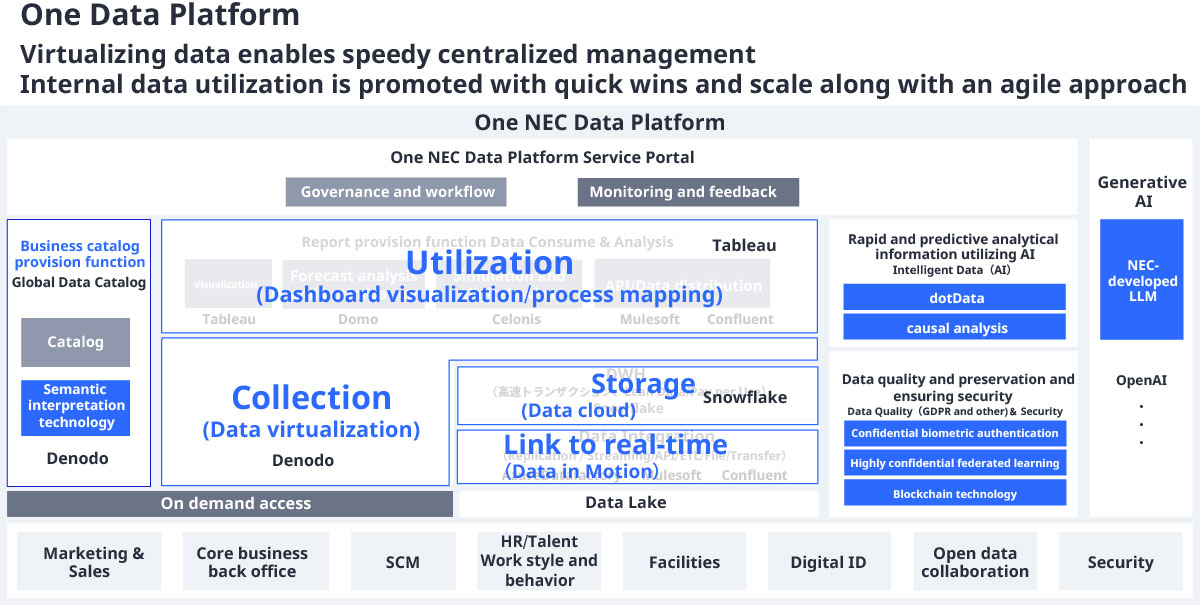
The One Data Platform is the core of the framework that supports data-driven management (Fig. 8). This platform enables rapid implementation of data virtualization with Denodo and centralized management using Snowflake, facilitating data utilization internally. Additionally, AI tools, such as dotData and generative AI are used to realize AI-driven decision-making.
 Click to Enlarge
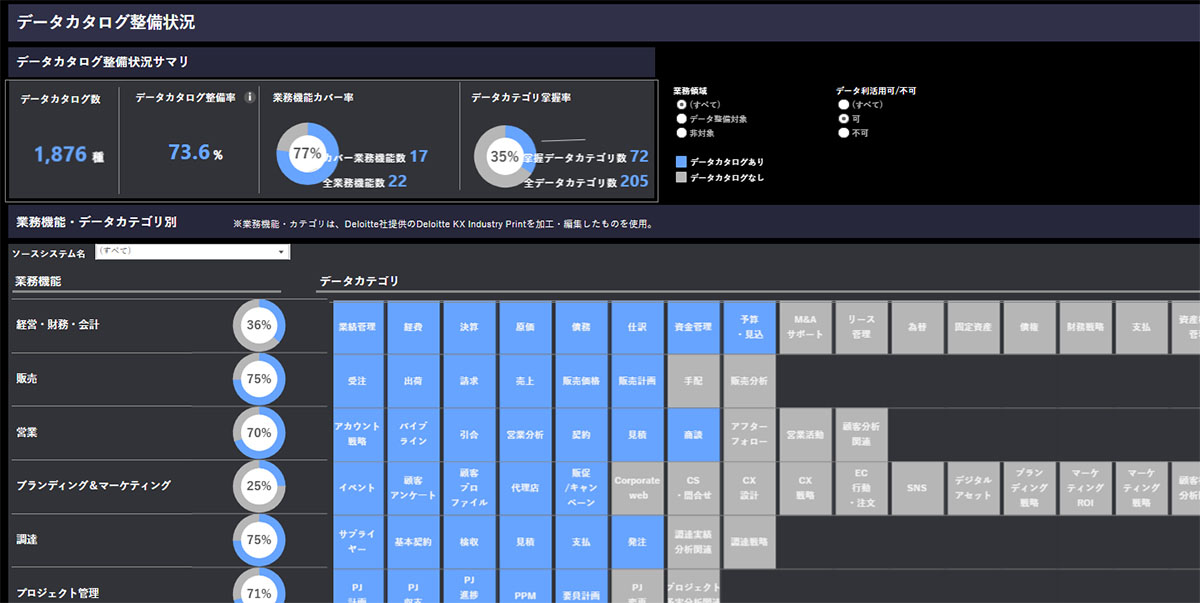
Using Denodo, we are preparing two types of catalogs: a catalog of standardized data (business catalog) and a catalog of data sources (data catalog), in an effort to manage metadata (Fig. 9). The business catalog clarifies the profiles of standardized data and the meanings of table items, enabling accurate data utilization when building dashboards. The data catalog turns the data available for use in each system into an asset, which significantly reduces the amount of work required to find out which system contains the necessary data.
 Click to Enlarge
4.3 Governance
A robust system of governance is essential for the sustained promotion of data-driven management. At NEC, the Data and Analytics Department, a specialized data organization, functions as the Center of Excellence (CoE) for data governance. Through initiatives such as the development of data strategy defining documents, data governance guides, data quality management guidelines, report design guidelines (including design and performance guides), analysis templates, feedback via ServiceNow, data talent development, the promotion of data-driven culture, workshops, and contests, NEC is advancing data-driven management by establishing and implementing a variety of systems and initiatives.
5. The Management Cockpit and AI
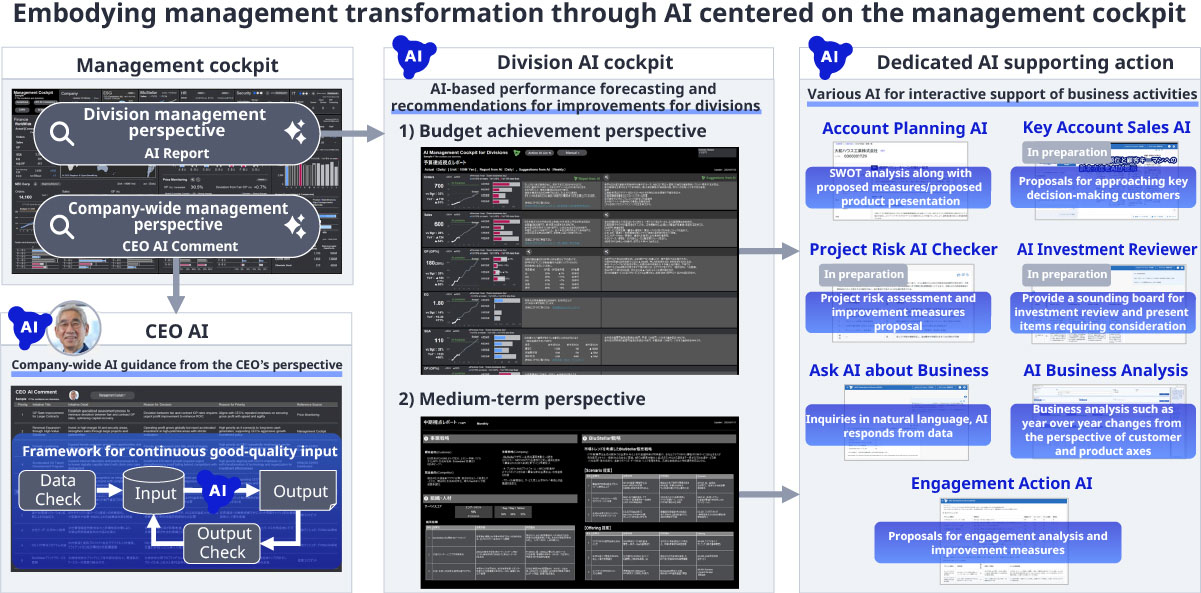
The development of generative AI is enabling the realization of a world where BI and AI support human decision-making, which is the embodiment of what data-driven management is striving to achieve. At NEC, we have created a concrete vision of transformation in management practices that connects the management cockpit to decision-making and actions (Fig. 10). This framework consists of three components. first, the CEO‘s AI insights into the overall management status; second, AI-driven performance forecasts for each division along with AI-generated improvement proposals; and third, AI support for implementing those proposals.
 Click to Enlarge
To make these tools truly usable, it is necessary to run feedback loops to further evolve AI. We continuously refine the system through practical application. By enhancing input data and incorporating user feedback, we improve both the quantity and quality of its output, thereby promoting an AI-driven management transformation.
6. Conclusion
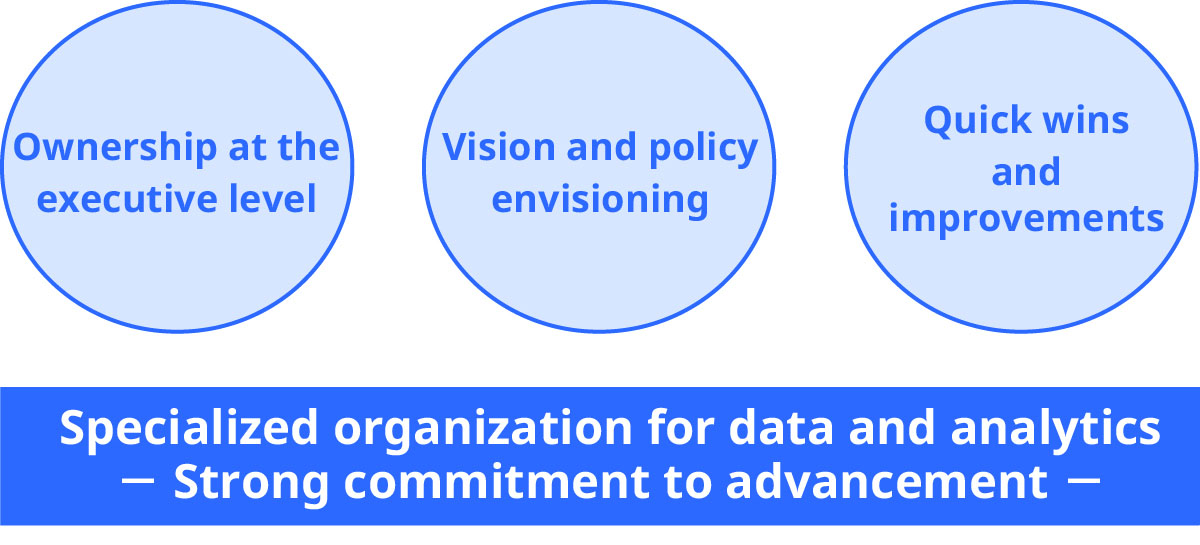
In this paper we introduced NEC’s data-driven management initiatives, and among them, the following four points are of particular importance (Fig. 11).
- (1)Ownership at the executive level: The importance of data-driven management is understood at the executive level, and they are taking the lead in vigorously driving company-wide transformation.
- (2)Establishing the vision and policy: By clearly presenting the desired state of data-driven management as a vision and formulating concrete strategies and roadmaps, the entire organization can work toward a common goal.
- (3)Quick wins and improvements: We have adopted an agile approach in which we rapidly accumulate small successes (quick wins) and continuously improve upon them as we experience their effects.
- (4)Specialized organization for data and analytics: A dedicated data organization with a strong commitment continuously drives these initiatives forward.
 Click to Enlarge
Going forward, we aim to continue creating value through management practices that utilize digital technologies, always staying one step ahead of the times. We intend to incorporate this value into NEC BluStellar’s offerings and contribute to the transformation of our customers’ management practices, as well.
Trademarks
- *BusinessObjects is a trademark or registered trademark of SAP SE in the United States and other countries.
- *Tableau is a trademark or registered trademark of Salesforce, Inc. in the United States and other countries.
- *Denodo is a trademark or registered trademark of Denodo Technologies.
- *Snowflake is a trademark or registered trademark of Snowflake Inc.
- *ServiceNow is a trademark or registered trademark of ServiceNow, Inc. in the United States and other countries.
- *All other company names and product names that appear in this paper are trademarks or registered trademarks of their respective companies.
Authors’ Profiles
AMANO Masahiko
Senior Director
Data and Analytics Department
Senior Director
Data and Analytics Department
KAWASHIMA Aoi
Director
Data and Analytics Department
Director
Data and Analytics Department