Global Site
Displaying present location in the site.
NEC BluStellar Modernization to Realize Customer Value
Vol.19 No.1 Special Issue on NEC BluStellar: NEC BluStellar Driving the Future of Digital Transformation — A Value Creation Model Pioneered by AI, Security, Data Management, and ModernizationIn recent years, amid rapid changes in social structures and technology, enterprises are required to address a wide range of challenges, such as the societal integration of AI, responses to geopolitical risks, and the promotion of carbon neutrality. NEC BluStellar Modernization is an NEC BluStellar Scenario that drives end-to-end, value-creating modernization with an eye toward an AI-native society. By leveraging AI-driven operations management and security capabilities proven through NEC’s Client Zero initiative, as well as consulting and standardized system integration (model-based SI), we deliver modernization optimized for each customer. Through the implementation of advanced IT infrastructure in society, we aim to create new value and contribute to a sustainable society.
1. Introduction
The IT infrastructure that forms the foundation of corporate activities is undergoing unprecedented transformation, driven by rapid changes in social structures and technological advancements. As enterprises face complex challenges—including the societal integration of AI, rising geopolitical risks, the pursuit of carbon neutrality, and a shrinking workforce—the need for IT infrastructure that can swiftly and flexibly adapt to these issues and translate them into business value is greater than ever.
NEC BluStellar Modernization delivers next-generation IT infrastructure optimized for an AI-native society, accelerating the creation of new value. In this paper, we provide an overview of the IT challenges confronting Japan and discuss NEC’s vision for the forefront of modernization and the customer value it delivers.
2. Modernization Trends
2.1 Key IT challenges faced by Japanese enterprises
Japan’s industrial sector is currently facing a fundamental IT challenge known as the “2025 Digital Cliff,” as identified by the Ministry of Economy, Trade and Industry (METI). This refers to the looming limits of maintaining aging and increasingly complex legacy systems, and serves as a warning that, without modernization and transformation, organizations will inevitably suffer a decline in competitiveness and economic losses. In reality, core systems that have been in operation for many years have accumulated substantial technical debt and become increasingly opaque. The reliance on individual expertise for operations and maintenance, the aging of IT personnel, and the shortage of successors are also becoming more serious issues. While efforts to modernize legacy systems are underway, progress remains slow compared to global standards. Looking toward 2030, the momentum for modernization is expected to continue and become central to securing enterprise competitiveness.
2.2 Societal and technological changes and the rise of AI
With intensifying global competition, increasingly diverse consumer needs, and heightened risks such as sophisticated cyberattacks and natural disasters, there is a growing expectation for IT infrastructure that enables efficient and automated operations based on cross-value-chain data analysis and AI utilization, as well as resilient systems that never stop. Furthermore, the recent emergence of advanced AI technologies like Agentic AI is accelerating this transformation. The evolution of enterprise-specific agents and the collaboration of multiple agents are making it increasingly possible for AI to support and even replace human decision-making at a high level, fundamentally changing the quality of enterprise management.
2.3 Expectations for next-generation IT infrastructure
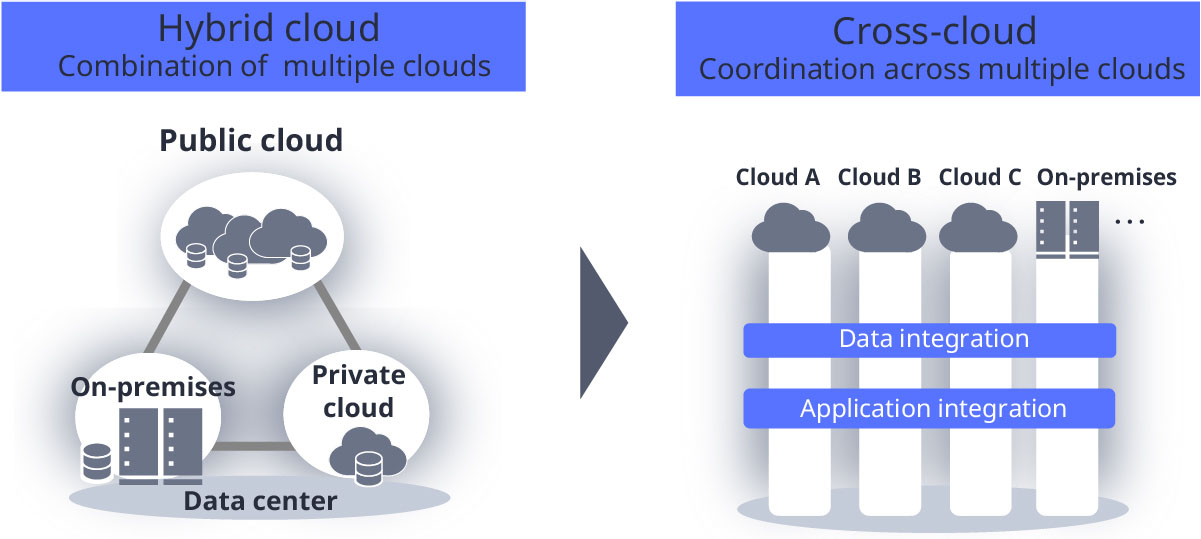
Given these circumstances, as shown in Fig. 1, it is expected that an architecture called "cross-cloud," which is an evolution of the hybrid cloud, will become mainstream in the future. Cross-cloud is an architecture that enables the integration of data and applications across different clouds, thereby enhancing interoperability.
 Click to Enlarge
With the utilization of AI, cross-cloud is expected to develop even further, making it possible to seamlessly and securely connect multiple clouds. This allows users to access optimal services without being conscious of the boundaries between clouds.
Forward-thinking enterprises are viewing these transformations not as risks, but as opportunities for growth. By building advanced IT infrastructure that enables rapid decision-making and business transformation, they are beginning to achieve both sustainable growth and the creation of new value.
3. Vision of NEC BluStellar Modernization
3.1 Concept
NEC offers NEC BluStellar Modernization as part of the NEC BluStellar Scenario, driving end-to-end, value-creating modernization with a focus on an AI-native society. Leveraging NEC’s unique system integration capabilities, advanced AI technologies, and security expertise—alongside consulting and standardized system integration (model-based SI)—we support the realization of modernization optimized for each customer.
3.2 Key features
This scenario has three main features:
The first feature is the provision of a multi-cloud connectivity platform centered on the NEC Inzai Data Center in Chiba Prefecture, Japan. This enables the full utilization of a hybrid cloud environment where cloud and on-premises systems coexist. Each cloud service can be connected via a closed network, and highly confidential data can be stored at the NEC Inzai Data Center.
The second feature is the adoption of AI-driven operations management technology as validated through Client Zero. This establishes a next-generation operations platform equipped with autonomy and advanced automation.
The third feature is standardized and model-based system integration. By leveraging the experience and expertise gained through Client Zero and leading-edge enterprises, NEC provides highly reliable IT infrastructure by offering model-based solutions.
3.3 Focused initiatives
3.3.1 Overview
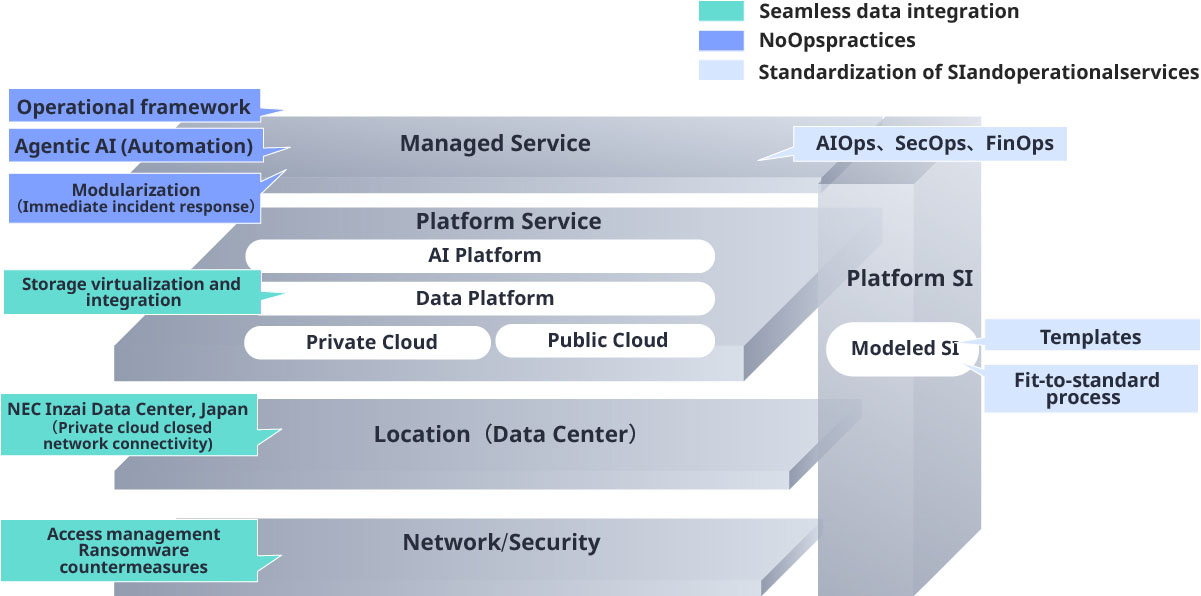
To realize achieve these objectives, NEC is working on seamless data integration, NoOps practices leveraging its Client Zero approach, and the standardization of system integration and operational services based on proven results (Fig. 2).
 Click to Enlarge
3.3.2 Seamless data integration
By implementing storage virtualization and integration, NEC eliminates environmental dependencies and establishes a data platform through the standardization of structured and unstructured data and the alignment of metadata. Furthermore, by leveraging the NEC Inzai Data Center, NEC provides robust security measures—including access management, protection against information leaks, and ransomware countermeasures—while governance is ensured through guardrail functions.
3.3.3 NoOps practices leveraging Client Zero
Based on ITIL (Information Technology Infrastructure Library), NEC provides an operational framework that incorporates best practices developed through years of system operations. Furthermore, NEC adopts AI-driven operations management technology validated through Client Zero, replacing operational tasks with Agentic AI and automation. By modularizing subsystems and improving operational efficiency, NEC enables the aggregation and visualization of operational information from each submodule, allowing for immediate response to incidents and other issues.
3.3.4 Standardization of SI and operational services based on proven results
By developing templates grounded in the results and know‑how from Client Zero and leading enterprises, NEC standardizes system integration (SI) and operational services. We shift from build‑and‑operate processes traditionally designed for each customer to a fit-to-standard process based on standard models, enabling high‑quality, efficient delivery.
Furthermore, we expand the scope of standardization by modeling not only NoOps practices but also AIOps, SecOps, and FinOps, and we provide these as full‑outsourcing services.
4. Customer Value Realized through NEC BluStellar Modernization
4.1 Value creation across the value chain
As data becomes increasingly seamless, each business operation and division can utilize optimal IT infrastructure, enabling enhanced data analysis and AI-driven operational efficiency throughout the entire value chain. This accelerates collaboration with external enterprises, improves customer experience, and fosters the creation of new business opportunities. All of these are achieved under robust security, supporting enterprise value creation.
4.2 Enhancing operational efficiency and sustainability
By promoting advanced automation and NoOps based on AI-native operations, enterprises can dramatically improve operational efficiency. Reducing the reliance on individual expertise and manual tasks enables IT personnel to shift toward higher value-added work. Furthermore, automation and optimization of operations increase IT infrastructure utilization rates and energy efficiency, contributing to carbon neutrality and, ultimately, the realization of a sustainable society.
4.3 Rapid response to changes in the business environment
By standardizing and modeling IT infrastructure, rapid deployment and rollout become possible. Adopting a fit-to-standard, model-based implementation process enables project teams to share transformation concepts in advance, preventing rework and missed considerations. Even the latest technologies, which may carry implementation risks, are provided by NEC in a pre-validated form, ensuring both delivery timelines and quality, and enabling the early realization of innovative IT infrastructure.
5. Conclusion
Building on the initiatives described in the previous sections, NEC BluStellar Modernization offers a diverse lineup of services designed to address industry-specific challenges, including modernization programs for financial institutions and cloud solutions for government agencies. Going forward, NEC will leverage accumulated industry knowledge to expand next-generation IT infrastructure for sectors related to economic and national security. In addition, the scope of NEC BluStellar Scenario will extend beyond IT infrastructure to applications and core SaaS offerings, evolving in line with market needs.
NEC will continue to lead the implementation of advanced IT infrastructure together with customers and partners, driving new value creation through cross-value-chain data utilization and AI, and striving to realize a sustainable, safe, and secure society.
Trademarks
- *ITIL is a registered trademark of AXELOS Limited, registered in the United Kingdom and other countries.
- *All other company names and product names that appear in this paper are trademarks or registered trademarks of their respective companies.
Authors’ Profiles
KODAMA Naohiro
Senior Director
BluStellar Scenario Department
Senior Director
BluStellar Scenario Department
IWAMURA Hisashi
Executive Professional
BluStellar Scenario Department
Executive Professional
BluStellar Scenario Department
TERADA Kei
Director
BluStellar Scenario Department
Director
BluStellar Scenario Department
NAKADA Yuuko
Professional
BluStellar Strategy Department
Professional
BluStellar Strategy Department