Global Site
Displaying present location in the site.
Co-Creation Between Brewers and AI: The Development of "The taste of life created by brewers and AI—Agentic AI × Craft Beer"
Vol.19 No.1 Special Issue on NEC BluStellar: NEC BluStellar Driving the Future of Digital Transformation — A Value Creation Model Pioneered by AI, Security, Data Management, and Modernization
NEC positions AI as a collaborative partner for humans. In this initiative, brewers and AI worked together in the product development process to create “The taste of life created by brewers and AI—Agentic AI × Craft Beer.” NEC’s core AI technology “NEC cotomi” was used to analyze the lifestyles and standards of Japanese people across different generations. Building on this, brewers engaged in interactive dialogue with an Agentic AI based on NEC cotomi to formulate recipe ideas tailored to each generation. As a result, the efficiency of the product development process improved by 40%, and by leveraging the creativity of both brewers and AI, the collaboration led to the creation of an innovative product that would not have been possible through conventional methods. This paper introduces new possibilities for product development arising from human–AI collaboration, detailing specific initiatives undertaken in this project.
1. Introduction
AI is not only making everyday life more convenient, but is also being utilized as a means to address societal challenges. In Japan, one major challenge is the labor shortage, which is driving efforts to improve operational efficiency and productivity through the use of AI. The Information and communication White Paper published by the Ministry of Internal Affairs and Communications, introduces generative AI as a key technology for business transformation,1) while columns from the Information-technology Promotion Agency (IPA), Japan highlight the growing adoption of agentic AI and expectations for its further evolution and widespread use.2)
NEC has long aimed to solve social issues and has implemented various AI-driven initiatives: from applications in contact centers serving financial, retail, and service industries, to predictive anomaly detection and demand forecasting in manufacturing, and supporting retail store operations by visualizing shop floors and analyzing customer behavior.
NEC positions AI as a collaborative partner for humans. In this paper, we focus on the “planning” function found in all companies and introduce a case study of collaborative product development, where brewers at Kyodoshoji Corporation Limited, the producer and distributor of COEDO Beer, and AI worked together in the product planning process to create a new craft beer.
2. Challenges in the Product Development Process
Generally, the product development process involves both information gathering and organization—such as market and customer needs research and competitive analysis—and creative tasks, including idea generation and prototyping. These activities are a blend of routine, structured work like research and analysis, and unstructured tasks that require experience and creativity. In recent years, however, the labor shortage has made it increasingly difficult to secure experienced employees and specialized talent. As a result, improving the efficiency of time-consuming and labor-intensive research and analysis tasks has become a significant challenge.
Moreover, in the field of product development, it is essential to extract valuable insights from vast amounts of information and to generate original ideas. Traditionally, these processes have heavily depended on the experience and instinct of individual employees, making them highly personalized and difficult to reproduce—raising issues of individual dependence and low repeatability. Under these circumstances, companies have begun to prioritize developing environments in which employees can focus on the creative work that only humans can do.
In this initiative, AI and brewers worked collaboratively, with the AI handling structured tasks such as research and analysis, thereby enabling brewers to concentrate on the creative aspects of recipe ideation and prototype development. This approach aimed to streamline the entire product development process and facilitate the creation of more innovative products.
3. AI Technologies Utilized
In this initiative, two types of AI technologies were utilized: NEC’s large language model (LLM) and Agentic AI.
NEC’s core AI technology “NEC cotomi” features highly accurate natural language processing capabilities specialized for Japanese, and was responsible for analyzing generational values and preferences from large-scale text data. This made it possible to accurately extract characteristics of each target generation, supporting persona design and the formulation of recipe proposals necessary for product development.
Meanwhile, Agentic AI autonomously decomposed objectives and instructions provided by the user into multiple tasks and executed them in an optimal sequence. When given the task of developing a recipe, Agentic AI automatically divided the process into several subtasks and proceeded with each efficiently.
Furthermore, through a web application, brewers and AI advanced product development interactively, enabling two-way communication in which brewers provided feedback on recipe proposals generated by AI, and the AI then refined its subsequent proposals based on this input.
4. Development Process for “The taste of life created by brewers and AI—Agentic AI × Craft Beer”
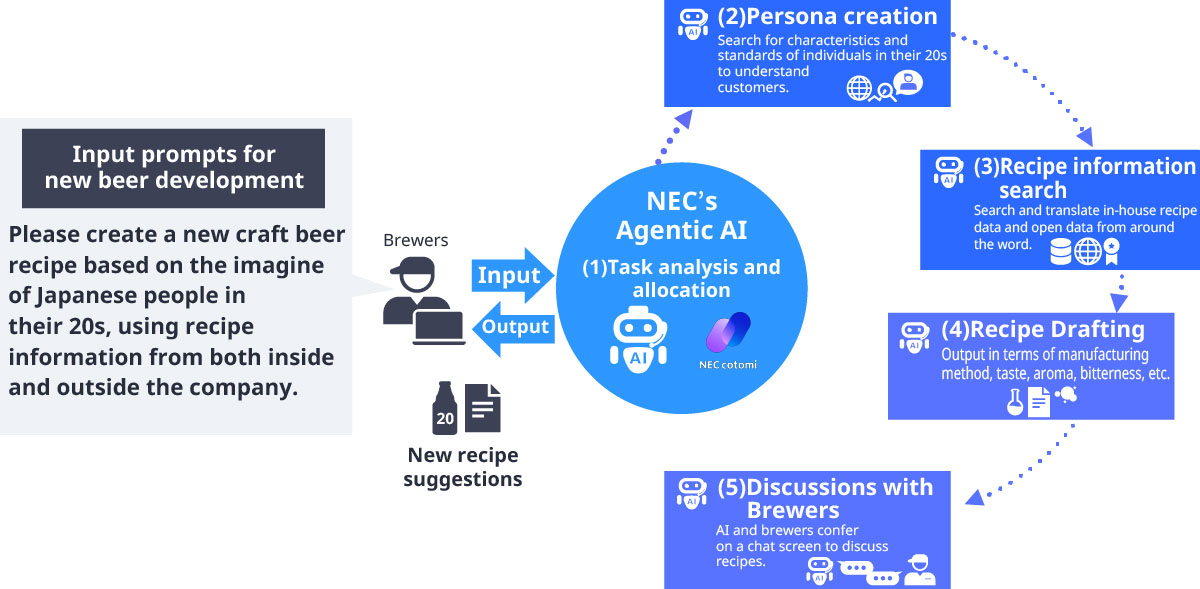
The development process for “The taste of life created by brewers and AI—Agentic AI × Craft Beer”, conducted in collaboration with AI, is carried out in the following five steps (Fig. 1):
- (1)Task analysis and allocation: Using Agentic AI, the given instructions are automatically broken down into specific tasks, which are then executed.
- (2)Persona creation: Using NEC cotomi, the characteristics and standards of Japanese people across different generations are analyzed to create detailed personas.
- (3)Recipe information search: Agentic AI searches internal recipe databases as well as vast amounts of global open data and translates the necessary information.
- (4)Recipe drafting: Based on the collected and analyzed information, Agentic AI generates recipe proposals.
- (5)Discussions with brewers: Brewers and AI engage in two-way dialogue to review and refine the proposed recipes.
 Click to Enlarge
Fig. 1 Development process for “The taste of life created by brewers and AI — Agentic AI × Craft Beer.”
4.1 Task analysis and allocation
In this application, NEC’s Agentic AI is used to automatically break down given instructions into individual tasks and execute them. For example, when provided with the instruction, “Please create a new craft beer recipe based on the imagine of Japanese people in their 20s, using recipe information from both inside and outside the company,” the Agentic AI decomposes the workflow as follows:
- Task 1: Persona creation—Using NEC cotomi, the AI identifies and analyzes the characteristics and standards of Japanese people in their 20s.
- Task 2: Recipe information search—The AI collects both internal and external recipe information and selects examples that align with the characteristics identified in Task 1.
- Task 3: Recipe drafting—The AI combines the outcomes of Task 1 and Task 2 to generate a new recipe.
In this way, Agentic AI executes the entire sequence of tasks automatically and presents novel recipe proposals to brewers.
A key feature of NEC’s Agentic AI is its ability to accurately interpret even ambiguous instructions and efficiently break them down into actionable steps. This allows users to achieve their objectives simply by inputting concise commands, regardless of the complexity of the request.
4.2 Persona creation
NEC cotomi was used to analyze the characteristics and standards of Japanese people across different generations and to create targeted personas. By processing large volumes of Japanese-language data, NEC cotomi extracted insights into the lifestyles and preferences of the target age group. This approach enabled the development of more concrete and realistic personas, which provided clearer direction for beer product development and recipe proposal consideration. An example of a persona for individuals in their 20s is shown in Fig. 2.
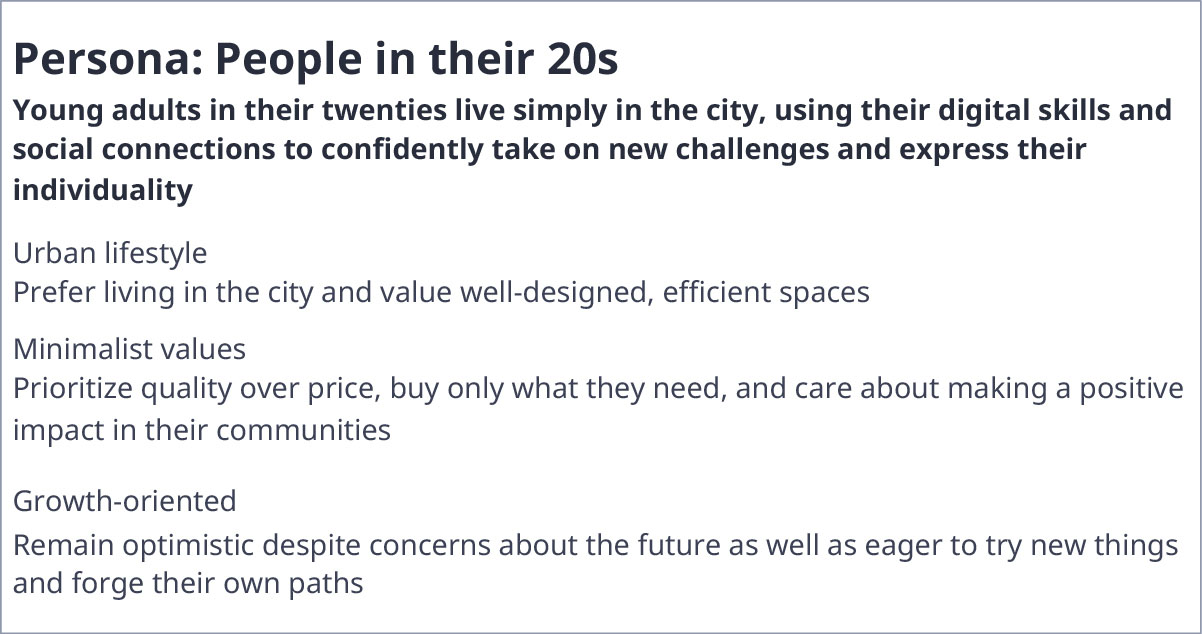
Fig. 2 Example of a persona.
4.3 Recipe information search
Next, Agentic AI searched both in-house recipe data aligned with the created personas and a vast amount of global open data, comprising approximately 1.4 million characters, and performed translations as necessary. Previously, these data processing tasks were handled manually, requiring significant time and effort. With the introduction of Agentic AI, the time needed for searching and translation was greatly reduced.
In addition to simply collecting data, a mechanism was implemented to extract and input only those points deemed especially important by the brewers. This approach enabled rapid and efficient processing even when dealing with large data sets. As a result, the examination of diverse recipe proposals tailored to the target segment became possible.
4.4 Recipe drafting
Based on the information collected and analyzed during persona creation and recipe information search, Agentic AI generated recipe proposals, as shown in Fig. 3.
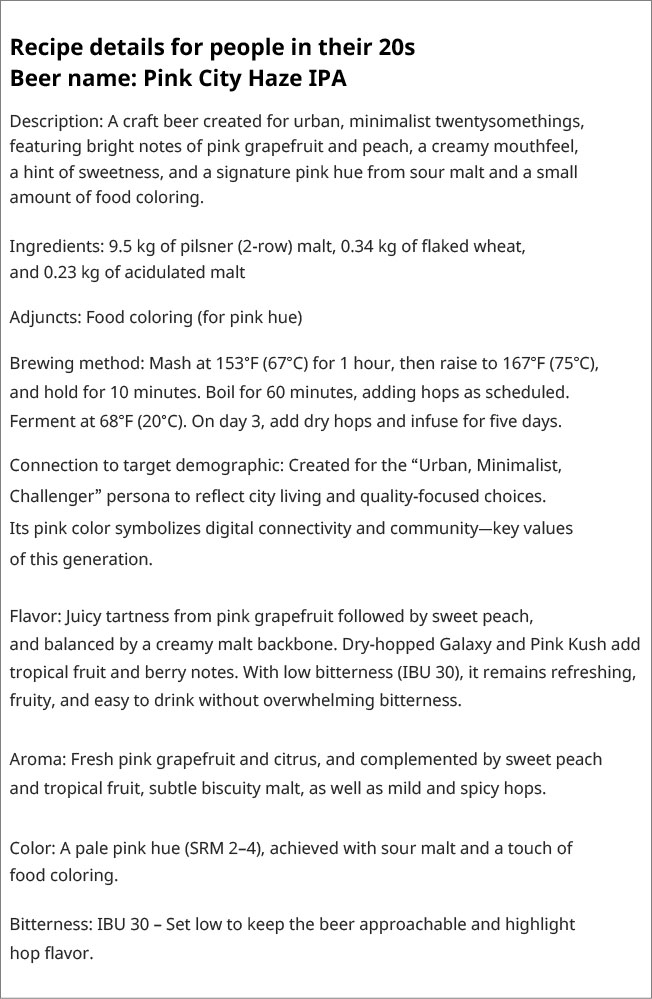
Fig. 3 Recipe suggestion by Agentic AI.
The output included various elements such as recipe description, main ingredients, adjuncts, preparation method, relation to the generational image, taste, aroma, color, and bitterness. In particular, for bitterness, a system was implemented to estimate and display the International Bitterness Units (IBU) for each generated recipe proposal, enabling brewers to make decisions more easily.
4.5 Discussion with brewers
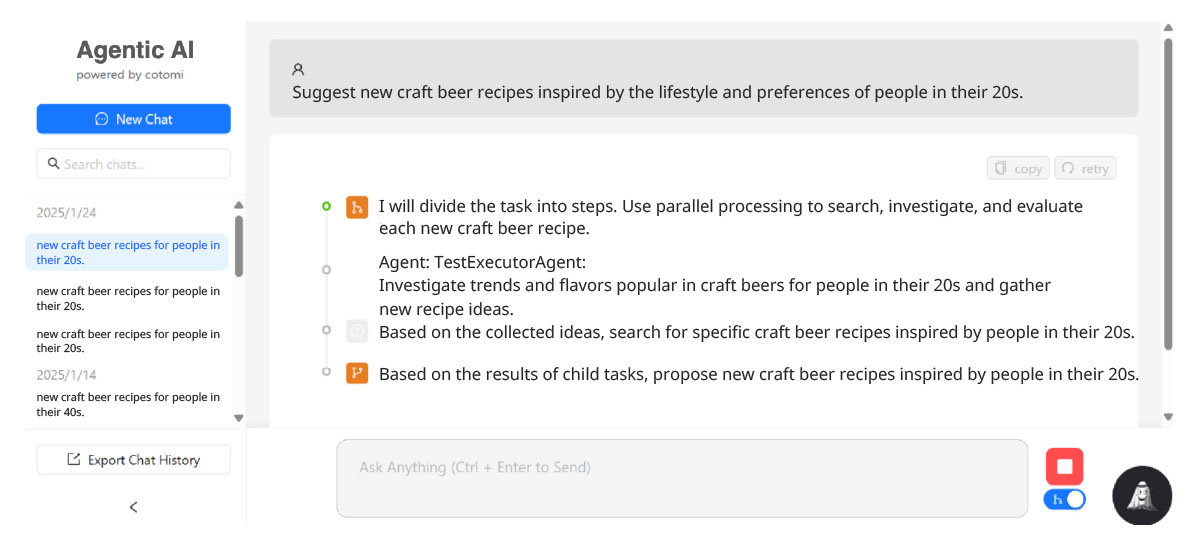
To enable interactive and continuous conversations rather than one-off exchanges—where brewers simply input requests and Agentic AI responds—we developed a dedicated web application (Fig. 4). This application allowed brewers to input follow-up questions and additional requests, such as ingredient selection, based on the initial AI response.
 Click to Enlarge
Fig. 4 Web application interface.
Brewers entered information about their desired beer through a chat interface, and the AI generated responses according to the content received. In addition, we prepared prompt templates in advance, allowing the basic prompts to be automatically inputted with a single button, making the application even easier to use.
Through repeated dialogue between the brewers and AI, it became possible to refine recipe proposals to a much higher degree of completeness.
4.6 Text generation for sales activities
Although not part of the development process itself, generative AI was utilized to create product descriptions for each of the four flavors, as shown in Fig. 5, as well as three promotional short stories, as shown in Fig. 6. These product descriptions and stories, generated by AI, helped consumers understand the product concept—promoting intergenerational communication—and contributed to their ability to visualize concrete scenarios for product use.
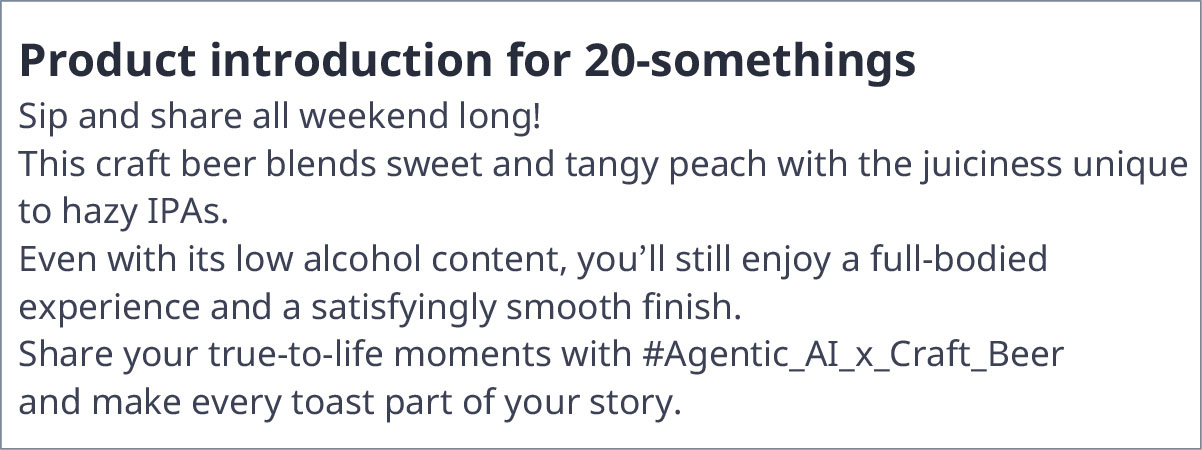
Fig. 5 Example of a product description.
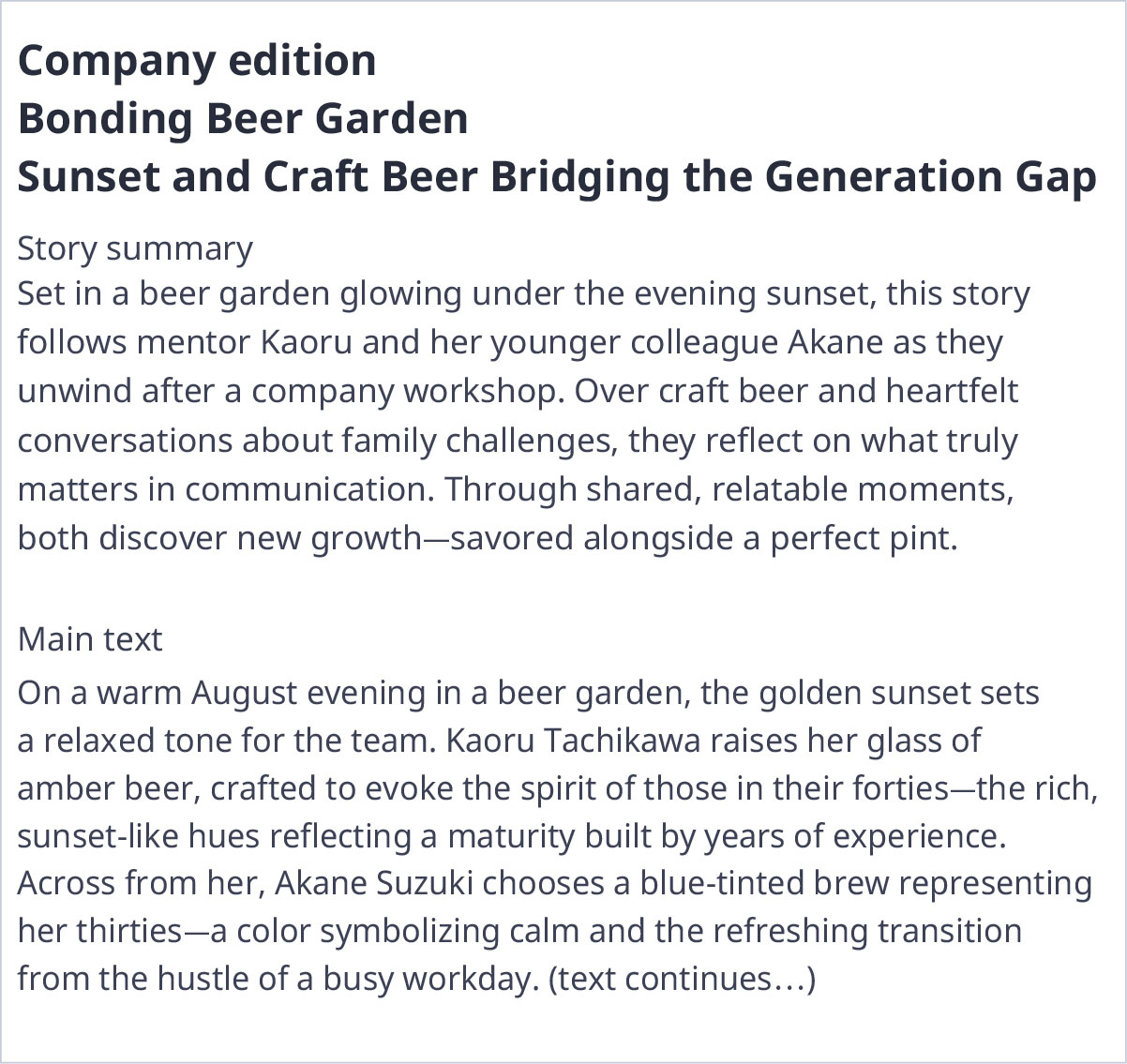
Fig. 6 Excerpts from AI-generated short stories.
5. Results and Discussion
In this product development process, brewers and AI collaborated to develop craft beers. As a result, four craft beers, each tailored to individuals in their 20s, 30s, 40s, and 50s, were commercialized, as shown in Fig. 7. According to comments from Kyodoshoji Corporation Limited, the use of AI reduced the workload in the product development process by 40% compared to conventional methods, and brewers were able to focus more on creative tasks such as brewing. Furthermore, Agentic AI stimulated the creativity of the brewers, expanding their knowledge to include previously unconsidered ingredients and brewing methods, which led to the creation of distinctive products that could not have been developed by brewers alone. This approach, in which the creative capabilities of humans and AI complement one another and produce results superior to those achievable independently, is referred to as hybrid intelligence.3)The initiative demonstrated not only a reduction in workload but also such synergistic effects.
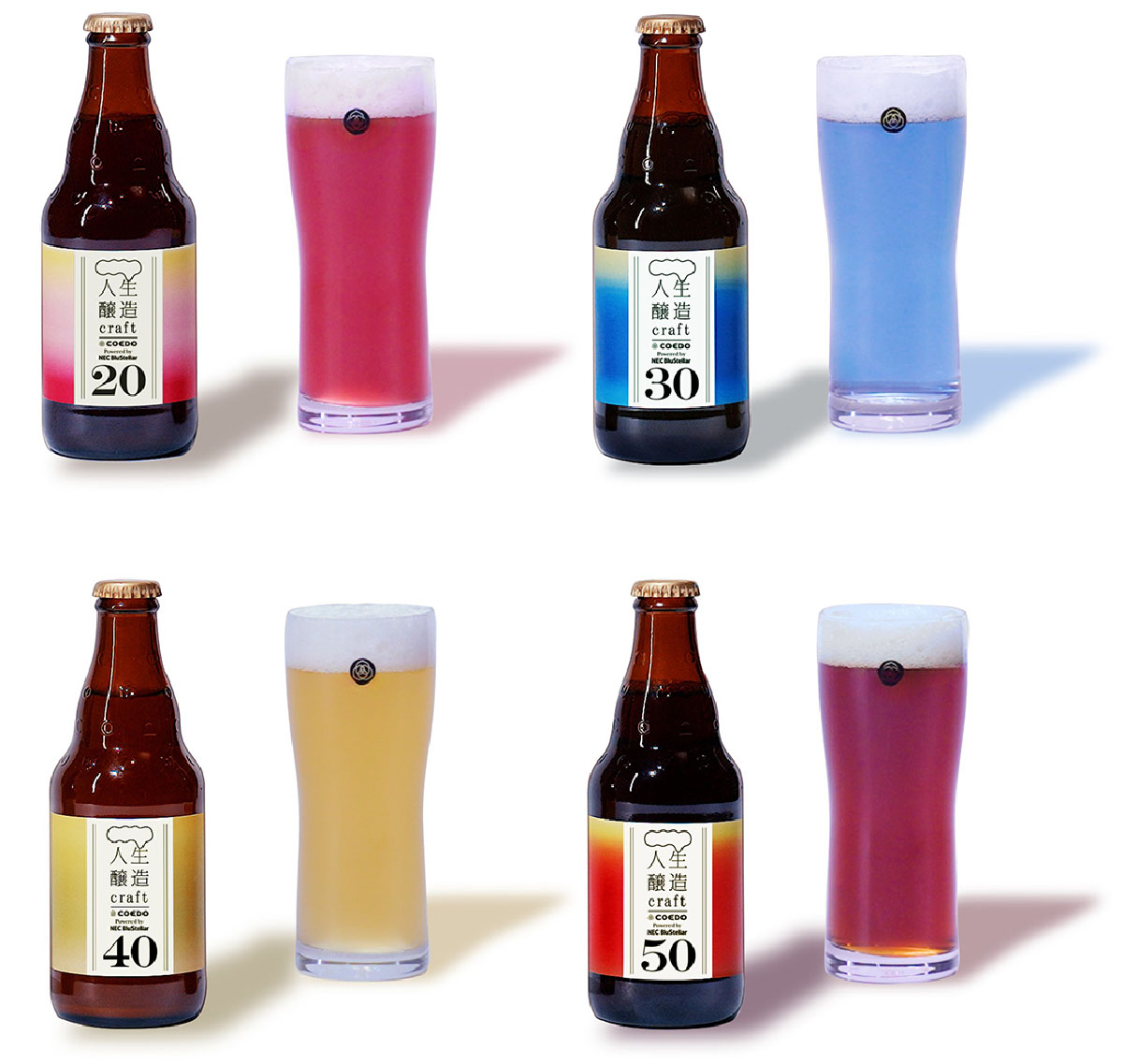
Fig. 7 The taste of life created by brewers and AI—Agentic AI × Craft Beer.
6. Conclusion
In this initiative, AI was positioned as a collaborative partner for humans, with a focus on the “planning” tasks common to all companies. Within this domain, an attempt was made to facilitate collaboration between brewers and AI specifically in the product development process.
As a result, the workload required for product development was reduced by 40%, enabling brewers to concentrate on creative tasks such as detailed recipe refinement and brewing. Additionally, during the creative process of generating recipe ideas, two-way interactions allowed the creative abilities of both brewers and AI to be fully leveraged, resulting in the creation of innovative products that could not have been achieved by brewers alone.
With the further decline of Japan’s working population foreseen, humans are expected to increasingly focus on tasks that only people can perform. NEC intends to continue contributing as a partner to humans in various operations, including planning tasks, by fostering collaboration between AI and human workers.
Trademarks
- *COEDO is a registered trademark of Kyodoshoji Corporation Limited.
- *All other company names and product names that appear in this paper are trademarks or registered trademarks of their respective companies.
References
- 1)
- 2)
- 3)
 Ministry of Internal Affairs and Communications: 2024 White Paper on Information and Communications in Japan, July 2024
 Authors’ Profiles
WASHIDA Azusa
Professional
Product Marketing & Alliance Department
Professional
Product Marketing & Alliance Department
SHIMURA Noritaka
Lead Data Scientist
AI Business Strategy Department
Lead Data Scientist
AI Business Strategy Department
ASAMI Ryuta
Data Scientist
Analytics Consulting Department
Data Scientist
Analytics Consulting Department