Global Site
Displaying present location in the site.
NEC BluStellar Scenario Case Study: Seven-Eleven Japan
Vol.19 No.1 Special Issue on NEC BluStellar: NEC BluStellar Driving the Future of Digital Transformation — A Value Creation Model Pioneered by AI, Security, Data Management, and ModernizationIn this paper we introduce a case study of Japan’s first full cloud-based next-generation store system, which was developed jointly by Seven-Eleven Japan and NEC. Transitioning the architecture from the conventional on-premise model to a cloud-based model enabled the implementation of microservices for applications and the usage of general purpose devices, which resulted in more efficient store operations, labor-saving, and improved function scalability. In addition, a balance of safety and convenience was also achieved with an authentication management system that uses both face recognition and an ID platform establishing device management for 310,000 devices through enterprise mobility management (EMM). Furthermore, utilizing information technology service management (ITSM) enabled centralized management of incidents in a multi-vendor environment. Going forward, the plan is to further enhance efficiency through data-driven decision-making by promoting data analysis and the automation of operations using AI and software as a service (SaaS).
1. Introduction
In recent years, the retail industry has been facing challenges such as labor shortages due to a declining workforce, rising labor costs, and the increasing burdens of training and educating personnel. In the convenience store industry, in particular, a wide variety of services are offered to meet the diverse needs of consumers, and with the broad scope of operations, various efforts are being made to ease the burdens of training and operational tasks in stores.
Amid these circumstances, NEC, together with Seven-Eleven Japan, has built a fully cloud-based operations system to achieve greater efficiency and sophistication in store operations. This deployment of a fully cloud-based operations system is a groundbreaking first in Japan’s convenience store industry.
In this paper, we introduce a case study in which the development of the next-generation store system was carried out based on the NEC BluStellar value creation model consistently from planning through development and operation.
2. Overview
Conventionally, store systems have been composed of an on-premises architecture centered around store computers and dedicated terminals (GOT/ST) for over 30 years, with hardware upgrades and functional enhancements implemented every seven to eight years. However, limitations in hardware performance and functionality ultimately restricted the ability to rapidly expand functions.
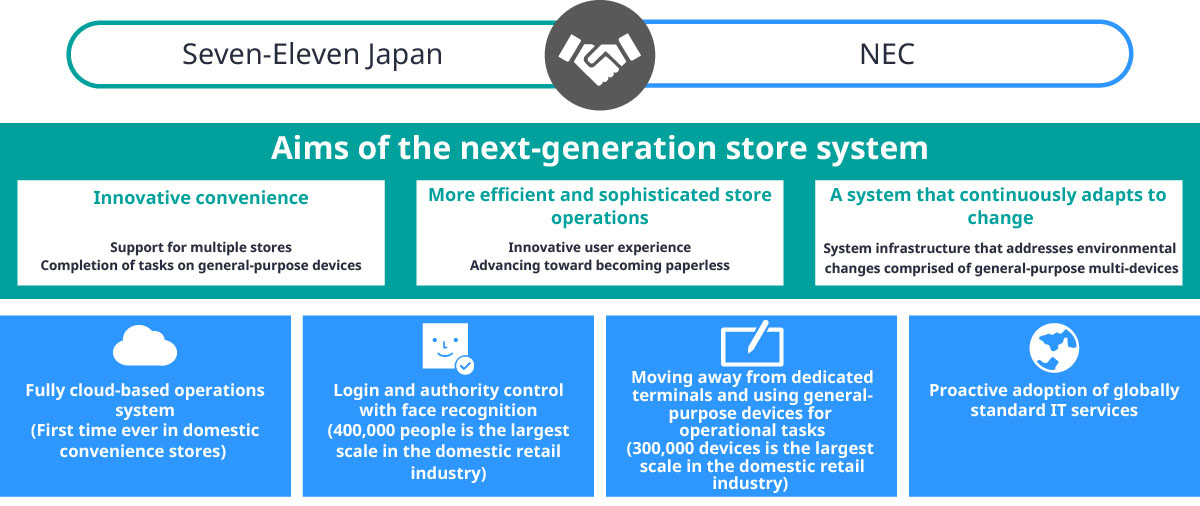
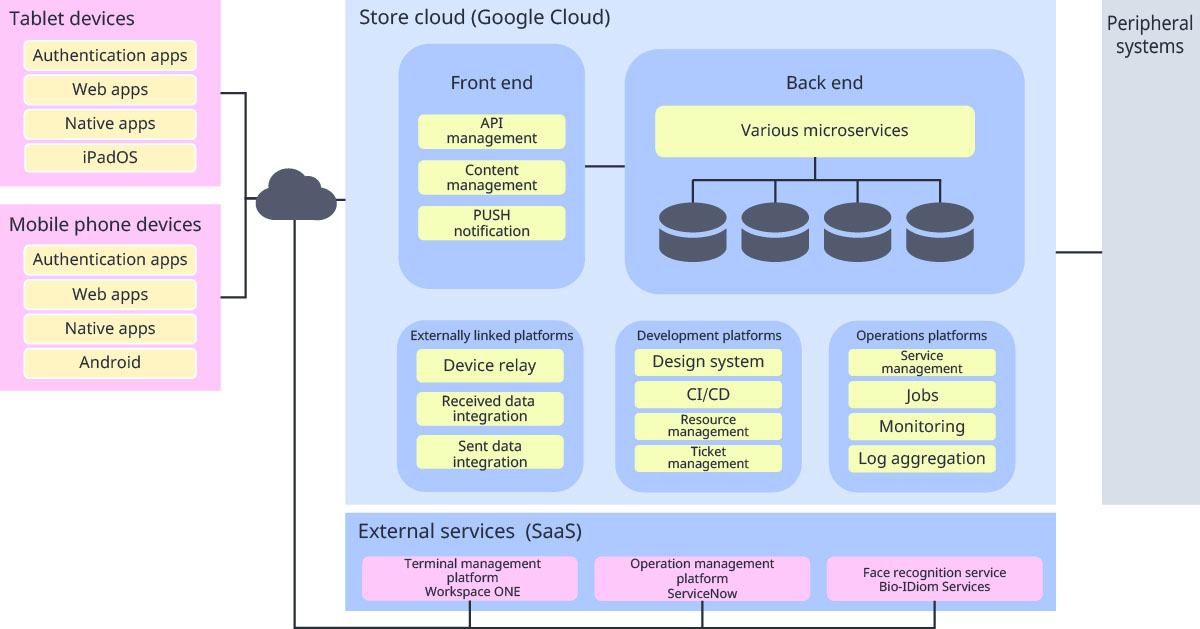
The next-generation store system achieved a full cloud implementation for the first time in Japan’s convenience store industry. Store computer functions were transferred to the cloud and applications were converted into microservices while terminals were integrated to work with general-purpose iPad and Android devices. This resulted in the further separation of hardware and software, freeing the hardware from end-of-life and performance limitations, and transforming the architecture into one that enables continuous functional expansion (Fig. 1).
 Click to Enlarge
Moreover, the next-generation store system provides an integrated infrastructure to support store systems, which includes authentication and authorization enabling seamless login functionality, Enterprise Mobility Management (EMM) offering a device management platform for 300,000 terminals, and the implementation of ServiceNow for standardizing business processes.
In the transition from the on-premises store system model to the cloud-based model, NEC fully leveraged its knowledge of the existing system, while at the same time actively adopted cloud-native architecture, development and operations methods, and globally standardized IT services based on the NEC BluStellar value creation model. Through these efforts, the system maintains the existing functionality and service level, while enabling rapid response to changes, thereby realizing Seven-Eleven Japan’s vision of a system that continuously adapts to change.
3. Distinctive key points
3.1 Modernization
The next-generation store system is not simply a transition to a new infrastructure; it is an innovation of the system’s entire architecture. The traditional monolithic structure transitioned into a microservices architecture ensuring the independence of each functional module. The efficient redesign of the core operations, such as the ordering system and inventory management, minimized the impact made by the changes and achieved a significant improvement in development efficiency. High performance was enabled with the detailed analysis of complex business logic and the application of cloud-native design methods.
In terms of infrastructure, in order to ensure high availability, a multi-region configuration and auto-scaling were implemented, resulting in the development of a flexible system able to smoothly respond to sudden fluctuations in workload.
Additionally, adopting general-purpose devices, such as iPads and Android devices, as business terminals, makes it possible to easily select the most up-to-date device compared to conventional dedicated terminals (Fig. 2). This architecture enables both applications and hardware to continuously benefit from the latest advancements in IT.
 Click to Enlarge
3.2 Authentication and authorization infrastructure
The authentication and authorization infrastructure allows approximately 400,000 store employees across all locations to use general-purpose devices, such as iPads and Android devices, to access business systems using face recognition for login control, along with strict role-based access control. The authentication and authorization infrastructure consists of NEC’s ID management and face recognition service, which, when integrated with business applications, achieves both seamless login and advanced security measures.
A key feature of this system is its design concept, which is tailored for convenience store operations. Anticipating that the system will be used by employees with a diverse range of attributes, measures have been taken to improve usability, such as enhanced visual guidance during face recognition and improvements to the accuracy and speed of face recognition. These measures have also contributed to increased productivity for store employees.
Additionally, by taking into account that convenience stores operate 24 hours a day 365 days a year, the system is designed to minimize the impact on business even during system maintenance, thereby ensuring high availability.
3.3 Device management platform
Traditionally, dedicated hardware was used to ensure security, but with the adoption of general-purpose devices in the next-generation store system, a new device management platform centered on EMM was developed to strengthen resistance against external connections and unauthorized access. NEC integrated convenience store operational expertise and EMM product knowledge to enable centralized management of a multi-OS environment spanning approximately 21,000 stores and 310,000 terminals nationwide, 90,000 of which are iOS based and 220,000 of which are Android based. We designed a multi-layered defense that includes EMM, device OS, and network architecture, minimizing risk by unifying device management policies and linking with the device control framework and operations and maintenance applications. Additionally, by controlling distribution groups with precision based on several hundreds of patterns that include region, store, device, and OS version, we were able to build an environment that enables the reliable and rapid deployment of application updates essential for business continuity. On the hardware side, we standardized and streamlined processes such as kitting, installation and removal, send-back replacement, and OS updates using EMM and existing expertise. As a result, we established a device management platform that supports robust security and stable service provision ensuring uninterrupted store operations.
3.4 Multi-vendor operations
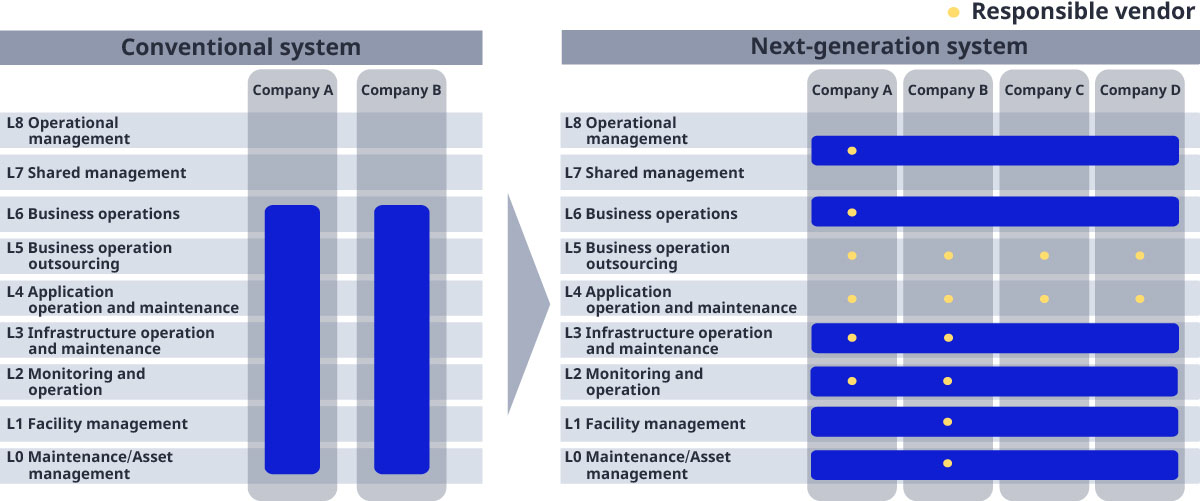
The conventional system was provided as a vertically integrated solution by a single vendor covering everything from hardware and applications to on-site maintenance, which was easy to maintain consistency from design through to operation. With the advancement of cloud adoption in next-generation store systems, hardware and applications have been separated and are now provided from multiple vendors through a horizontally distributed model, and as a result, overall system governance and management are expected to become more complex (Fig. 3).
 Click to Enlarge
This change has brought an increase in communication among different domains and vendors, raising the risk that operational challenges such as information fragmentation and longer incident response times will become more pronounced. The diversification of failures and their causes is also expected to make troubleshooting more difficult, and the increase in the number of systems to operate and monitor will likely further expand the management burden.
To address these issues, NEC leveraged its Information Technology Infrastructure Library (ITIL)-based operations design expertise, cultivated across a wide range of public and private sectors, to provide comprehensive support from upstream planning to maintenance and operations. During the operations phase, Information Technology Service Management (ITSM) via ServiceNow was introduced to promote ticket management, process management, and visualization through dashboards. Additionally, by integrating with Salesforce, which is used by the call center, automatic ticket creation was implemented, enabling centralized management of over 200,000 inquiries annually and allowing for real-time status tracking and prompt response within a multi-vendor environment.
4. Future development
This next generation store system is based on the concept of a system that continuously adapts to change, and leveraging a cloud-native platform achieves ongoing functional expansion and advanced operations. The core themes are the digital transformation (DX) of store operations through data utilization and the DX of system operations through the use of Software as a Service (SaaS).
In terms of store operations DX, vast amounts of business data, such as orders and inventory, are linked to AI and analytics platforms for real-time analysis. This enables information to be shared with each business application, allowing for optimal store management tailored to the unique characteristics of each location. As a result, store operations are streamlined and more efficient, while also achieving increased sales and standardized operational quality.
As for operations DX, cloud adoptions has increased compatibility with the latest technologies, allowing for the proactive introduction of SaaS and AI to accelerate operational efficiency and automation. By collecting and analyzing various system-wide data in real time, and combining ITSM platforms with AI-driven incident prediction, we aim to speed up response to failures and reduce human workload. Furthermore, by promoting automation, routine operations and recovery procedures can be executed automatically, minimizing the need for manual intervention. Process improvements and cost optimization are also continuously carried out through analysis of operational data, driving advanced operations.
Through these initiatives, the next-generation store system will evolve beyond a simple cloud platform, becoming a resilient foundation for value creation that leverages data and SaaS to adapt to change.
5. Conclusion
As a case study emphasizing these initiatives, the efforts implemented at Seven-Eleven Japan have been formulated into a NEC BluStellar Scenario, and expansion is anticipated into sectors beyond the retail industry. NEC will continue to support business innovation utilizing AI, contributing to the streamlining and advancement of store operations.
Trademarks
- *ServiceNow is a trademark or registered trademark of ServiceNow, Inc. in the United States and other countries.
- *iPhone and iPad are trademarks of Apple Inc. The iPhone trademark is used under license from AIPHONE CO., LTD.
- *Android is a trademark of Google LLC.
- *Information Technology Infrastructure Library (ITIL) is a registered trademark of AXELOS Limited.
- *Salesforce is a trademark or registered trademark of Salesforce, Inc. in the United States and other countries.
- *Any other company names and product names that appear in this paper are trademarks or registered trademarks of their respective companies.
Authors’ Profiles
MAEDA Yasuhiro
Professional
1st Retail Solutions Department
Professional
1st Retail Solutions Department
KAMIYA Akihito
Professional
1st Retail Solutions Department
Professional
1st Retail Solutions Department
ITO Yoshihiro
Director
1st Retail Solutions Department
Director
1st Retail Solutions Department
YAMASAKI Shinya
Director
1st Retail Solutions Department
Director
1st Retail Solutions Department
MURAKAMI Daisuke
Senior Business Producer
1st Retail Solutions Department
Senior Business Producer
1st Retail Solutions Department
SATO Yoshiyuki
Senior Director
1st Retail Solutions Department
Senior Director
1st Retail Solutions Department