Global Site
Displaying present location in the site.
Consulting as a Business in an Era Where AI Is Changing Corporate Activities and Management
Vol.19 No.1 Special Issue on NEC BluStellar: NEC BluStellar Driving the Future of Digital Transformation — A Value Creation Model Pioneered by AI, Security, Data Management, and ModernizationThe conventional consulting model, which relies on people and information asymmetry, is reaching its limits amid accelerating environmental changes and advances in generative AI. The model is currently evolving toward an “AI-as-a-Service” type co-creation model that combines AI with expertise, continuously creating value while working in accompaniment with customers. Consultants need to shift toward more strategic and creative roles and transform into partners who support the realization of a sustainable competitive advantage by leveraging industry-specific expertise and data. This paper examines the impact of AI utilization on corporate activities and management, as well as new directions for consulting as a business.
1. Introduction
The remarkable advances that have been made in AI are expected to bring significant changes to the way corporate activities and management are conducted. For companies to establish and maintain a competitive advantage, they need to use AI not only as a tool, but they must also transform their entire corporate activities with AI at the core. Amid such large-scale transformation, substantial changes are also expected in how consulting is conducted. This paper describes how consulting services are adapting in an era where the use of AI is driving corporate transformation.
2. Problems Facing the Consulting Business
Traditionally, consulting has centered on human-dependent activities such as research, analysis, and proposal development, with fees calculated by adding a margin to the associated labor costs. Continued growth under this model would require an increase in the number of personnel deployed, higher margins, or both. However, given the value expected by customers, the current business model is approaching its limits. In addition, consulting firms have, to date, differentiated themselves and delivered value by keeping their intellectual assets confidential, including methodologies and templates, thus creating information asymmetry with customers. However, advances in technologies such as generative AI have made it easier to access useful information, thereby diminishing the effectiveness of maintaining the confidentiality of intellectual assets. Furthermore, in the so-called VUCA (volatility, uncertainty, complexity, and ambiguity) era, characterized by rapid environmental change, the usefulness of established strategies can quickly deteriorate due to the emergence of new trends or unforeseen disruptors, forcing companies to address these problems to achieve sustainable growth1).
3. Changes in the Roles Required of Consultants
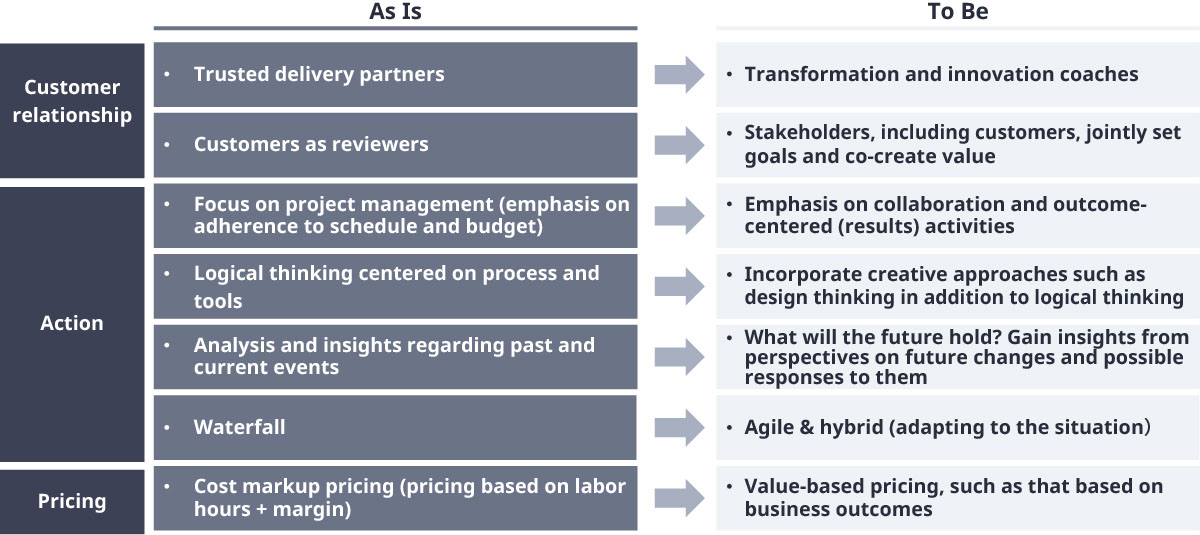
In the past, when environmental changes were slow and the nature of industries remained largely unchanged, businesses could operate by taking a certain amount of time to formulate outputs, have them evaluated by customers, and achieve customer satisfaction. However, in situations where environmental changes are rapid and unexpected trends and disruptions occur, formulated strategies can quickly become obsolete, and the roles that customers expect from consultants are also changing (Fig. 1).
 Click to Enlarge
In situations with rapid environmental changes, it is necessary not only to accurately define the issues to be addressed but also to formulate solutions of a certain quality within a short timeframe and promptly verify those solutions and other ideas by bringing them to market. Furthermore, given that the environment will continue to change, it is necessary to continuously implement a cycle in which plans are updated based on verification results, ideas are tested again, and the plan is updated further. To promote this kind of activity, customers are now moving away from the role of evaluator who judge consultants’ outcomes, and they are instead increasingly seeking relationships in which trusted partners accompany them on their journey or in which value is created jointly with them.
4. Present and Future State of AI and Its Impact on Corporate Activities
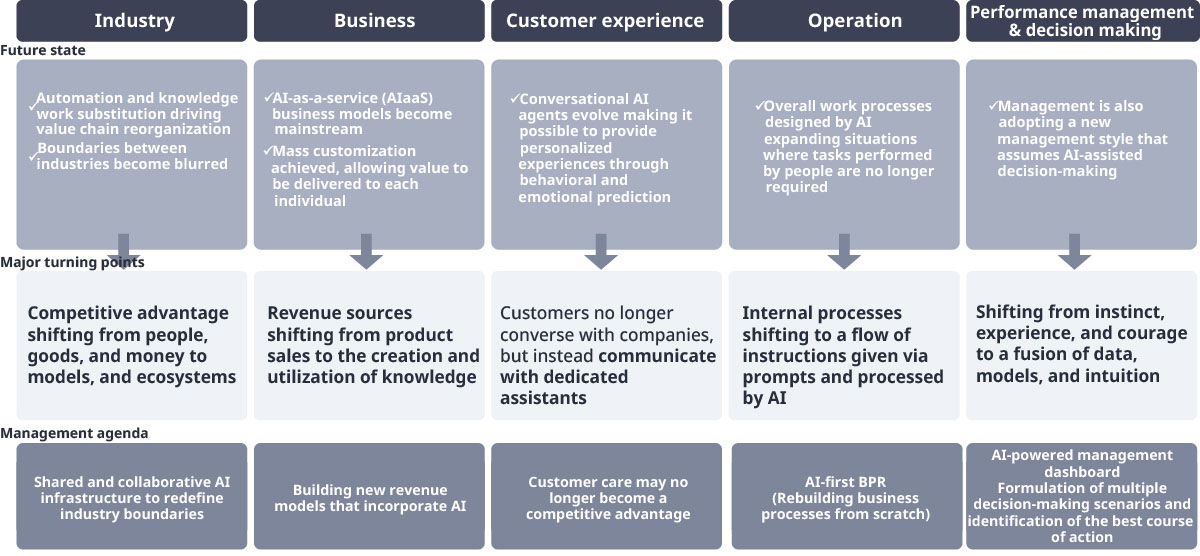
Multiple initiatives have been implemented to leverage AI to improve operational efficiency and productivity (Fig. 2). In industries such as manufacturing, logistics, and customer service, efforts are underway to utilize AI agents in customer care (customer support) functions to automate complex, repetitive tasks. In software engineering, AI is being used to improve productivity by shortening the time required for development. The use of AI is also being considered across a wide range of fields beyond customer care and software engineering. For example, the CEO of Anthropic has predicted that up to half of entry-level white-collar positions could be taken over by AI, while a McKinsey report2) forecasts that generative AI is likely to have the greatest impact on highly educated, high-income white-collar knowledge workers. In the future, AI is expected to not only be used as a tool, but also to substantially reshape corporate activities as a whole3).
 Click to Enlarge
People, goods, and money have long been regarded as the three primary resources for building competitive advantage. However, people present scalability challenges due to their dependence on individual capabilities, while goods, such as products and equipment, lack flexibility. Money, which is used for business expansion or mergers and acquisitions (M&A), also has its limitations, as relying on it alone makes differentiation difficult.
As AI evolves and is increasingly incorporated into corporate activities, competitive resources are predicted to shift toward data, models, and ecosystems. Data, such as customer behavior, usage patterns, and transaction histories, serves as the fuel that drives AI, while models, which support forecasting and decision-making, act as engines that convert the data into value. Ecosystems, encompassing partnerships and API integrations, form the foundation for value creation. Leveraging these resources to create value from data will be key to building sustainable competitive advantage.
Providing new revenue models that incorporate AI, rebuilding operations from a zero base with AI at the core, and enhancing and streamlining management decision-making through AI-enabled dashboards are expected to become a future focus on the management agenda.
5. Impact of AI on the Consulting Business
The quality of generative AI outputs has improved to the point where repetitive tasks that previously depended on humans, such as research, document preparation, and analysis, are increasingly being replaced by AI. In addition, as customers advance in their use of AI, differentiation based on intellectual assets, such as methodologies that were previously kept confidential, is expected to become less effective. Given these circumstances, consulting firms must go beyond merely substituting AI for repetitive tasks such as analysis, and instead focus on more strategic and creative activities to deliver new value. AI-native companies such as Palantir and OpenAI have already entered the consulting market by promoting the practice of AI as a Service, which combines AI platforms with expertise to deliver value (see Table). Consulting firms are also required to practice value delivery by integrating AI platforms with expertise to achieve sustainable growth. Furthermore, considering customers are increasingly requiring that consultants act as partners who accompany them in co-creation, pricing will need to shift away from the traditional cost-plus-margin approach and more toward outcome-based pricing.
Table Advantages of AI as a Service
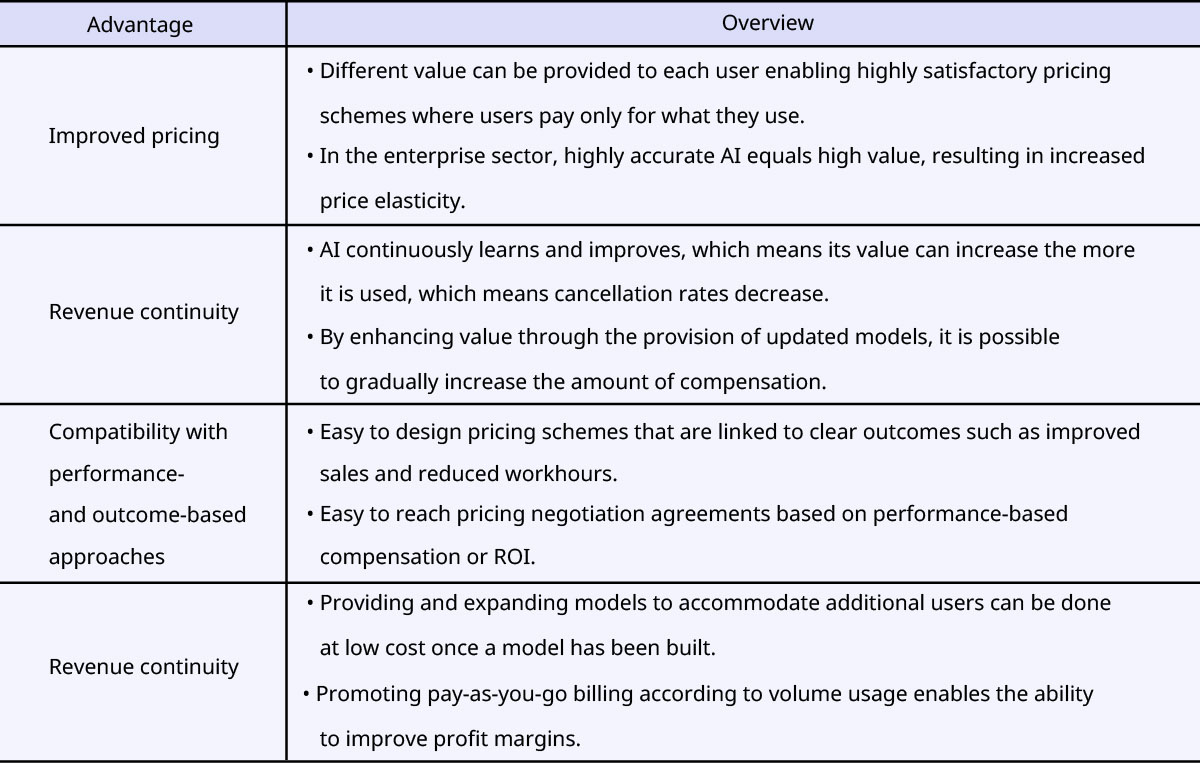
AI as a Service can deliver differentiated value to each user and improve the quality of its outputs through continuous learning. As such, it is expected to enable ongoing revenue and increased pricing (value). In addition, because it enables clear billing structures linked to results, the ability to expand the functionality of models once built, and deploying them to other areas at low cost, it is highly compatible with outcome-based pricing and offers advantages in terms of scalability.
6. Changes in Corporate Activities Driven by AI and the Future of Consulting
In the future, consulting must promote a business model that delivers AI as a Service, enhanced with expertise, and which increases customer value through continuous learning. To this end, it is essential to engage deeply with customers, earn their trust as a co-creation partner, and leverage industry- or customer-specific knowledge and data to collaborate with those companies, using AI platforms to deliver and create data-driven value.
In order to truly engage with customers, a consulting firm must possess knowledge and expertise regarding the customers’ industry, as well as have a thorough understanding of the customer themselves. It is also important to share insights gained from the various digital transformation (DX) initiatives, including Client Zero, implemented by NEC to foster empathy from customers for NEC’s efforts. The know-how and expertise acquired through Client Zero should be used as a foundation for grounded discussions when considering measures to address the challenges of our customers. Through such activities, recognition by customers as a DX co-creation partner will become increasingly important moving forward.
7. Consulting Services (CS) Business Unit Initiatives
NEC’s CS Business Unit is currently shifting away from traditional human-centric consulting tasks toward a model in which consultants and AI work collaboratively. To achieve this, we are conducting various internal demonstrations and introducing this approach to our customers. Across a wide range of fields, such as new business development and service design, members of the marketing division and consultants are working together using generative AI, aiming to improve both operational efficiency and output quality. Internal demonstrations have been very well-received in evaluations and introducing outputs created using generative AI to customers is helping to expand our customer base. The outputs developed using AI have been evaluated highly by customers, and some have requested that their members participate in the collaboration process. At NEC, we refer to these initiatives as Human AI Collaboration, positioning them as the future model of consulting, in which humans and AI work in harmony.
8. Conclusion
The evolution of AI presents a major opportunity to reexamine the essence of consulting. Going forward, consulting will be expected to evolve beyond the mere provision of expertise toward a model in which AI and humans collaborate to create value together with customers. By sharing concrete images of how AI can be utilized and enhancing consensus, we can build relationships of trust with customers, leading to the realization of accompaniment and co-creation. Through such initiatives, our customers will be able to enjoy greater value in addressing their challenges and achieving sustainable growth. Moving forward, NEC will continue to pursue new consulting approaches in which AI and people collaborate under the concept of Human AI Collaboration, and provide solid support for the transformation and growth of our customers.
References
- 1)
- 2)
- 3)
 David G. Fubini: Are Management Consulting Firms Failing to Manage Themselves?, Working Knowledge, Harvard Business School, September 2024
 The World Economic Forum: AI in Action: Beyond Experimentation to Transform Industry, January 2025
Author’s Profile
ABEKI Takumi
Managing Director
Consulting Services Division
Managing Director
Consulting Services Division