Global Site
Displaying present location in the site.
Promoting Effective AI and Data Utilization through AI-Ready Enterprise Data: An Approach Using NEC Data-Driven DX Assets & Framework
Vol.19 No.1 Special Issue on NEC BluStellar: NEC BluStellar Driving the Future of Digital Transformation — A Value Creation Model Pioneered by AI, Security, Data Management, and ModernizationTo enhance competitiveness, many enterprises are accelerating digital transformation (DX), with the use of AI as a core technology now essential. Nevertheless, there are still only a limited number of cases where AI has been fully integrated into mission-critical operations and has contributed to business outcomes. This situation arises from several complex factors: the difficulty of defining use cases that are directly linked to business outcomes; challenges with data, such as the lack of AI-ready data that serves as the source of value; and the difficulty of technology selection, as leading solutions change rapidly and it is hard to determine which products and technologies to invest in. This paper introduces specific approaches using the NEC Data-Driven DX Assets & Framework, providing practical guidance for effective enterprise utilization of AI and data.
1. Introduction
AI technology is expected to accelerate enterprises’ digital transformation (DX) and is regarded as a core technology for enhancing competitiveness. In addition, AI-ready data—which enables AI to learn effectively and make appropriate inferences—is attracting attention as a solution to the various challenges associated with preparing data for AI, an area where many enterprises continue to struggle.
In this paper, we introduce the concept of building an AI‑ready data foundation using the NEC Data‑Driven DX Assets & Framework (DDX Assets), which NEC proposes for generating business outcomes for enterprises. We also present approaches to accelerate the utilization of AI and data.
2. Barriers to Achieving Business Outcomes with AI and Data for Enhanced Enterprise Competitiveness
To enhance their competitiveness, many enterprises are accelerating digital transformation (DX) initiatives and advancing efforts to leverage AI and data, including expanding AI talent and strengthening organizational frameworks to support these activities. However, there are still relatively few cases where AI has been fully integrated into core business operations and has contributed to tangible business outcomes. Enterprises are now shifting from simply experimenting with AI to fully operationalizing it within their business processes to achieve real results, and this transition presents several critical challenges that must be addressed.
2.1 Challenge 1: The difficulty of defining use cases
One of the initial challenges in advancing AI and data utilization is the difficulty of clearly defining the purpose for using data—that is, specifying concrete use cases. When objectives and goals remain vague, merely experimenting with internal data often leads projects to stall at the proof-of-concept (PoC) stage, with many ultimately failing. This is especially true when business or operational challenges are not directly linked to specific initiatives, making it difficult to achieve significant results.
Typical reasons why defining use cases is difficult include:
- The issues to be addressed are abstract, making it hard to determine whether AI can provide a solution.
- There is a disconnect between frontline staff and IT departments regarding objectives and expectations.
- It is difficult to envision how AI outputs can be effectively integrated into business operations.
On the other hand, enterprises that succeed in AI and data initiatives set clear success criteria and define use cases that are directly tied to business goals and management strategies.
2.2 Challenge 2: The difficulty of preparing AI-ready data
To effectively advance AI and data utilization, it is essential to prepare AI-ready data that enables AI to learn and infer appropriately. According to NEC, AI-ready data should possess the following characteristics:
- Be in a format that is easily understood by AI, such as tabular or vector formats.
- Ensure consistency and integrity across datasets.
- Enable the extraction of business insights (knowledge) from accumulated data.
However, in practice, many organizations struggle to prepare AI-ready data due to issues such as deficiencies in data models and the inherent difficulty of extracting knowledge from data. As a result, the development of AI-ready data often remains incomplete.
2.3 Challenge 3: The difficulty of selecting evolving AI technologies
Another major challenge is selecting the most appropriate AI technologies from among the many that are rapidly evolving. AI technologies advance at a remarkable pace, creating the risk that solutions adopted today may quickly become obsolete. Furthermore, with a vast array of options—including cloud services and open-source technologies—organizations must consider scalability and maintainability, while also ensuring functional compatibility and integration with existing IT assets in which they have already invested.
Compounding these issues, it is extremely difficult to make optimal technology selections with limited in-house expertise. This requires organizations to make complex decisions such as:
- Avoiding vendor lock-in and choosing architectures that can flexibly adapt to future technological advancements.
- Determining whether to maintain or upgrade the AI technologies currently deployed in the existing system.
- Selecting technologies that align with the organization’s operational structure and skill levels.
3. NEC Data-Driven DX Assets & Framework: An Approach to Achieving Business Outcomes
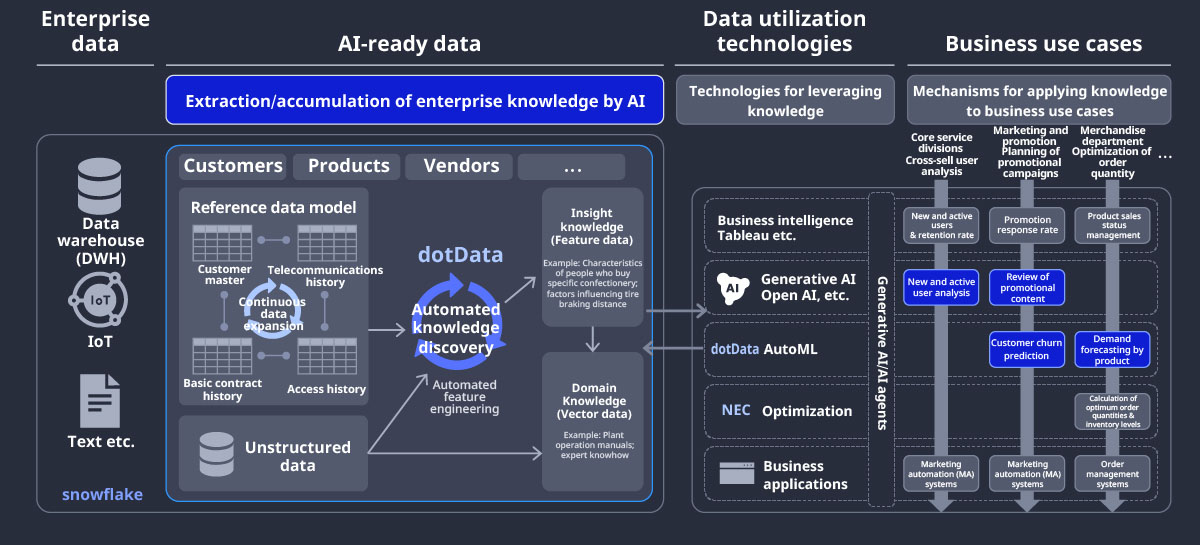
To strengthen enterprise competitiveness, organizations must overcome the three challenges described in the previous section and expand the effective use of AI and data throughout the company. Drawing on extensive experience supporting AI and data utilization across diverse industries, NEC presents its best practices as the NEC Data-Driven DX Assets & Framework (Fig. 1).
 Click to Enlarge
- DDX Matrix: To address Challenge 1, “Difficulty in defining use cases,” the DDX Matrix enables organizations to select use cases based on proven customer successes, facilitating the rapid launch of new use cases.
- Logical Data Model (LDM) and automated feature engineering: For Challenge 2, “Difficulty in preparing AI-ready data,” the LDM organizes data in a consistent, AI-interpretable format and supports the structuring of business knowledge within AI-ready data through automated feature engineering.
- DDX Reference Architecture: For Challenge 3, “Difficulty in selecting evolving AI technologies,” the DDX Reference Architecture enables a best-of-breed approach by combining and leveraging the latest AI technologies.
By leveraging these assets and framework, enterprises can more flexibly and sustainably promote AI utilization centered on their own data assets.
3.1 DDX Matrix
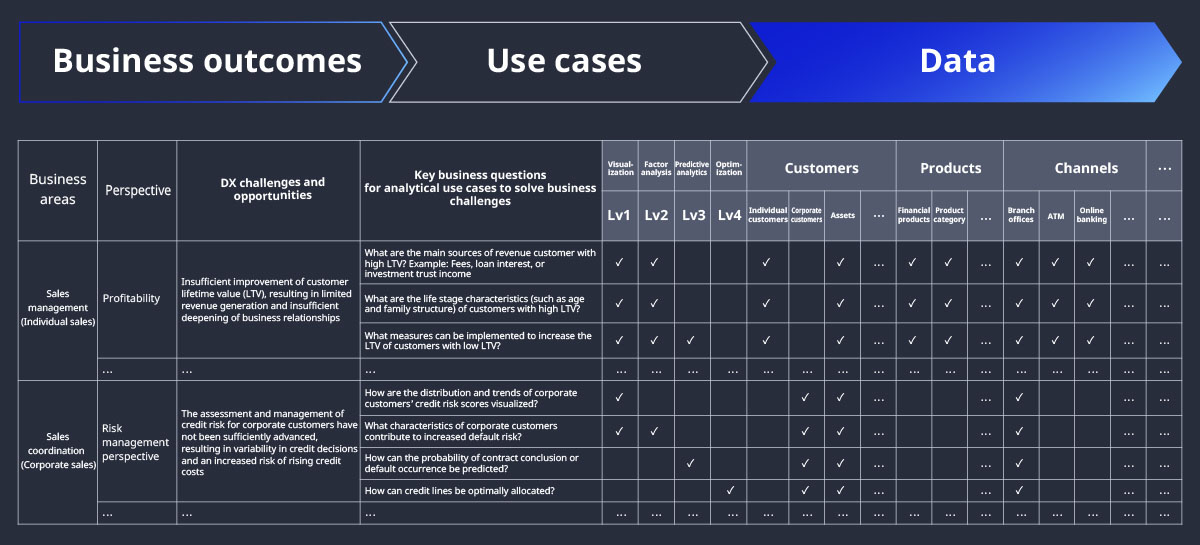
The DDX Matrix is an industry-specific asset that organizes, in tabular format, sets of use cases directly linked to representative business outcomes for each industry, along with the data utilization technologies and data types required to realize those use cases. (Fig. 2).
 Click to Enlarge
The DDX Matrix consists of three main components:
- (1)Business outcomes:
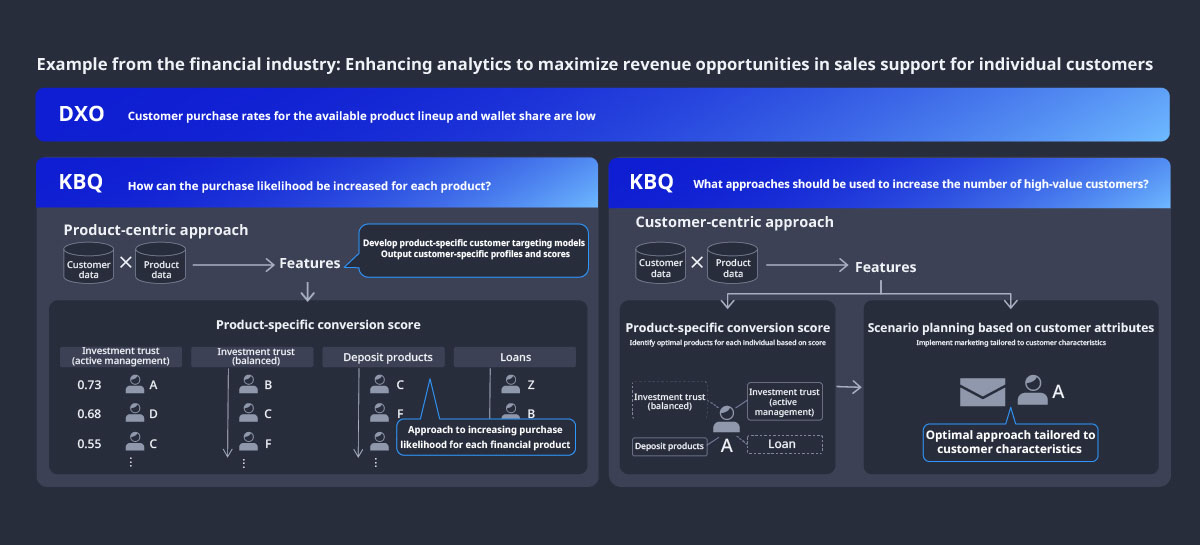
A comprehensive list of major business domains for each industry and the principal DX opportunities (DXO) within each domain. - (2)Use case groups:
A comprehensive list of key business questions (KBQ) that enterprises should address in relation to DXOs (Fig. 3).
 Click to Enlarge
- (3)Data utilization technologies and data:
An overview of the data utilization technologies—such as descriptive analytics, diagnostic analytics, predictive analytics, and prescriptive analytics—as well as the data types required to realize these use cases.
3.2 Logical Data Model (LDM)
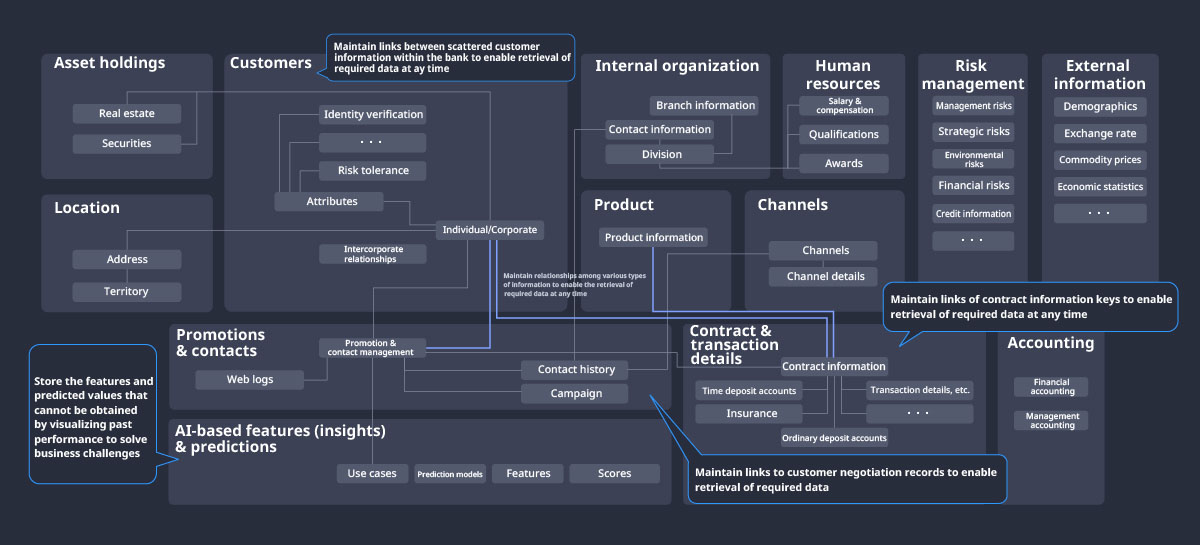
This is a generic, industry-specific data model (Fig. 4) that comprehensively covers the data types required to realize the use cases presented in the DDX Matrix.
 Click to Enlarge
The model includes table names and attributes for storing information on data types and the outputs of data utilization technologies, as well as primary keys and relationship information to link the tables together.
3.3 AI-ready data and automated feature engineering
3.3.1 AI-ready data and knowledge
The business outcomes of AI and data utilization depend on whether an enterprise can organize its corporate knowledge as AI-ready data. By inputting this knowledge, AI learning and inference become more tailored to the enterprise, resulting in highly effective outcomes.
Within the DDX Assets, knowledge is classified into two categories—insight knowledge and domain knowledge—and managed as feature data or vector data.
- Insight knowledge: Implicit insights unique to the organization, uncovered through data analysis and other methods. For example, “a particular product tends to sell better to a specific age group.”
- Domain knowledge: Explicit, language-based knowledge particular to the enterprise or its industry, such as information contained in internal manuals.
Of these two types of knowledge, acquiring insight knowledge is especially challenging. It primarily relies on hypothesis-driven approaches, but both setting appropriate hypotheses and verifying them can be difficult.
3.3.2 Insight knowledge and automated feature engineering
When managing insight knowledge as feature data, feature engineering is indispensable for its extraction. However, traditional feature engineering relies heavily on the skills and experience of data scientists and is susceptible to biases arising from human thinking. This creates a bottleneck in organizing insight knowledge and, by extension, in the overall utilization of AI and data.
Automated feature engineering provides a solution to this challenge. It automatically and comprehensively searches for and extracts features without being influenced by bias, enabling efficient and high-quality extraction of insight knowledge from data.
3.4 Implementation of automated feature engineering with dotData
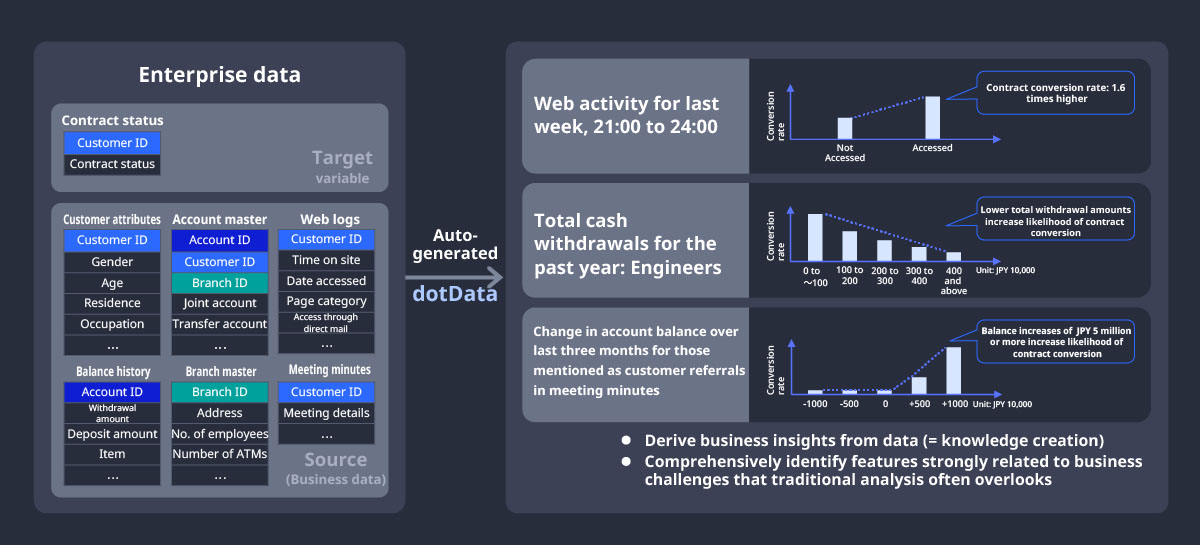
NEC has adopted dotData products1) to implement automated feature engineering within its DDX Reference Architecture. dotData is equipped with functionality to generate hundreds of thousands to millions of hypothetical features from input data and to search for useful features among them.
The input data encompasses a wide range—including master data, transaction data, and text data—and by utilizing keys and relationship information between datasets, it is possible to design features that span multiple data sources (Fig. 5).
 Click to Enlarge
For example, by linking customer attributes, account master data, and balance history using customer IDs and account IDs, dotData can automatically extract features such as “Total cash withdrawals for the past year: Engineers.” This approach is highly compatible with the Logical Data Model (LDM), and accumulating data in line with the LDM enables more effective automated feature engineering with dotData.
3.5 DDX Reference Architecture
The DDX Reference Architecture is a framework that connects enterprise data to business outcomes end-to-end, centered on data utilization technologies and an AI-ready data platform, and designed to realize the use cases defined in the DDX Matrix.
This architecture satisfies the following three requirements.
- (1)Based on a best-of-breed approach, it enables the selection of the most advanced AI technologies available at any given time.
- (2)It allows for loose coupling between enterprise data and AI technologies through knowledge generated by AI-ready data.
- (3)It enables the automated extraction of knowledge via automated feature engineering from enterprise data stored in the LDM.
4. Accelerating AI and Data Utilization with NEC Data-Driven DX Assets & Framework
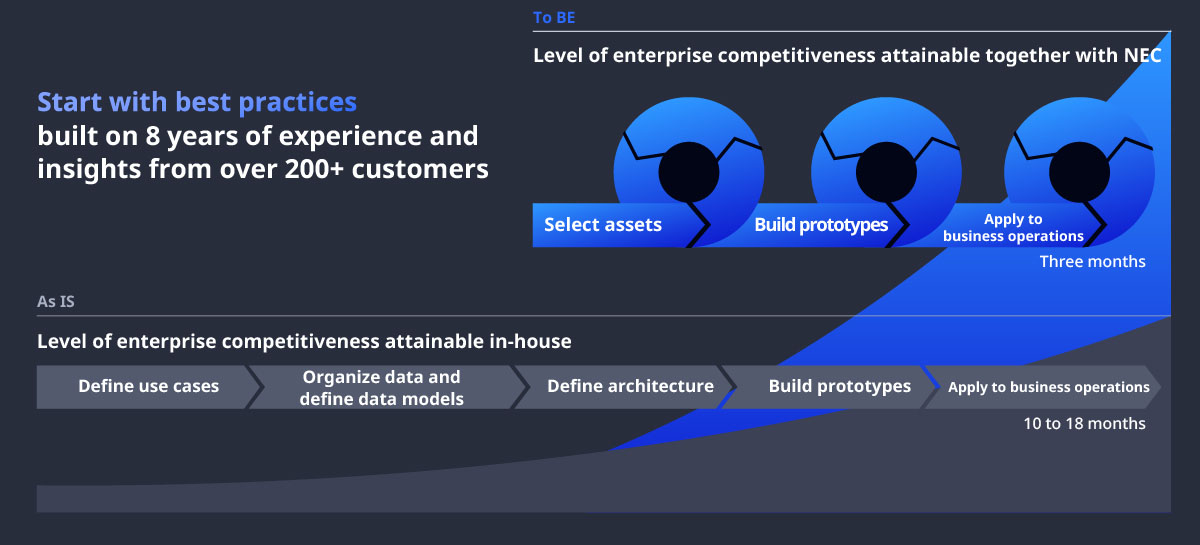
In driving digital transformation (DX), enterprises are expected to pursue initiatives that directly address management challenges and generate business outcomes, rather than merely implementing new technologies. DDX Assets support enterprises in continuously generating business outcomes, centered on three pillars: effectiveness, quick start & quick win, and agile response to change2) (Fig. 6).
 Click to Enlarge
4.1 Effectiveness
First, effectiveness is assured by NEC’s proven track record. Drawing on expertise gained from supporting DX initiatives across hundreds of enterprises, NEC provides intellectual property packages that are both reproducible and scalable. This allows enterprises to implement successful patterns suited to their own needs with minimal risk.
In addition, DX opportunities (DXOs) and use cases (KBQs)—organized by industry such as finance, manufacturing, and distribution—are broken down from a management perspective to support the launch of initiatives that address not only frontline operations but also directly solve management challenges.
4.2 Quick Start & Quick Win
Next, DDX Assets are designed to enable agile, parallel execution of multiple use cases focused on priority issues with minimal initial setup. Their architecture and data models can be customized for each enterprise through a fit & gap analysis, allowing rapid results without the need for the rigorous waterfall development process.
Stepwise expansion is also possible. By first targeting areas with the highest potential for success, organizations can achieve swift DX outcomes, lower adoption barriers, and ensure smooth progression to subsequent phases. Additionally, sharing success stories from the field across the organization helps drive adoption in other departments and deepens understanding among management, thereby promoting company-wide DX penetration and sustained initiatives.
4.3 Agile Response to Change
Finally, DDX Assets enable enterprises to respond flexibly to change. With the rapid evolution of data utilization technologies, as exemplified by the emergence of generative AI, enterprises require flexibility to quickly adapt to changes.
DDX Assets place AI-ready data—integrated with the Logical Data Model (LDM) and automated feature engineering—at their core and adopt a loosely coupled architecture with data utilization technologies to facilitate the easy addition or replacement of the latest technologies. Unlike conventional methods in which data processing is performed separately for each technology or use case, AI-ready data accumulates the analytical knowledge needed in an instantly accessible format, greatly reducing the effort required for data processing when new technologies are introduced. This not only enables rapid implementation of new technologies but also accelerates ongoing improvements and value creation. In this way, DDX Assets provide enterprises with the mechanisms to turn change into opportunity and drive sustainable digital transformation.
5. Conclusion
In this paper, we introduced NEC’s approach to generating business outcomes by utilizing the NEC Data-Driven DX Assets & Framework, with AI-ready data at its core. Guided by the principles of data-driven digital transformation, NEC aims to enhance enterprise competitiveness in today’s rapidly changing environment by accelerating the use of AI and data through the NEC Data-Driven DX Assets & Framework.
References
 dotData
Authors’ Profiles
TOMONAGA Yasuyuki
Director
Data-Driven DX Division
Director
Data-Driven DX Division
KINOSHITA Yohei
Director
Data-Driven DX Division
Director
Data-Driven DX Division
KOUYAMA Shinya
Senior Professional
Data-Driven DX Division
Senior Professional
Data-Driven DX Division
KAYUGAWA Takanobu
Director
Data-Driven DX Division
Director
Data-Driven DX Division