Global Site
Displaying present location in the site.
Adaptive MBS Using Private 5G and Hybrid MIMO for Cable Television IP Broadcasting
Vol.19 No.1 Special Issue on NEC BluStellar: NEC BluStellar Driving the Future of Digital Transformation — A Value Creation Model Pioneered by AI, Security, Data Management, and ModernizationThe use of private 5G is being considered as an alternative to wired infrastructure for cable television services in apartment complexes and households in remote areas served by shared reception facilities. However, the 100 MHz bandwidth available in the sub-6 GHz frequency band does not provide sufficient network capacity for multi-channel broadcasting and internet services offered by cable television, raising concerns about efficient spectrum utilization. This paper presents an adaptive multicast and broadcast service (MBS) system, incorporating hybrid MIMO technology, that simultaneously achieves both reliable broadcasting and efficient data communications.
1. Introduction
Cable television plays an indispensable role in distributing regional information and supporting disaster response, while also helping to bridge the digital divide. In aging apartment complexes and households in remote areas served by shared reception facilities, the high cost of replacing coaxial cables presents significant challenges for the delivery of advanced services such as 4K and 8K broadcasting. Under these circumstances, private 5G-based fixed wireless access (FWA) has garnered attention as a cost-effective alternative to fiber to the home (FTTH), which relies solely on optical cabling from the central office to each household. However, providing multi-channel broadcasting and internet services requires greater network capacity than is available, and spectrum scarcity in the sub-6 GHz band poses further challenges.
To address these issues, we focus on multi-input multi-output (MIMO) technology—which has traditionally been studied at the physical layer—and consider hybrid MIMO as a new approach for simultaneously expanding network capacity and improving the reliability of IP broadcasting.1)
This paper introduces a system that integrates hybrid MIMO technology into the adaptive MBS system proposed by the authors, aiming to realize IP broadcasting using private 5G for apartment complexes and remote communities served by shared reception facilities.2) 3)
2. Adaptive MBS
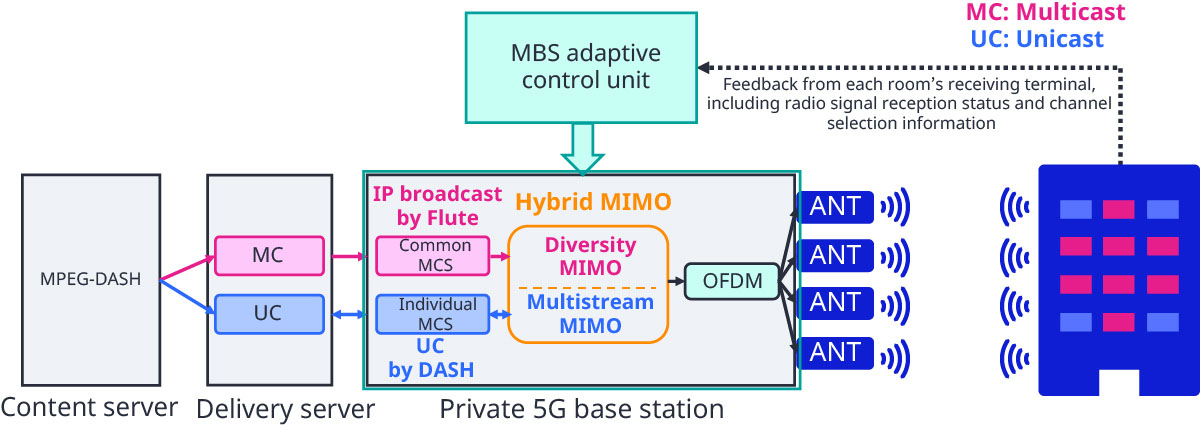
In Release 17, the 3rd Generation Partnership Project (3GPP), the standardization body for mobile communications, defined multicast and broadcast services (MBS) as part of 5G multicast and broadcast specifications. MBS is recognized as a technology that can dramatically improve network utilization efficiency compared to conventional unicast transmission, and is particularly well-suited for delivering 4K and 8K video content to a large user base. Building upon these MBS specifications, the authors propose an adaptive MBS system, shown in Fig. 1, which further enhances bandwidth efficiency and error resilience from the application layer perspective.
 Click to Enlarge
When distributing video over private 5G networks, reception conditions vary among apartment complexes and households in remote areas served by shared reception facilities. This results in differences in the modulation and coding scheme (MCS)—a combination of modulation format and coding rate—assigned to each household. In multicast video transmission, the MCS must be set to accommodate the worst-case household in terms of reception conditions, meaning even households with favorable reception are forced to use a lower, suboptimal MCS, resulting in reduced throughput and lower network utilization efficiency.
To address this, the adaptive MBS system sets an MCS threshold. Households with conditions below this threshold receive unicast transmission via TCP, which supports retransmission, while multicast delivery is applied only to households whose MCS meets or exceeds the threshold. This enables multicast transmission at higher MCS for households with good reception conditions, and tailored unicast delivery for those with poor reception, thus improving overall network utilization efficiency. Furthermore, by feeding back radio signal reception reports and channel selection information from each household’s terminal to upper layers, the system can dynamically switch from multicast to unicast in cases of reception errors caused by fading or other channel impairments, ensuring stable video delivery.
3. Hybrid MIMO
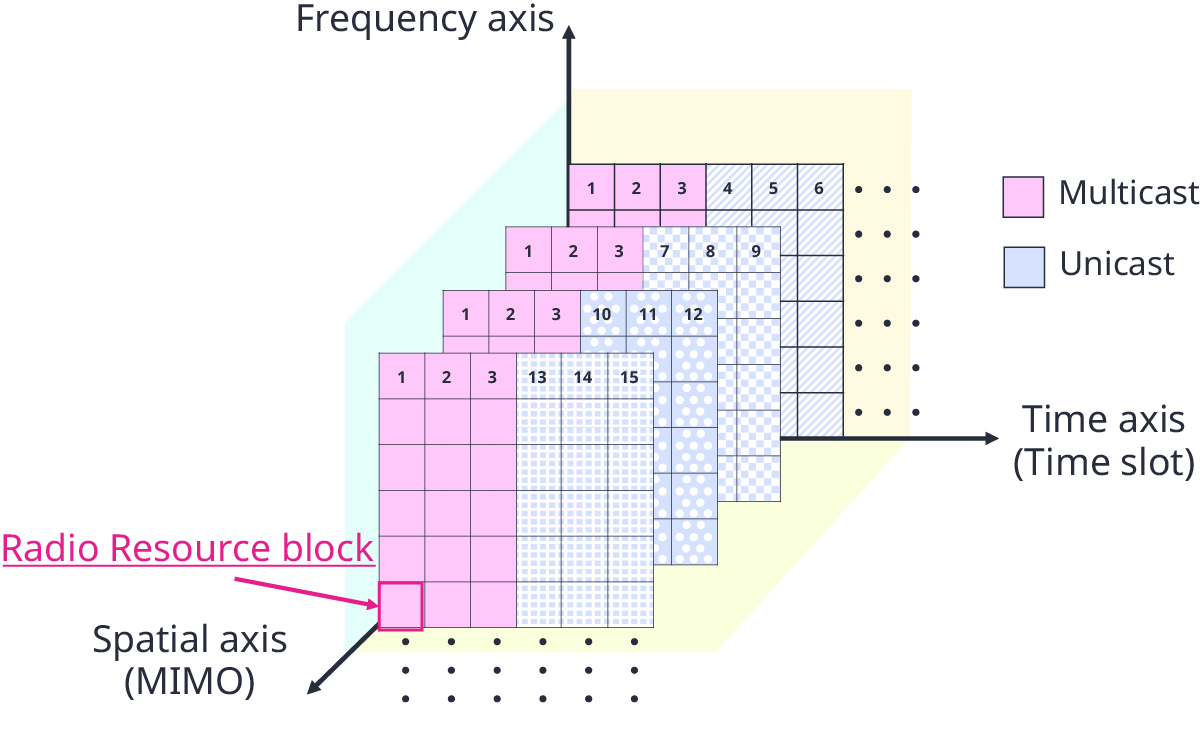
In the adaptive MBS system, the optimal transmission method is selected based on reception conditions and viewing status. Households with favorable reception are served via multicast UDP communication, while those with poor reception or single-channel viewers are addressed with unicast TCP communication, thereby enhancing network utilization efficiency. To further improve the efficiency of adaptive MBS, this section describes the hybrid MIMO approach. Fig. 2 illustrates the concept of hybrid MIMO, where the vertical axis represents frequency, the horizontal axis represents time, and the depth axis denotes the MIMO layers. Each block in the diagram depicts a radio resource block, the smallest unit of data exchange between the base station and terminals in wireless communications.
 Click to Enlarge
With multicast delivery over UDP, retransmission is not possible when data is lost due to poor reception conditions. Conversely, unicast delivery requires communication with households experiencing challenging reception, and when the MCS is notably low, the transmission bit rate becomes insufficient for video streaming. In the hybrid MIMO scheme, diversity MIMO is applied to multicast delivery by transmitting identical data streams from each antenna, improving robustness against reception errors. For unicast delivery, multi-stream MIMO is implemented, where different data streams are transmitted from each antenna, allowing the transmission bit rate to increase up to the number of MIMO layers. Furthermore, when providing services such as Internet access, multi-stream MIMO is used to improve transmission rates.
4. Simulation Evaluation
4.1 Simulator for apartment complexes
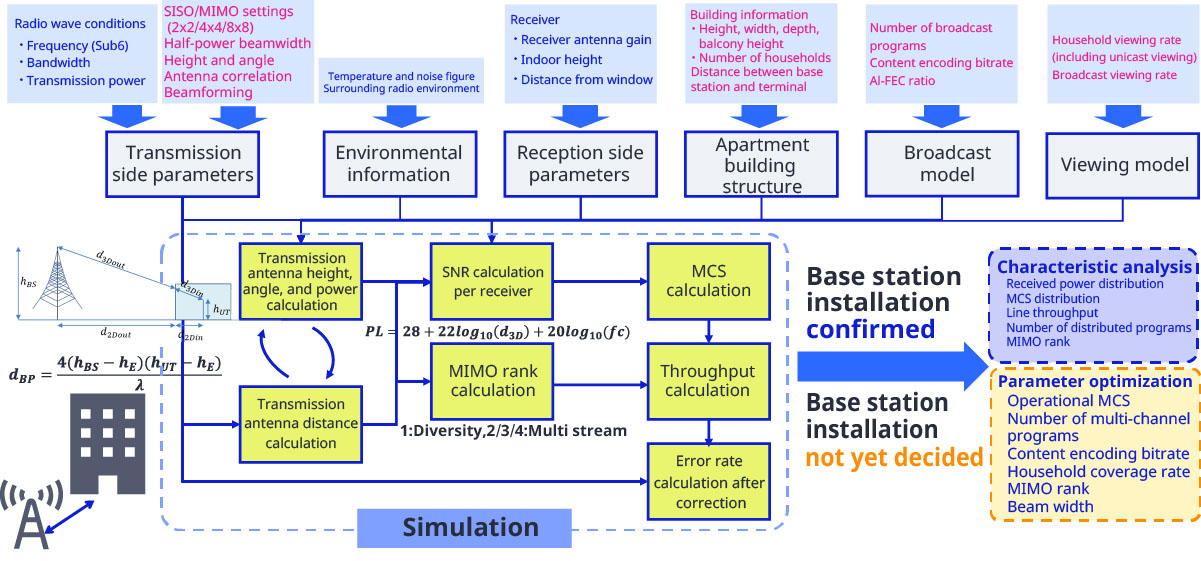
We developed a radio wave propagation simulator to model the multiplexed transmission of multicast and unicast streams via hybrid MIMO for apartment complexes. A conceptual overview is shown in Fig. 3. The input parameters for the simulator include transmission parameters on the base station side, environmental information such as temperature, reception parameters on the terminal side, apartment complex structural parameters such as the number of households and floors, broadcast parameters such as the number of programs and video quality, and viewing parameters including the households receiving broadcasts. The output parameters generated by the simulation include wireless characteristics such as received power, signal-to-interference-plus-noise ratio (SINR), and the distribution of modulation and coding schemes (MCS) across households. In addition, the number of remaining radio resource blocks is defined as the total number of radio resource blocks minus those consumed by each delivery method (adaptive MBS, multicast distribution, and unicast distribution), and this is used as an indicator of network utilization efficiency. Through these simulations, it is possible to optimize the MCS threshold for switching between multicast and unicast in adaptive MBS, the multicast household coverage rate, and verify network utilization efficiency by using parameters such as the number of programs and the number of households for both multicast and unicast distribution.
 Click to Enlarge
4.2 Simulation results
For the simulation input parameters, the transmit power was set to 0.5 W, and the distance between the base station and terminals was 100 meters. The apartment complex was modeled as a 10-story building with 10 units per floor, for a total of 100 households. The encoding bit rate for 4K broadcasting was set to 10 Mbps, and the number of broadcast programs was set at 10. Details of the parameter settings are presented in the Table. Based on these settings, we compared network utilization efficiency—measured by the number of remaining radio resource blocks—for each transmission method (adaptive MBS, multicast delivery, and unicast delivery), with MIMO configurations set to single-input and single-output (SISO) and 4×4 MIMO, and the number of viewing households varied from 10 to 90 in increments of 10.
Table Simulation Input Parameters.
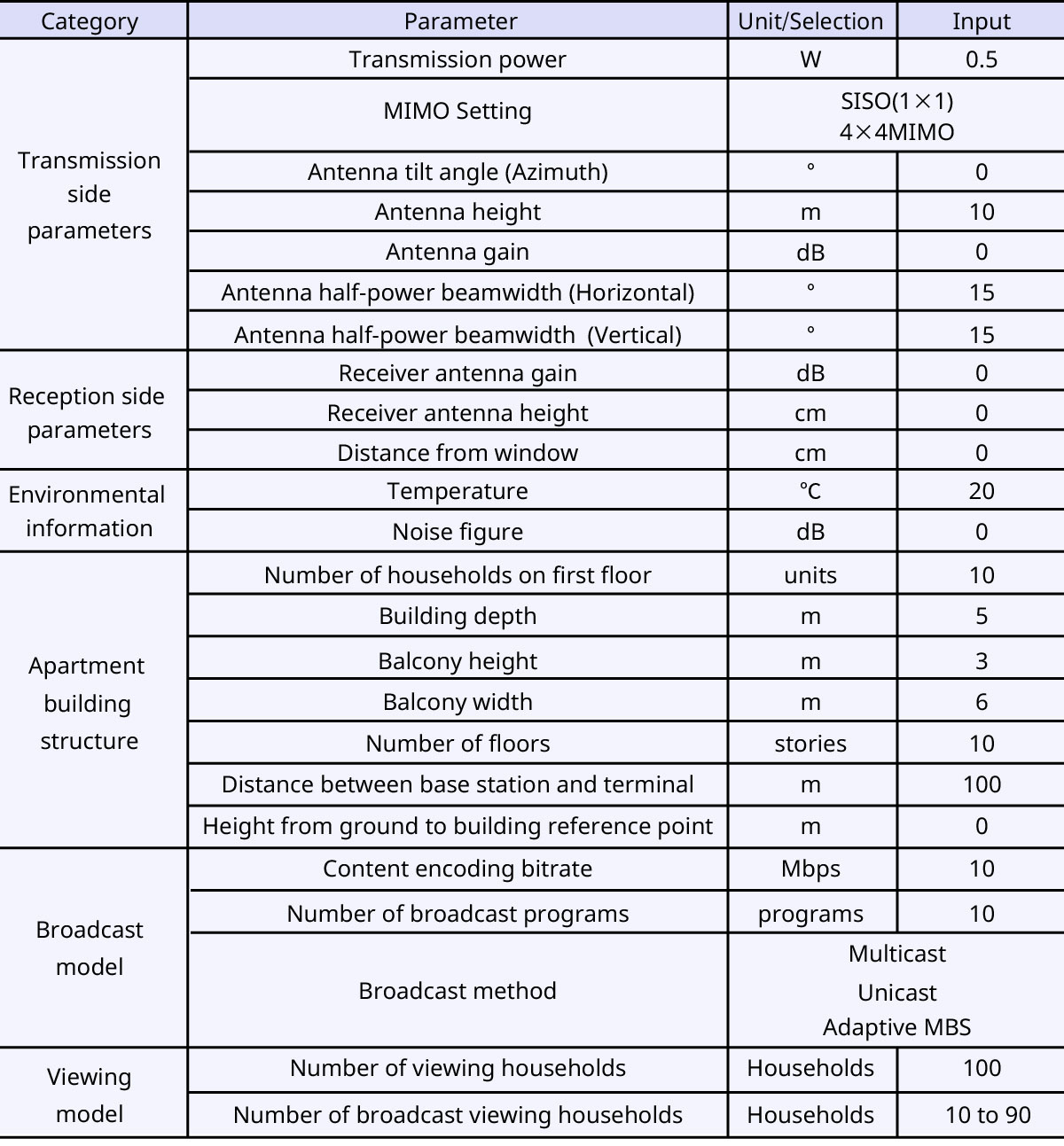
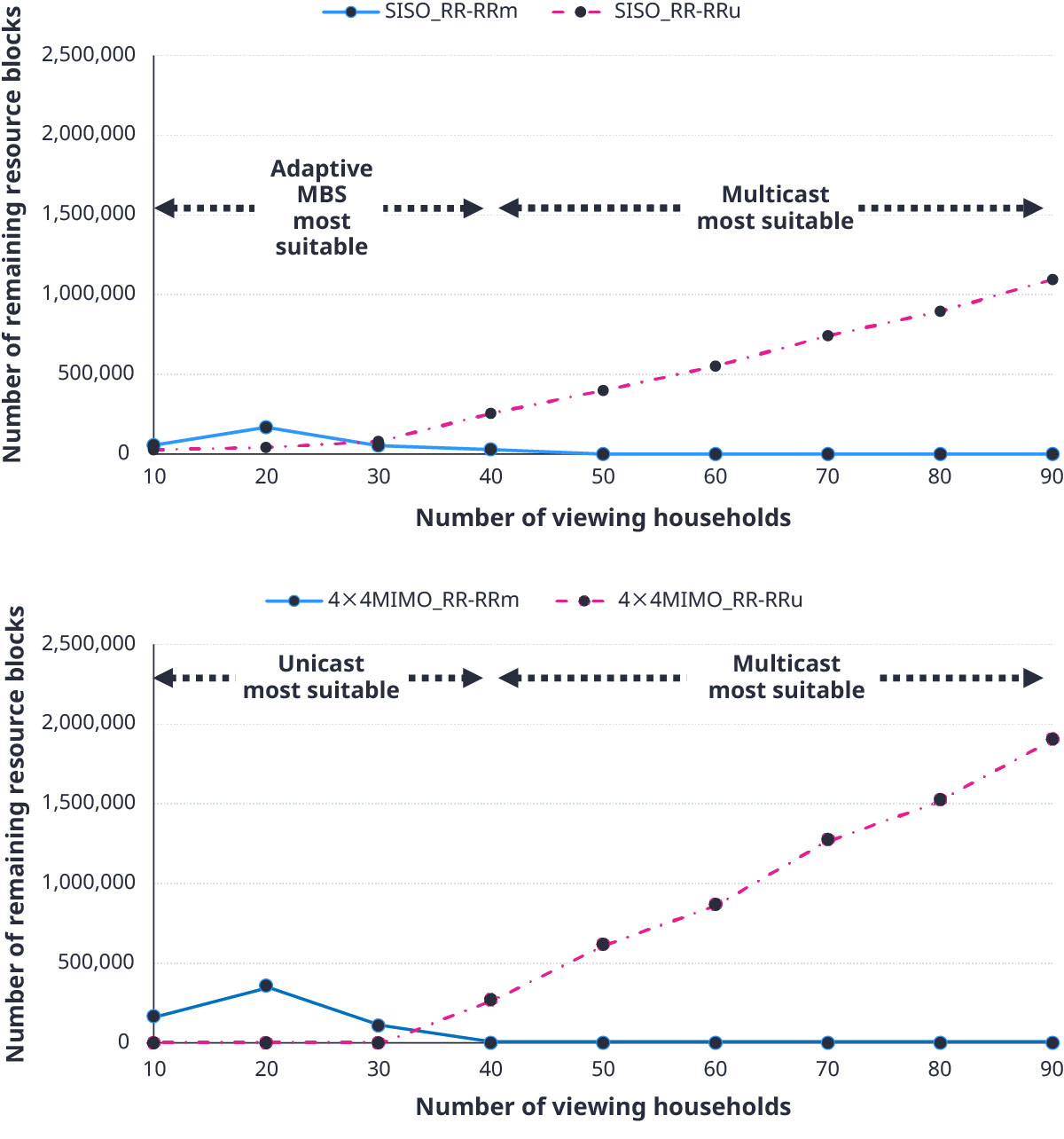
Fig. 4 shows the characteristics of the remaining radio resource blocks for SISO and 4×4 MIMO configurations under the conditions specified in the table. The vertical axis represents the number of remaining radio resource blocks, and the horizontal axis represents the number of viewing households. The blue line indicates the difference in remaining radio resource blocks between adaptive MBS and multicast delivery (RR-RRm), and the red line shows the difference between adaptive MBS and unicast delivery (RR-RRu). Higher values indicate that adaptive MBS is more effective than multicast or unicast delivery, respectively.
 Click to Enlarge
From the SISO results, adaptive MBS is the most suitable delivery method for 10 to 40 households, while multicast becomes optimal above 40 households. In contrast, with the 4×4 MIMO configuration, unicast delivery is most efficient for 10 to 30 households, and multicast is preferable when there are more than 30 households. This is attributed to the increased throughput enabled by multi-stream MIMO, which improves network utilization for unicast delivery when the number of viewing households is small.
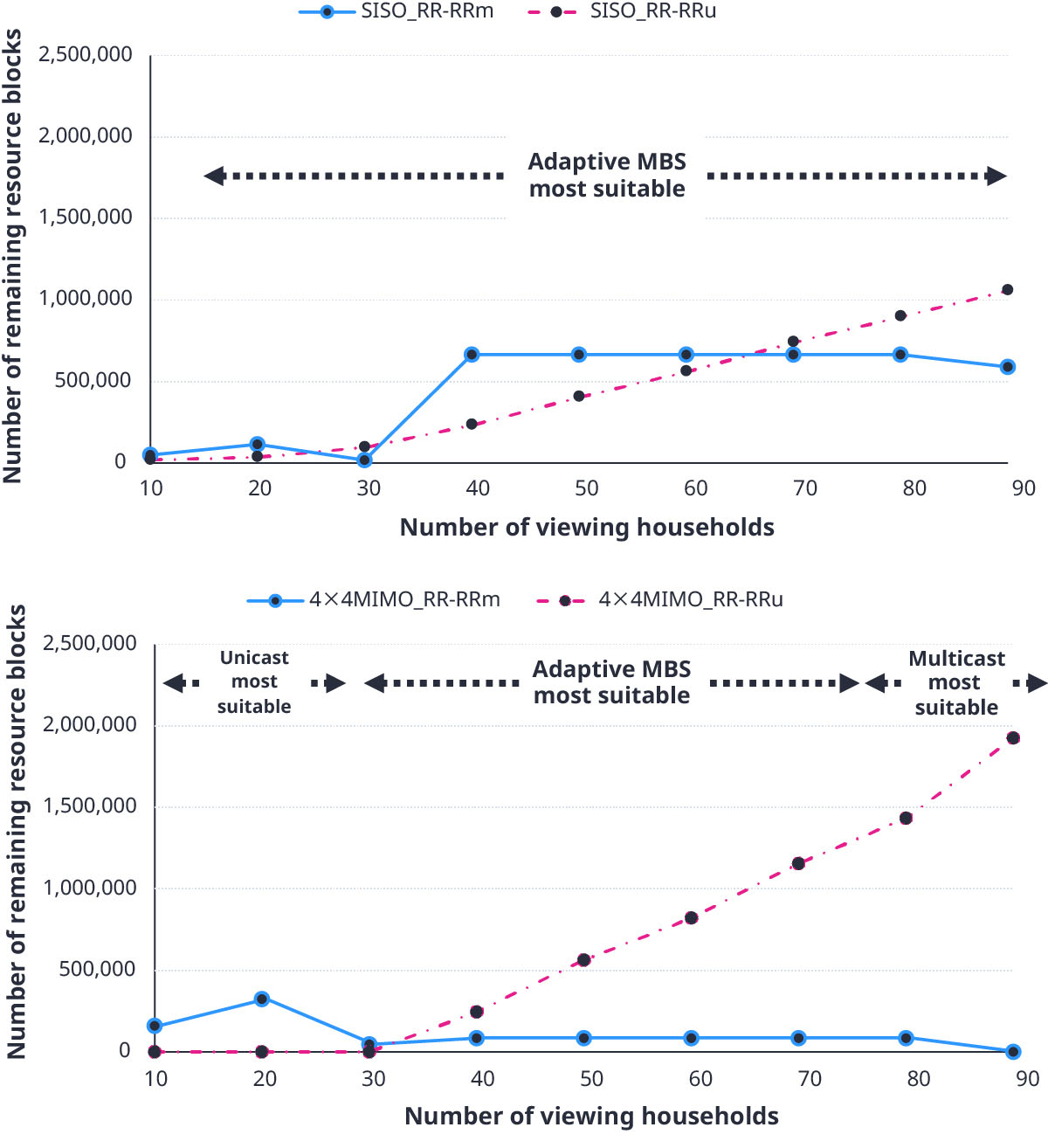
Additionally, we conducted simulations under degraded reception conditions by introducing a 3 dB attenuation to the first floor of the apartment complex, based on the parameters used in Fig. 4. Fig. 5 presents the remaining radio resource block characteristics under these conditions. Under degraded reception, adaptive MBS demonstrates a marked advantage over both multicast and unicast in both SISO and 4×4 MIMO configurations. This is because the degraded reception on the first floor leads to lower MCS values for those households, increasing the disparity in MCS across households. As a result, the efficiency of multicast delivery decreases, highlighting the effectiveness of adaptive MBS in such environments.
 Click to Enlarge
5. Conclusion
This paper has presented adaptive multicast and broadcast service (MBS) technology utilizing private 5G for cable television IP broadcasting, and introduced the results of radio wave propagation simulations conducted using an apartment complex model.
By combining adaptive MBS—which dynamically switches between multicast and unicast delivery based on reception conditions and viewing patterns—with hybrid MIMO, which enhances the robustness of multicast and increases the transmission bit rate of unicast, we further enhanced overall network utilization efficiency.
Simulation results confirmed that the combined use of adaptive MBS and hybrid MIMO is particularly effective in scenarios where there is significant variability in reception conditions among households within apartment complexes.
6. Acknowledgments
This paper includes outcomes of the research project, Research and Development for Expansion of Radio Wave Resources (JPJ000254), commissioned by the Ministry of Internal Affairs and Communications
References
- 1)
- 2)
- 3)
 Benjebbour Anass: Evolution of MIMO Technology in Mobile Communication Systems, The Journal of The Institute of Image Information and Television Engineers, Volume 70 Issue 1, pp.28-34, 2016 (Japanese)
Authors’ Profiles
KITANO Hikaru
System Engineering Services Business Unit
NEC Networks & System Integration Corporation
System Engineering Services Business Unit
NEC Networks & System Integration Corporation
ITO Hiroshi
Assistant Manager
System Engineering Services Business Unit
NEC Networks & System Integration Corporation
Assistant Manager
System Engineering Services Business Unit
NEC Networks & System Integration Corporation
MATSUMOTO Shuichi
Chairman
Japan Cable Laboratories
Chairman
Japan Cable Laboratories