Global Site
Displaying present location in the site.
Promoting Modernization Through the Latest Technology and Next-Generation Models for IT Operations
Vol.19 No.1 Special Issue on NEC BluStellar: NEC BluStellar Driving the Future of Digital Transformation — A Value Creation Model Pioneered by AI, Security, Data Management, and ModernizationThis paper reports on the modernization of internal systems using the latest technologies, such as Google Cloud, as well as the status of the IT operational reforms accompanying this modernization. Through the unification of operational platforms and the automation of business processes, we were able to improve business efficiency and early detection of issues with visualization initiatives utilizing IT dashboards aimed at all employees. Additionally, the implementation of generative AI and agentic AI is paving the way for operational autonomy and a No Operations (NoOps) model. Moving forward, the development of personnel and strengthening governance will be crucial challenges for the sustainable advancement of these initiatives.
1. Introduction
In recent years, the rapid advancement of digitalization has pushed corporate information systems beyond the traditional goals of greater efficiency and cost reduction. Today, there is a demand for flexibility and agility in order to swiftly respond to change, as well as sophisticated strategic capabilities to support business transformation. Legacy systems that are primarily on-premises have increasingly become obstacles to business activities due to their complexity, aging, and the fact that they lack transparency and are becoming so-called “black boxes.” Globally, digital transformation (DX) has been positioned as the key to corporate growth, and at the core of DX, modernization, which is essentially revamping existing system, and fundamentally reviewing IT operations are essential.
This paper discusses actual examples and future outlooks of our transformation to the latest IT operation models, including the migration of internal systems to the cloud using Google Cloud as a base, operational DX measures, the unification of operational platforms into a digital-native operating model, the visualization of operational status, and the adoption of AI technologies for autonomous operations referred to as “No Operations (NoOps, hereafter).”
2. Significance of Promoting Modernization and an Overview of the Latest Technology
In today’s business environment, it is essential to move away from legacy systems and enhance agility and security. The implementation of Google Cloud, AWS, Azure and other cloud platforms has enabled improved system scalability and reliability. Modernization aims to make business processes more flexible and strengthen security, and at NEC, by establishing an internal DX platform, we are striving to improve managerial agility and sustainability, aiming to maintain and strengthen competitiveness in a rapidly changing market environment.
2.1 Latest case study of cloud platform migration and its effects
We adopted a multi-cloud approach in the modernization of our internal systems by utilizing several cloud services, such as Google Cloud, AWS, and Azure. Additionally, we implemented the 6R strategy—Retire, Repurchase, Re-architect, Re-platform, Rehost, and Retain—to classify and optimize existing systems. As a result, we were able to improve the flexibility and sustainability of our internal systems, leading to reduced operational costs and increased business efficiency.
2.2 Specific example of modernization at NEC
- (1)Migration of core systems to the cloud: By adopting RISE with SAP for our core systems and moving them to SAP’s cloud ERP, SAP S/HANA Cloud, running on AWS, we have significantly reduced operational costs and improved system availability.
- (2)Rapid migration to a virtual platform: 490 virtual machines (VMs) that had been running on-premises were fully migrated to VMware on AWS (VMC) in just 70 days, resulting in a 90% reduction in migration costs and a 20% reduction in platform costs.
- (3)Promotion of AI and Software as a Service (SaaS) utilization: By proactively adopting Google Cloud, promoting the utilization of AI, and leveraging various SaaS applications internally, we have enabled rapid business decision-making and strengthened our competitiveness.
2.3 Structure and governance for promoting modernization
In order to promote this initiative sustainably, it is essential to strengthen both the system of promotion and governance. In particular, technology selection, migration planning, and project management are key factors. At NEC, we have established the utilization of SaaS and common services as our basic policy, and we are building an optimized overall architecture. In addition, by applying standardized operational processes and introducing integrated monitoring tools, we are working towards improving operational efficiency and strengthening governance.
3. Operational DX Measures and the Unification of Operational Platforms (Digital-Native Operation Model)
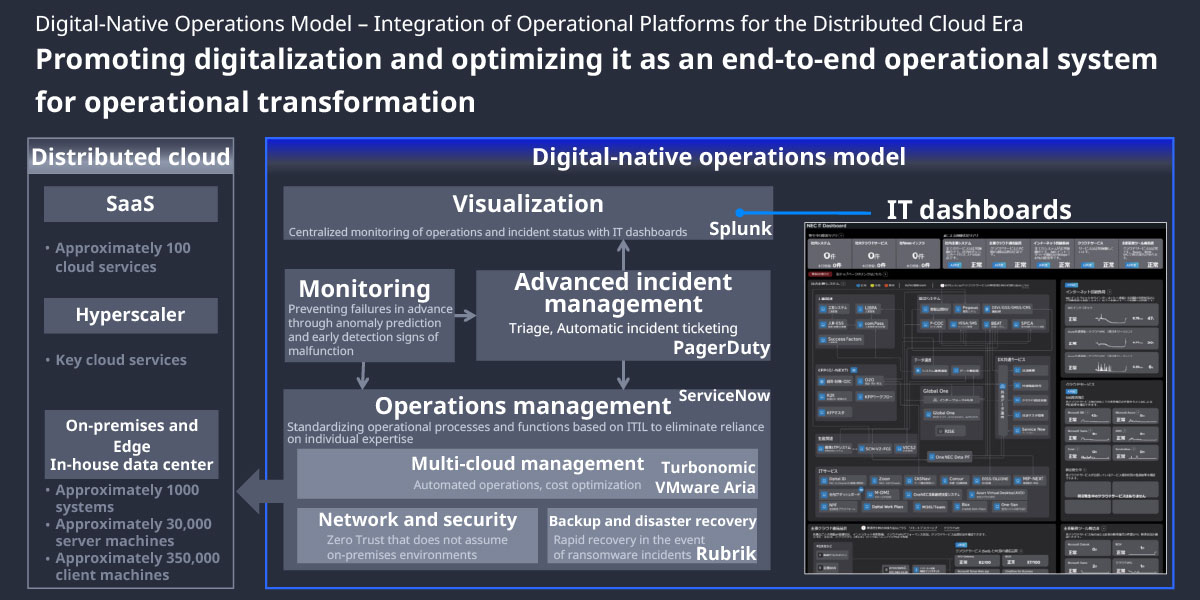
In order to achieve a sophisticated IT operational model through cloud migration, it is essential not only to revamp technologically, but also to transform business processes and organizational structures. The digital-native operation model refers to the unification of business systems that were conventionally designed and operated individually by each business unit onto a single common platform. This aims to reduce operational costs and workload, and strengthen governance (Fig. 1).
 Click to Enlarge
3.1 Standardization and automation of operational processes
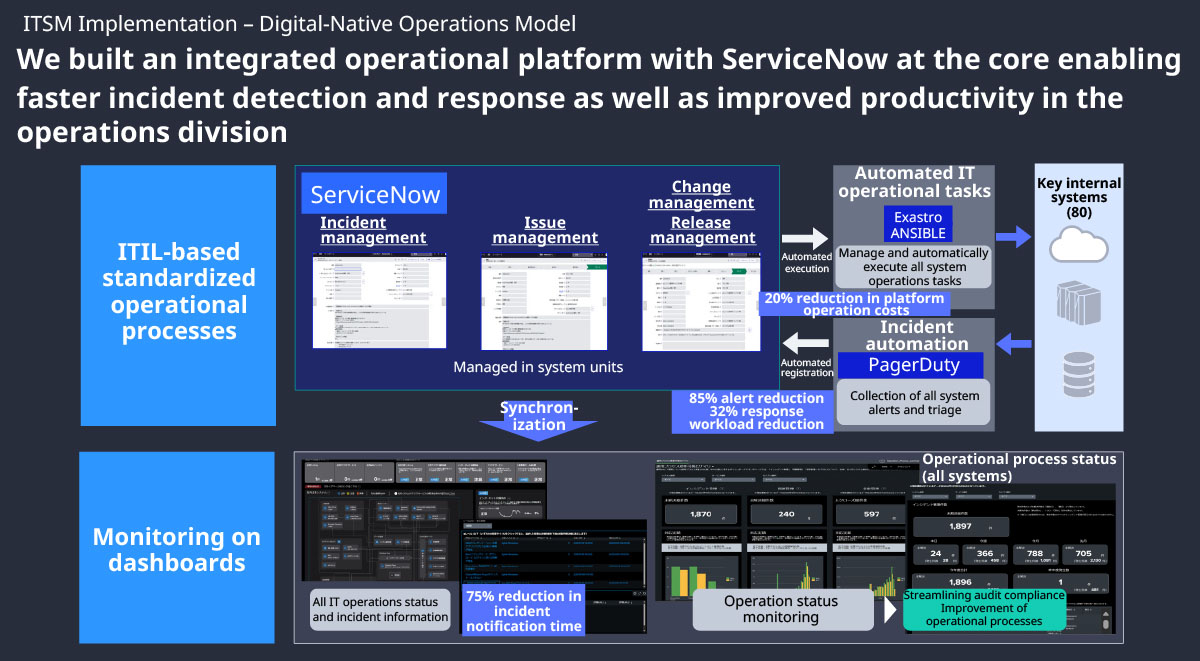
At NEC, to promote the standardization of operational processes, we have leveraged ServiceNow to establish company-wide operational process standards. This has unified the flow of operational procedures and approvals that once differed between departments, resulting in strengthened governance across the entire company and improved work quality. Furthermore, by integrating with a common automation platform, we have introduced a system where tasks approved through change management on ServiceNow can be automatically executed by the automation platform. Through these efforts, we expect a significant reduction in errors during manual operations and a substantial improvement in business efficiency.
3.2 Cross-departmental visualization of operational data and enhanced collaboration between business systems
Based on the standardized operational processes, we have established a system for collecting operational data across business units and centrally visualizing and analyzing it (Fig. 2). This enables us to monitor the operational status of each business system in real time and visualize overall trends and bottlenecks on a dashboard. Leveraging such cross-departmental data utilization has accelerated the streamlining of business processes and the improvement of operational issues, resulting in enhanced synergies between business systems across different business units.
 Click to Enlarge
3.3 Operational efficiency and organizational benefits
Implementing tools to automate and standardize operational processes has freed operations staff from routine tasks, and they are now able to focus on higher added value work, such as problem solving and proposing new services. Additionally, operational know-how, which tended to be dependent on individuals, is increasingly being systematized in a knowledge base, leading to an overall improvement in operational capabilities across the company.
4. Operational Status Visualization and Impact on Organizational Transformation
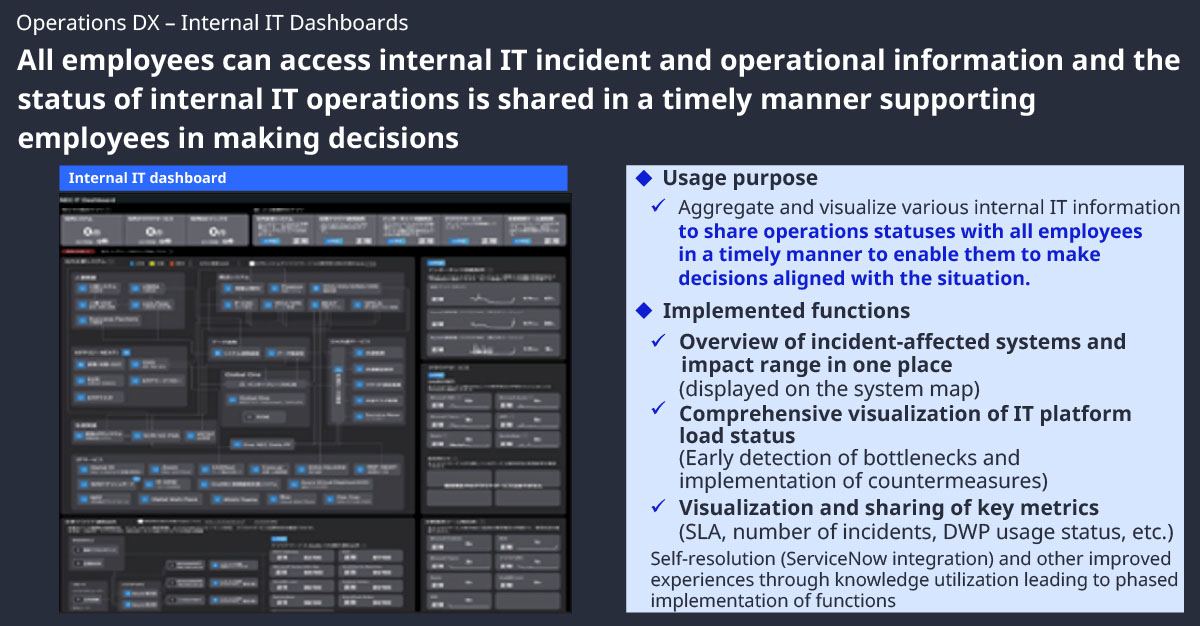
In parallel with the unification of operational platforms, we also focused on the visualization of the IT operational status in real-time. The most prominent initiative was the unveiling of IT dashboards for all employees (Fig. 3). Doing so established an environment in which our 110,000 employees can reference information such as the operational status of NEC systems, incident information, and resource usage at any time. As a result of this initiative, organization-wide improvement activities based on visualization have accelerated, and the following effects have been observed.
 Click to Enlarge
4.1 Improved transparency and frontline-driven issue identification
Making information that had previously been confined within the IT division visible to the entire company, enabled frontline staff to have an immediate understanding of the status of the systems they use along with any issues that may arise in those systems. Users are now proposing specific improvements directly, creating a foundation for the entire organization to address operational challenges together.
4.2 Organizational culture transformation and improved engagement
The visualization of numerical data and statuses has fostered a culture where frontline staff and the IT division work together to resolve issues. This has served to spread awareness that IT operations are not simply back-office tasks, but rather that they are critical corporate activities in which all employees participate.
4.3 Concerns and countermeasures
On the hand, concerns were raised about confusion caused by information overload, as well as risks of information leaks and security. To address these issues, we overcame governance challenges by refining access permissions, anonymizing the dashboard, and strengthening monitoring of usage logs. Additionally, by combining phased disclosure of information with IT literacy education, we are working to improve the information utilization skills of all employees.
5. IT Operations Automation with Generative AI and Agentic AI and the Future NoOps Model
Since 2023, the wave of business automation brought about by generative AI and agentic AI has had a major impact on IT operations. AI technology has become the core of automating operations, and a new style of collaboration between humans and AI is beginning to emerge.
5.1 Generative AI usage status
Generative AI is now being routinely used in IT operations. Specifically, its implementation is advancing in the performance of various tasks, such as automatic generation of reports and knowledge articles when issues occur, creating and updating FAQs and operational manuals, and automated responses to inquiries via chatbots. Using AI to extract and summarize the key points from the enormous incident histories generated by companies—which traditionally relied on manual labor--has made sharing insights and the accumulation of knowledge dramatically more efficient.
5.2 Advances in automated responses through agentic AI
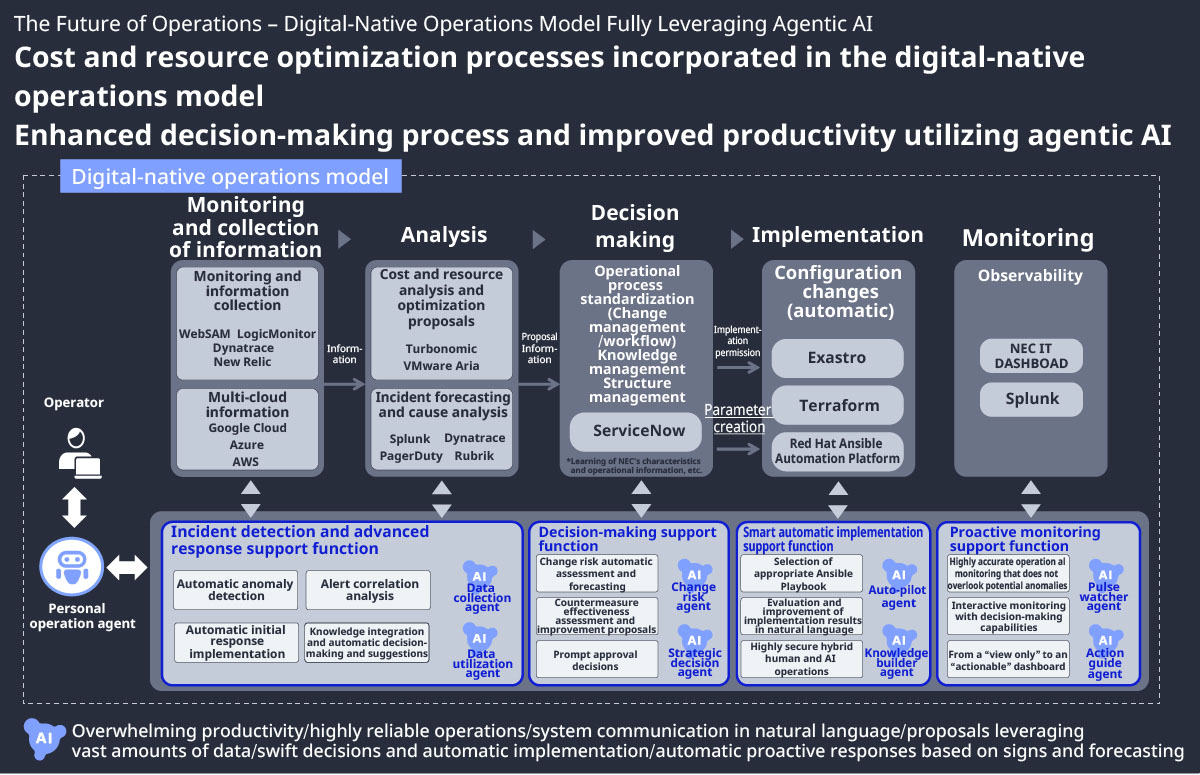
Agentic AI automatically detects anomalies in system logs and monitored data and performs initial responses and remediations. Tasks such as resource scaling, server reboots, and notifications when incidents arise are also AI driven, significantly streamlining the entire workflow from monitoring to incident response. In addition, agentic AI advances overall operational management optimization by enabling forecasting of operational status, automated creation of incident tickets when anomalies occur, and progress management (Fig. 4).
 Click to Enlarge
5.3 Realization of the NoOps model and future challenges
The NoOps model refers to minimizing human intervention and establishing an autonomous operational system using AI and other technologies. Critical challenges in achieving this include highly reliable autonomous judgement and response by AI, as well as accountability for the decision-making process. At present, there are still many unresolved issues, such as explaining the evidence AI uses to make decisions, flexible response to irregular incidents, and countermeasures against an overload of alerts. Therefore, IT operations departments need to foster personnel who are well-versed in both AI and operational tasks, improve machine learning models, and strengthen operational governance frameworks. To realize NoOps, it is essential to promote automation in stages, harmonize with on-site operational processes, and establish AI utilization policies that provide accountability.
6. Conclusion and Future Outlook
In this paper, we introduced practical examples of modernization utilizing Google Cloud, the transformation of IT operations using a unified platform, the advancement of DX initiatives, and future perspectives on AI technology and the NoOps model. Through these efforts, the role of operations personnel is changing significantly—from simple system maintenance and management to driving business transformation and creating value for customers with technology. In particular, with the advancement of AI-driven automation, IT operations are expected to become even more efficient, higher in quality, and increasingly value-added in the future.
Meanwhile, as AI-driven operations automation progresses, issues such as training new personnel, operations governance, ensuring accountability and transparency, and improving digital literacy among all employees have become increasingly apparent. Moving forward, transformation to an operational culture that includes all employees and integrates frontline departments, IT departments, management, and AI will be necessary along with fostering talent and building a platform that enables both continuous technology innovation and autonomous operational capabilities.
IT operations in the future will require the ability to quickly adapt to rapid technological advances and flexibly respond to changes in management. It is our hope that this paper will serve as a guide for the large number of companies aiming to promote modernization and put next-generation IT operations models into practice.
Trademarks
- *Google Cloud is a trademark or registered trademark of Google LLC.
- *Amazon Web Services and other AWS trademarks are trademarks of Amazon.com, Inc. or its affiliated companies in the United States and other countries and regions.
- *Azure is a trademark or registered trademark of Microsoft Corporation.
- *SAP, the SAP logo, and all SAP product and service names mentioned are registered trademarks of SAP SE in Germany and other countries around the world.
- *VMware is a registered trademark or trademark of VMware, Inc. in the United States and other regions.
- *ServiceNow is a trademark or registered trademark of ServiceNow, Inc. in the United States and other countries.
- *All other company and product names that appear in this paper are trademarks or registered trademarks of their companies.
Authors’ Profiles
TAKATSU Masaaki
Senior Professional
Infrastructure Operations Department
Senior Professional
Infrastructure Operations Department
TSUJIKAWA Yousuke
Director
Infrastructure Operations Department
Director
Infrastructure Operations Department