Global Site
Displaying present location in the site.
Latest Developments in NEC Quantum Cryptography Technology
Vol.19 No.1 Special Issue on NEC BluStellar: NEC BluStellar Driving the Future of Digital Transformation — A Value Creation Model Pioneered by AI, Security, Data Management, and ModernizationThis paper outlines recent developments in NEC’s quantum cryptography technology. For roughly 20 years, NEC has been a research and development leader in this field and is the only company in Japan working on both the BB84 protocol—already in practical use—and the CV-QKD protocol which is expected to reduce costs. Achievements include demonstration experiments of low-latency, large-volume quantum cryptographic data transmissions in financial transactions and the world’s first successful demonstration of quantum token issuance. These developments are raising expectations that quantum cryptography will become a foundational technology supporting future digital transformation (DX). As a technology that enables secure and reliable data exchange, quantum cryptography is anticipated to be initially adopted in mission‑critical fields such as finance and government, with gradual expansion into a wide range of industrial sectors. This paper outlines the features and advantages of NEC’s quantum cryptography technology, application examples, current challenges and countermeasures, as well as future prospects.
1. Introduction
In recent years, as our data‑driven society has advanced, industries and the essential infrastructure of daily life have become increasingly dependent on networks. Ensuring the security of communications involving national institutions—such as financial transactions, administrative services, and medical data management—has become a critical issue that impacts social stability. However, modern cryptography schemes, including the widely used RSA encryption, are becoming increasingly vulnerable to cryptanalysis with the advent of quantum computers. In particular, the risk of “Store Now, Decrypt Later” attacks—where data is stolen today and decrypted in the future—has become a realistic threat, making it urgent to establish technologies capable of ensuring secure communications over the long term.
Against this backdrop, international attention is focused on post-quantum cryptography (PQC) and quantum key distribution (QKD), which are considered information-theoretically secure based on the principles of quantum mechanics, and also on quantum cryptographic communication using these keys. Wide-area quantum network build-out is underway in Europe and China; while in Japan, national projects led primarily by the Ministry of Internal Affairs and Communications and the National Institute of Information and Communications Technology (NICT) are actively driving research, development, and demonstration trials.
NEC has more than 20 years of research and development experience in this field and is the only company in Japan working on both the Bennett-Brassard 84 (BB84) protocol—already in practical use—and continuous-variable quantum key distribution (CV-QKD) protocol which is expected to reduce costs. This paper outlines the features and advantages of NEC quantum cryptography technology, application cases, challenges, and countermeasures for social implementation, as well as future prospects for the technology.
2. About Quantum Cryptographic Communication
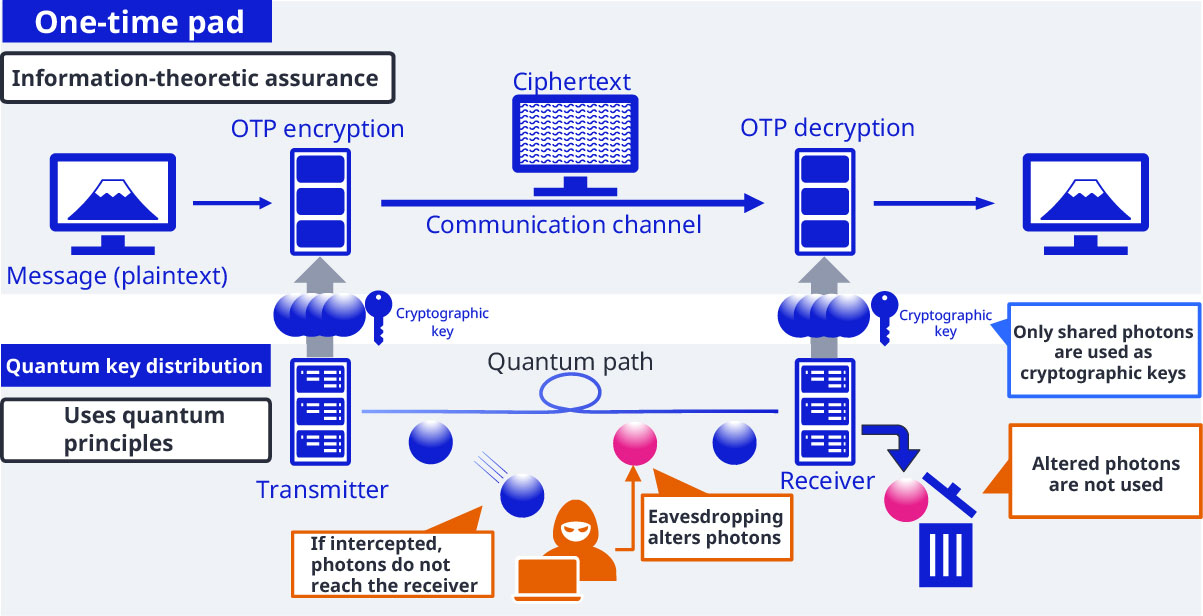
Quantum cryptographic communication consists of two technological elements: QKD and one-time pad (OTP) encryption (Fig. 1).
 Click to Enlarge
QKD is a protocol for securely sharing cryptographic keys (random bit strings) between a transmitter and a receiver by leveraging the quantum properties of light to transmit key information over optical fiber. If an eavesdropper tried to extract photons, these photons do not reach the receiver and cannot be used to generate a valid key. Because any such attempt to observe the photons alters their state, eavesdropping can be detected by an increase in the error rate. This detection capability provides information-theoretic assurance of key confidentiality. Several QKD protocols have been proposed, including the BB84 protocol—a representative discrete-variable approach—and the continuous-variable (CV) protocol that uses the orthogonal phase amplitudes of light. Each has undergone rigorous security analysis.
One-time pad encryption, on the other hand, is a simple and lightweight encryption and decryption method, in which a key of the same length as the plaintext is combined with the plaintext using an exclusive OR operation. The key is discarded after use. This structure enables information-theoretically secure communication.
3. NEC’s Research and Development
3.1 BB84 systems
NEC has been conducting research and development on QKD based on the BB84 protocol, demonstrating its robustness by developing a system that operates at a 1.25-GHz clock rate and remains stable even under harsh conditions. In recent years, NEC has further advanced the technology with a new system operating at a 2.5-GHz clock rate (Fig. 2), achieving twice the key generation speed of previous systems while maintaining the same level of stability.
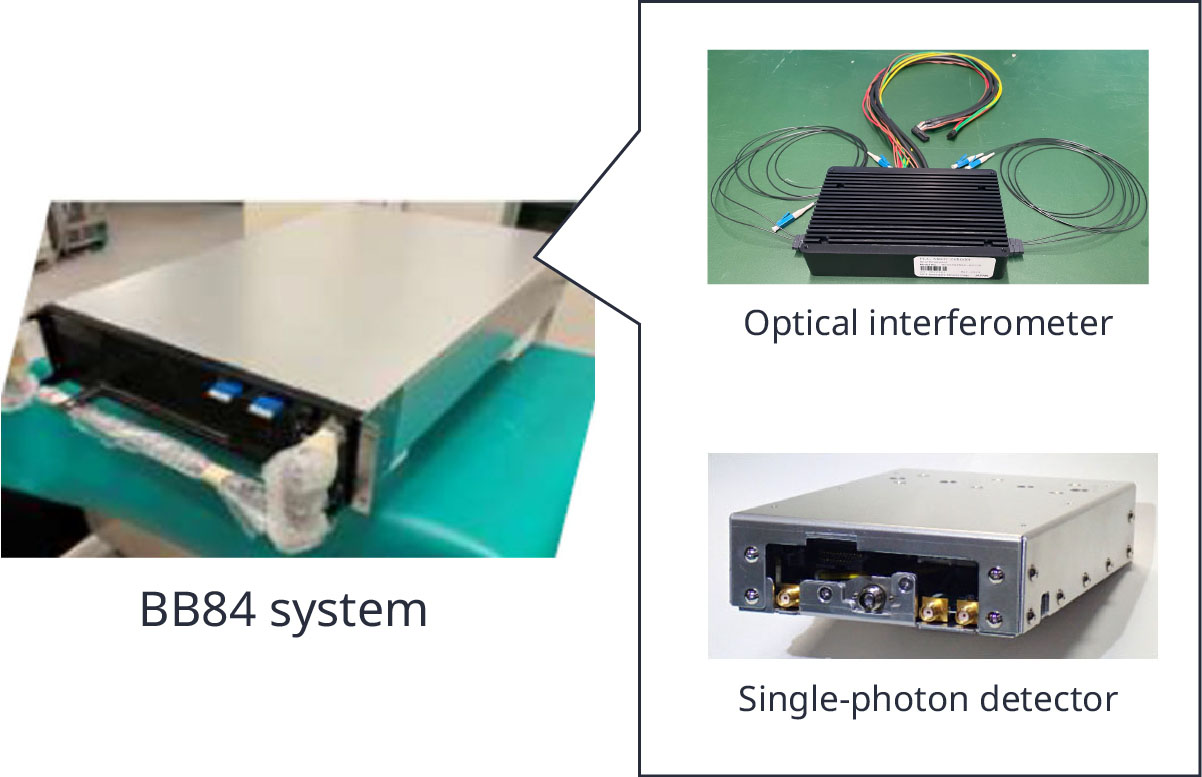
This increase in speed is enabled by a compact, high-performance single-photon detector1) and enhancements to the optical interferometer. By efficiently detecting light while reducing noise and implementing measures to mitigate the effects of temperature and fiber polarization fluctuations, the system now generates keys faster and more reliably than before. In experiments, this system has successfully operated continuously for three hours over a 50-km optical fiber with deliberately induced polarization fluctuations, demonstrating a key generation rate exceeding 200 kbps.2)
These results show that NEC’s BB84 system can achieve both high speed and robustness in real-world environments, representing a significant step toward commercialization.
3.2 CV-QKD system
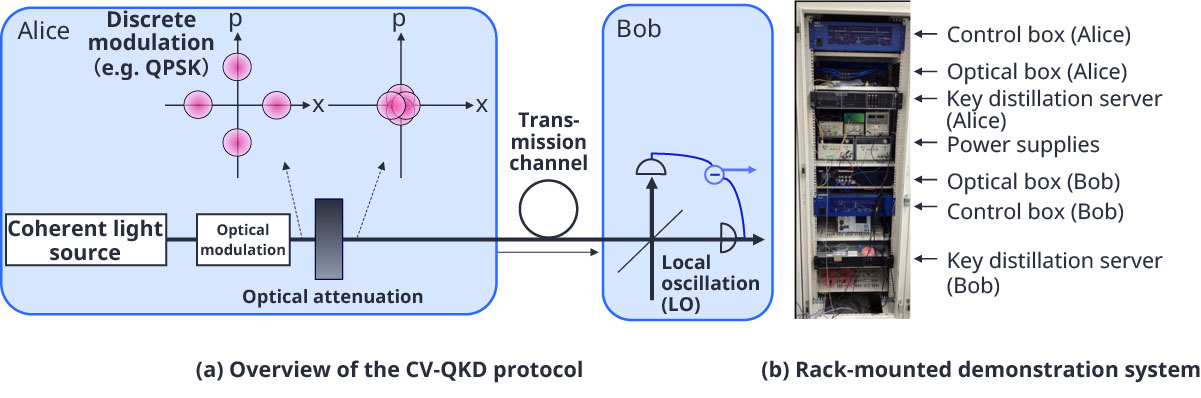
The CV-QKD system can leverage the general-purpose optical transceivers used in high-speed coherent optical communications, enabling a compact and cost-effective implementation. Furthermore, coherent detection is resistant to stray light, making it suitable for multiplexed transmission over the same fiber and wavelength band as data communication optical signals.3) NEC has recognized this practicality and is advancing research and development by applying optical communication technologies that have been developed over many years.
On the transmitter side (Alice), key information is modulated onto the optical quadrature amplitudes and transmitted as a weak light signal. On the receiver side (Bob), the quadrature amplitudes are measured with high precision—close to the quantum noise limit—by interfering the received signal with a local oscillator (LO) light. Due to the overlap of symbol distributions in the weak light regime, it is fundamentally impossible for an eavesdropper to obtain complete information. To achieve reception close to the quantum noise limit, NEC employs a polarization-multiplexed digital coherent transmission scheme, transmitting a reference signal alongside the key information to enable error correction and enhance secrecy, thereby generating a secure final key.4) Furthermore, NEC has developed a demonstration system (Fig. 3) capable of semi-real-time processing from demodulation to final key generation, successfully demonstrating continuous key generation operation.
Future challenges include improving key generation speed through increased processing throughput and realizing compact, low-cost optical transceivers.
 Click to Enlarge
3.3 Integration into optical communication networks
To popularize quantum cryptographic communication, it is essential not only to develop devices but also to build wide-area QKD networks connecting major cities. QKD traditionally relied on dedicated infrastructure using dark fiber, but the high costs of deployment and operation limited to popularization and scalability. In contrast, integrating QKD systems into existing optical communication networks offers a more cost-effective means of achieving wide-area implementation.
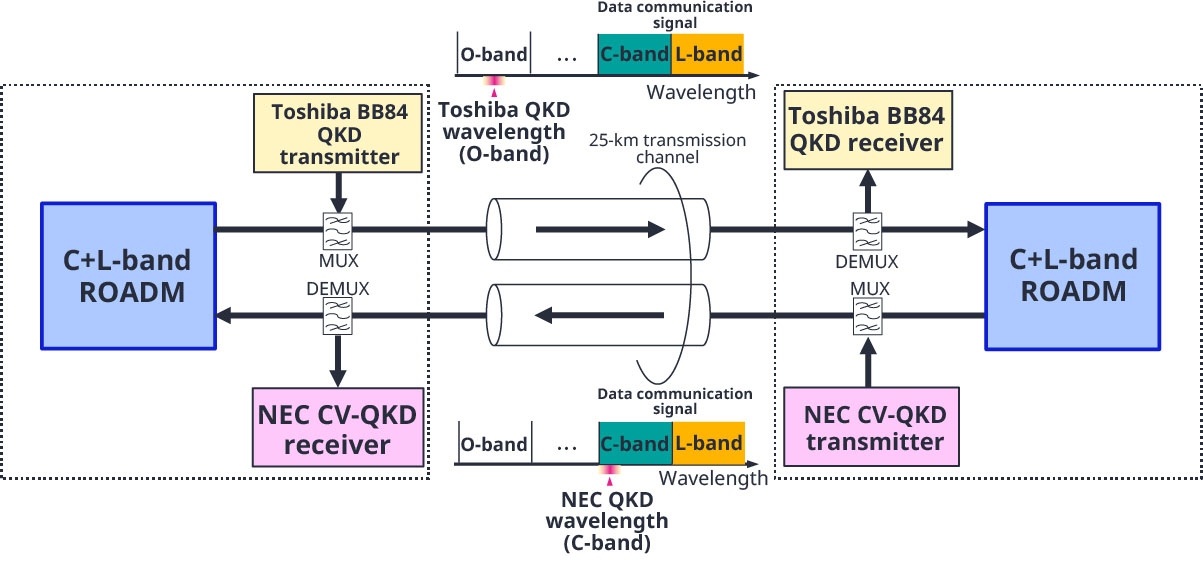
NEC, in collaboration with Toshiba, built a near-real-world configuration using a ROADM system compatible with the C+L wavelength bands to verify the possibility of the coexistence of QKD in a backbone optical network operated by a telecommunications carrier (Fig. 4). QKD signals encrypted with NEC’s CV protocol and with Toshiba’s BB84 protocol, along with their corresponding control signals, were transmitted over two-core optical fibers, each of which was assigned to a different propagation direction. Dummy optical signals for data communication equivalent to 47.2 Tbps were multiplexed, spanning the C and L wavelength bands. As a result, simultaneous generation of encryption keys was achieved over an 8-hour continuous period, and it further demonstrated that real data signals with 400 Gbps and 800 Gbps per wavelength could be transmitted error-free while coexisting with single-photo-level QKD signals.5)
 Click to Enlarge
3.4 Challenges and countermeasures for quantum key distribution
To enable widespread adoption of quantum cryptographic communication, it is not enough for QKD systems to succeed in laboratory experiments; robust mechanisms are also needed to ensure stable, everyday operation in the field. One major challenge is the limitation of key generation speed and communication distance. Optical fiber loss and noise result in reduced key generation rates over long distances, prompting the development of higher-sensitivity optical receivers and similar devices. When connecting a large number of sites, operational measures are also essential for managing the generated keys securely and delivering them safely to applications. Furthermore, to promote adoption while keeping costs low, integrating QKD networks into existing optical communication networks is an effective approach. NEC is actively collaborating with telecommunications carriers and other industry partners to accelerate these efforts.
Through these initiatives, QKD is expected to be applied across diverse fields, including finance and government, with NEC positioned to play a key role in supporting its practical adoption.
4. Status of Social Implementation
NEC’s initiatives go beyond research, with demonstrations being undertaken with a view to real-world application. The following are recent representative achievements.
4.1 Financial transaction demonstration experiment
Five companies—Nomura Holdings, Nomura Securities, NICT, Toshiba, and NEC—collaborated to establish a simulated financial transaction environment on the Tokyo QKD Network. NICT built this test communications network using its QKD devices to emulate investors and a securities company. By using simulated data from actual stock orders, they verified the encrypted communication.
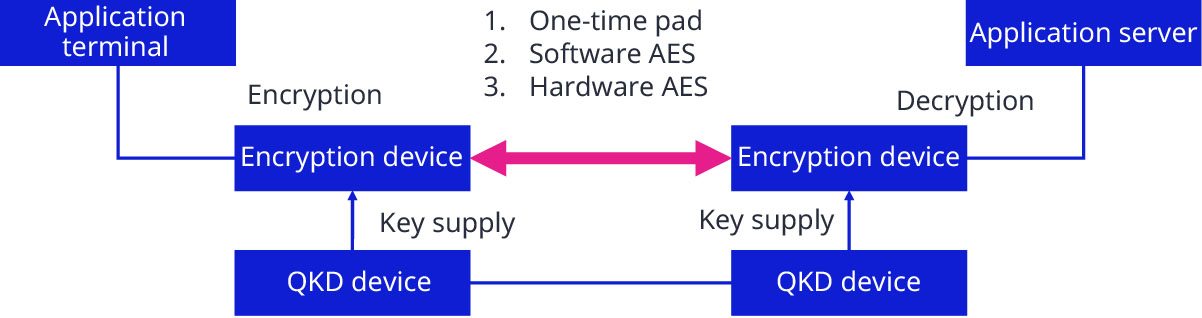
Two encryption methods were used: the one-time pad method (quantum encryption) and the Advanced Encryption Standard (AES) method. Because the one-time pad uses the same amount of encryption keys as those used in transmission, a large number of keys tends to be consumed. To prevent key depletion, AES was used in conjunction with OTP (Fig. 5). Specifically, NICT implemented a one-time pad encryption device, while NEC implemented AES encryption both in software and in hardware. The encryption keys for both methods were supplied by the QKD devices from Toshiba and NEC.
The experiment demonstrated that, using these three encryption methods, communication speeds comparable to those of conventional systems could be maintained even with quantum cryptographic communication. It also demonstrated that high-security, high-speed encrypted communication could be achieved without depleting keys, even when high-volume stock transactions were being conducted.
 Click to Enlarge
4.2 Demonstration experiment highlighting quantum token issuance
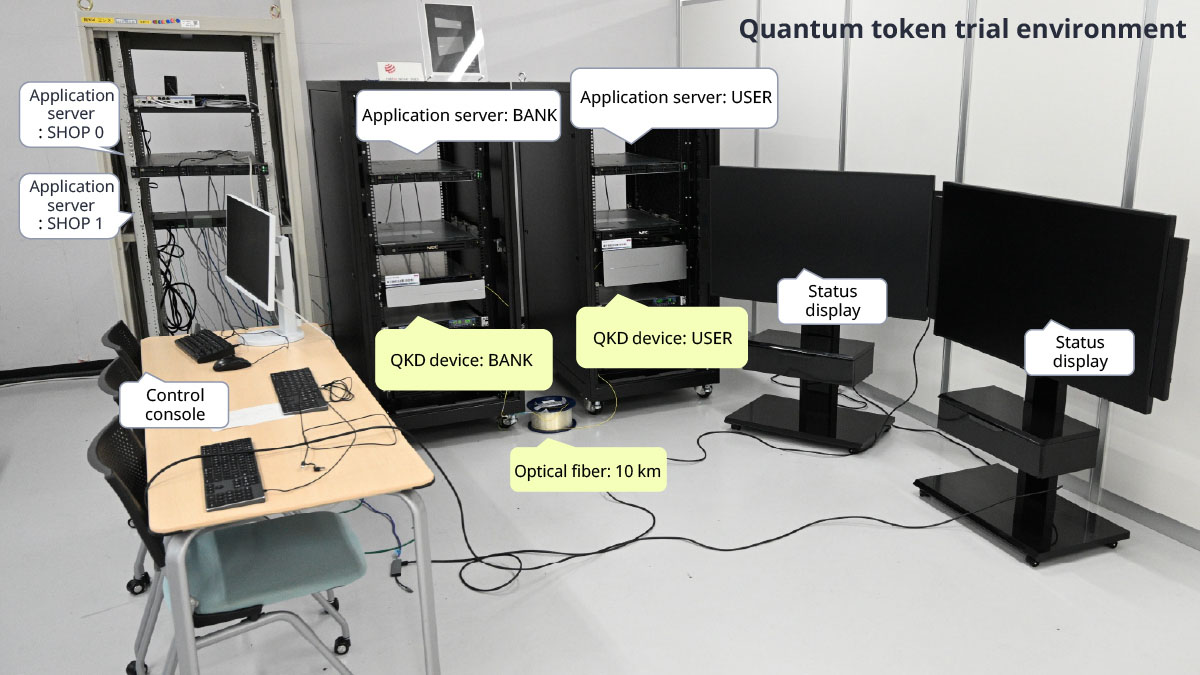
Mitsui & Co., Ltd. and Quantinuum have been working on the practical implementation of unforgeable quantum tokens—leveraging the properties of quantum physics—for which Quantinuum owns the basic patents. While the principles of quantum tokens had been theoretically proven, no verification had been conducted with actual devices. As a new method for applying quantum technology, NEC provided a QKD system suitable for quantum tokens while Quantinuum built an application system that used quantum tokens on a server (Fig. 6). In anticipation of commercialization, the world’s first demonstration of quantum token issuance and redemption was conducted over a 10-km optical fiber in an environment simulating banks, branches, and users. The experiment confirmed that token issuance and redemption could be performed as theoretically predicted.
5. Prospects
As advanced data systems are increasingly integrated into society, greater emphasis will be placed on the security of exchanged data. With the advancement of quantum technologies, as exemplified by quantum computers, it is no longer sufficient to rely solely on classical cryptography based on computational security as the foundation of societal information networks. Instead, the social implementation of quantum cryptography based on information-theoretic security, even partially, will become necessary. For this reason, research and development focused on miniaturizing and reducing the cost of QKD devices is essential, and early productization is highly anticipated. NEC will continue to advance both technological development and productization to realize these expectations.
Some of the technologies presented in this paper are the results of activities conducted as part of the Ministry of Internal Affairs and Communications’ R&D project on key ICT technologies, “Research and Development for Construction of a Global Quantum Cryptography Network” (JPMI00316).
References
- 1)
- 2)
- 3)
- 4)
- 5)
 Seigo Takahashi et al.: 2.5 GHZ Clocked Compact Single-photon Detector for BB84 Quantum Cryptosystem, The Institute of Electronics, Information and Communication Engineers Society Conference 2024, September 2024
 Hiroki Kawahara et al.: Polarization-independent 2.5-GHz For-encoding / Two-decoy State BB84 QKD Systems Using Gated InGaAs SPADs, ECOC2025, October 2025
Authors’ Profiles
ISHII Naoto
Director
Quantum Cryptography System Research Group
Advanced Network Research Laboratories
Director
Quantum Cryptography System Research Group
Advanced Network Research Laboratories
KAWAHARA Hiroki
Principal Researcher
Quantum Cryptography System Research Group
Advanced Network Research Laboratories
Principal Researcher
Quantum Cryptography System Research Group
Advanced Network Research Laboratories
Related URL
- World’s First Integrated System for Quantum Key Distribution and High-Speed Data Transmission in a Large-Capacity Optical Transmission System Demonstration Environment for IOWN Open APN
- Successful Joint Verification Test for Low Latency Transmission of Highly Confidential Data Using Quantum Cryptography for Large-volume Financial Transaction Data
- World's First Successful Trial of Quantum Tokens Created Using Quantum Technology