Global Site
Displaying present location in the site.
NEC’s Perspective on the Future of Data-Driven Social Value Creation
Vol.19 No.1 Special Issue on NEC BluStellar: NEC BluStellar Driving the Future of Digital Transformation — A Value Creation Model Pioneered by AI, Security, Data Management, and Modernization
With the advancement of digital transformation (DX), data-driven management is becoming increasingly important in the formulation and execution of corporate growth strategies. To realize this, it is essential to build a data utilization platform that supports the sustainable growth of the enterprise. However, the process of considering and implementing such a platform involves numerous factors, and the complexity itself often becomes a barrier to getting started. This paper introduces NEC’s initiatives to support all phases of realizing data-driven management—from identifying challenges to providing operational support—with a particular focus on consulting for the architecture of data utilization platforms, which is central to these efforts.
1. Introduction
1.1 What is data-driven management?
Data-driven management is a management approach in which decisions are made based on data to achieve business objectives. Rather than relying solely on experience or intuition, the concept of data-driven management is to continuously realize business growth by planning and executing strategies and initiatives based on objective facts and events derived from data.
1.2 Evaluation of data-driven management
The concept of data-driven management has existed for some time, but with the advancement of digital transformation (DX), it is once again being recognized as one of the essential management approaches to be adopted. In recent years, its effectiveness has been evaluated by both the public and private sectors, based on the results of practical implementation in various companies.
In the Japanese Cabinet Office’s policy, the application of evidence-based policy making (EBPM) is being promoted1). By basing policy decisions and execution on evidence such as statistics and indicators, efficiency can be improved. Furthermore, by measuring and widely publishing policy outcomes, transparency is enhanced and continuous improvement becomes possible.
Additionally, one method for evaluating the degree of corporate transformation and DX promotion is the DX Stocks2) program. DX Stocks is a system jointly established by the Ministry of Economy, Trade and Industry and the Tokyo Stock Exchange to recognize companies that have achieved increased corporate value through the implementation of data-driven management. The evaluation criteria, known as the Digital Governance Code3), summarize the responses required of management, such as formulating and publishing a management vision that reflects social transformation through digital technology. The revised Digital Governance Code 3.0 in 2024 emphasizes the importance of data utilization in management, recognizing DX and data utilization as indispensable elements for corporate growth.
In this way, the importance of data-driven management in the practice of DX by companies has become widely recognized in society.
2. For Sustainable Corporate Growth
2.1 Rapid repetition of decision-making
In today’s world, where market environments and business conditions change rapidly, it is effective for companies to quickly cycle through data-driven decision-making in order to achieve sustainable growth. By detecting changes from data, planning and implementing initiatives, and evaluating the results based on data, companies can identify new issues and make improvements. By swiftly repeating this process, companies can continuously grow while adapting to change.
2.2 Expansion of data sources and applications
To realize data-driven management, it is first necessary to clarify the target data. For example, use cases are identified based on high-priority management indicators, and the scope of data collection is determined accordingly. While management indicators often exist as aggregated, structured data in many companies, it is possible to broaden the scope of data utilization by extending it to include related operational data as well as unstructured data such as documents and images. Therefore, in systems that handle data, it is essential to have mechanisms that can flexibly expand both data sources and applications, taking into account that the methods of collection and processing may differ depending on the type of data.
3. Realization through a Data Utilization Platform
A data utilization platform is a system that stores and manages data which serves as the foundation for decision-making, enabling the realization of data-driven management. It also plays a key role in efficiently providing data to various applications.
3.1 Stages leading to data utilization
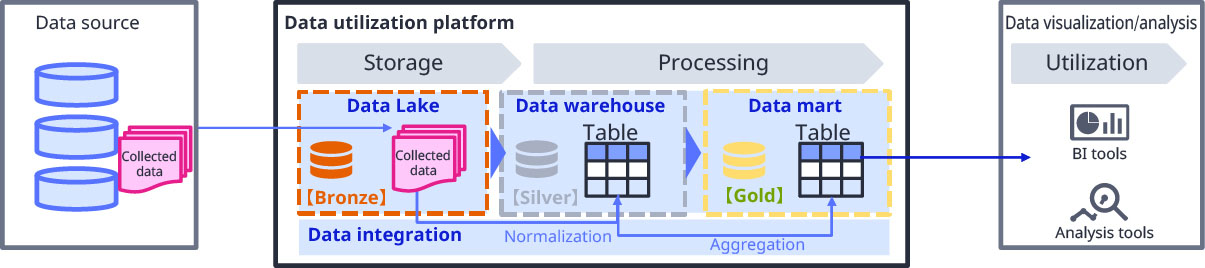
The process of deriving insights from data to support decision-making can be broadly divided into three stages: collection, storage, and utilization. Within this process, the medallion architecture4) provides a framework for logically managing data by organizing it into three distinct layers (Fig. 1):
- (1)Bronze: Raw data is ingested and stored in its original, unprocessed format
- (2)Silver: Data is cleansed and normalized, then stored in a format suitable for analysis
- (3)Gold: Data is aggregated and curated for each use case, stored in an optimized format for reference
 Click to Enlarge
Fig. 1 Medallion architecture.
3.2 Main functions of the data utilization platform
To implement the logical three-layer structure described in the previous section as system functions, a data utilization platform is equipped with the following three core capabilities:
- (1)Data lake: Stores raw data in a cost-effective manner
- (2)Data warehouse (DWH):Stores cleansed and normalized data in a format suitable for analysis
- (3)Data mart: Stores aggregated data optimized for specific applications, enabling high-performance and efficient responses to multiple reference requests
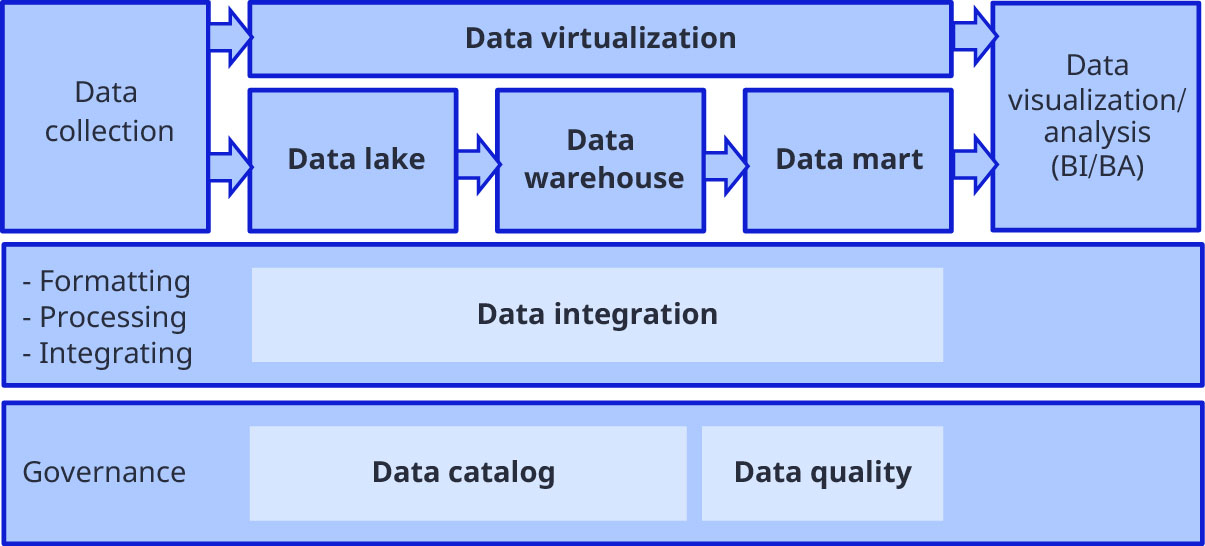
In addition, data integration plays a key role in connecting these core functions by processing and moving data between layers. Raw data is structured, aggregated, and consolidated into a format suitable for analysis, and then further aggregated according to specific use cases before being transferred to the next layer.
These four elements—data lake, data warehouse, data mart, and data integration—constitute the main feature of the data utilization platform (Fig. 2).
 Click to Enlarge
Fig. 2 Functional areas of the data utilization platform.
3.3 Optional functions of the data utilization platform
Depending on requirements, the following optional functions may be implemented:
- Data catalog: By classifying and organizing data according to its meaning, users can search for the desired data based on its semantic attributes and easily begin analysis. Additionally, data catalogs can improve the accuracy of semantic understanding by generative AI and strengthen data governance within the organization by data administrators.
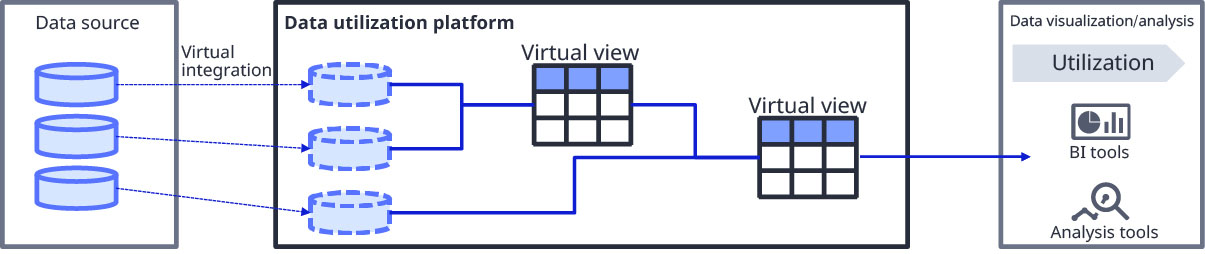
- Data virtualization: Data can be handled in a virtually integrated state without physically gathering it. This allows for effective use of existing environments and helps to minimize the scale of new environment construction.
3.4 Examples of implementation patterns for data utilization platforms
(1) Effective use of existing environments: Data virtualization (Fig. 3)
Advantage: There is no physical movement of data, so storage costs are low.
Disadvantage: When in use, performance load is placed on the data sources.
 Click to Enlarge
Fig. 3 Implementation pattern using data virtualization.
(2) Building a new environment: Data lake, data warehouse, data mart, and data integration (Fig. 4)
Advantage: By referencing pre-aggregated data marts, it is easier to control performance load.
Disadvantage: Physical movement of data occurs at each layer, so storage costs increase.
 Click to Enlarge
There are also several other implementation patterns as well, but it is necessary to organize the current environment, types of data sources, and intended use before determining the optimal architecture.
4. NEC’s initiatives
4.1 Supporting every phase of data utilization
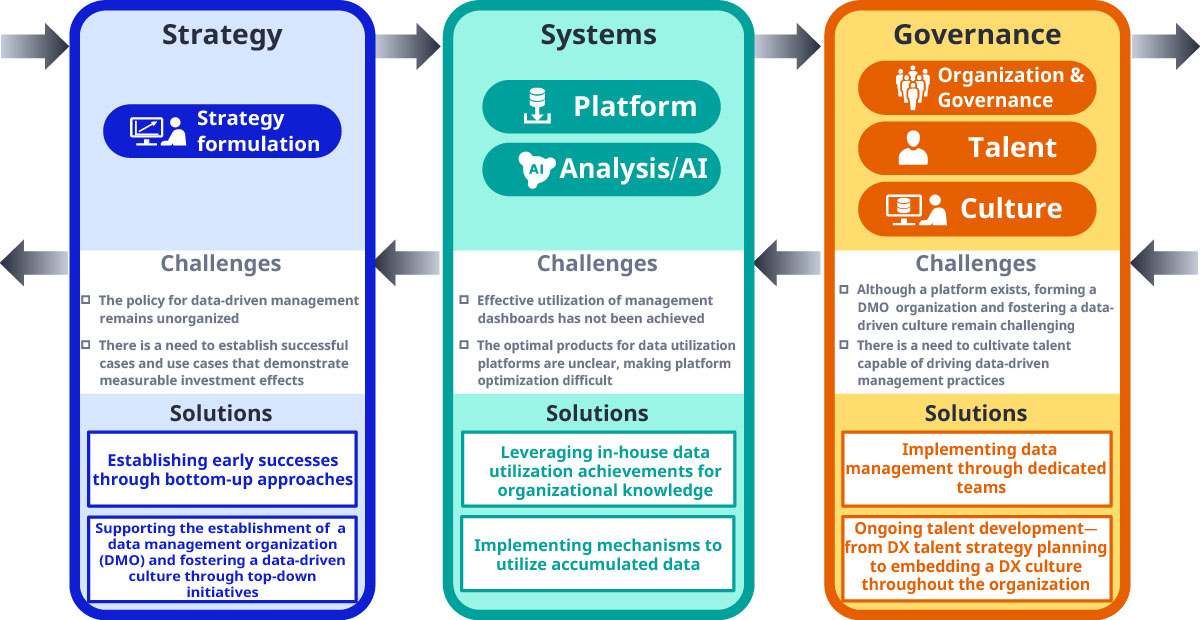
NEC has accumulated extensive expertise in addressing the challenges of realizing data-driven management, both through the advancement of its own data management practices—such as the development of the One NEC Data Platform—and through supporting a wide range of customers. Drawing on this practical knowledge, NEC provides the NEC BluStellar Scenario as a comprehensive reference model that supports every phase—from issue identification to ongoing support—including not only system construction, but also the formulation of data utilization strategies, selection and implementation of data utilization platform products, and the development of organizations and human resources for sustained data utilization (Fig. 5).
 Click to Enlarge
4.2 Support for core data utilization platform planning
To successfully realize a data utilization strategy, it is essential to consider a wide range of factors when planning the core data utilization platform. Through its NEC BluStellar Scenario, NEC provides support to facilitate smooth architecture planning and product selection prior to platform implementation.
As part of the NEC BluStellar Scenario, NEC offers a Data Utilization Platform Consulting service, which includes a structured process for architecture planning (Fig. 6).
 Click to Enlarge
The process begins with interviews to clarify requirements for the data utilization platform. These requirements are organized based on the current environment, types of data sources, and intended use cases, ensuring that key considerations and priorities are clearly identified. Next, system architecture is examined, and products and services with functions that meet these requirements are compared and selected. Finally, a roadmap is developed for realizing the overall concept. For new environments, it is common to start with a small-scale data utilization platform configuration and design a future structure that anticipates expansion of use cases.
5. Emerging Trends
As the importance of data utilization platforms continues to grow, the ways in which data is used are becoming increasingly diverse each year, and new methods of data utilization are expected to emerge in the future.
5.1. Changes in data utilization methods
Methods for utilizing data have evolved, beginning with data visualization aimed at recognizing ongoing phenomena, then progressing to analysis that combines multiple datasets to uncover new insights. Furthermore, the introduction of AI has accelerated and streamlined these processes. As a result, the functions required of data utilization platforms now extend beyond traditional collection, storage, and analysis, to include data quality management for improving the reliability of results, and the growing importance of data catalogs to support data organization.
5.2 Utilizing data with generative AI
One of the most significant technological changes in recent years has been the emergence of generative AI. Through natural language queries, it is now possible to visualize and analyze data, as well as generate proposals for actions. For generative AI to handle data correctly, it is essential to establish a semantic layer between the application layer and the data layer. The semantic layer is a framework for systematically classifying and organizing the meaning and structure of data. As a result, the importance of data quality management and data catalogs—which were previously considered optional—has grown even further within data utilization platforms.
5.3 Data serving as the foundation for data products
A new concept known as the "data product" has been proposed. A data product is an approach that treats a complete, well-organized set of data—which delivers value to users—as a single product. This concept emphasizes the importance of using raw data as the material to generate high-quality, curated datasets. Furthermore, from a data management perspective, creating data products for each organization responsible for the data enables the provision of higher-quality, more valuable data to users.
6. Conclusion
The ways in which data is utilized continue to evolve in response to new technologies and changes in the business environment. Nevertheless, the essential functions remain the collection, storage, and analysis of data, and it is data that flows through these processes.
For organizations to achieve sustainable growth, it is important to design data utilization platforms with scalable architectures and roadmaps. Furthermore, by expanding the scope of data sharing beyond individual companies to include collaboration between enterprises and government, there is potential to create new social value.
NEC will continue to support the realization of data-driven management and the sustainable growth of businesses, contributing to the creation of future social value.
References
- 1)
- 2)
- 3)
- 4)
 Cabinet Office, Government of Japan: Efforts for EBPM in the Cabinet Office, September 2025 (Japanese)
 Authors’ Profiles
DEJIMA Takashi
Professional
Data Platform Service Department
Professional
Data Platform Service Department
KAWABATA Terumasa
Senior Manager
Data Platform Service Department
Senior Manager
Data Platform Service Department
YAMAKAWA Satoshi
Director
Data Platform Service Department
Director
Data Platform Service Department