Global Site
Displaying present location in the site.
Creating a New Trend in Identity Verification with DID/VC and Biometric Authentication
Vol.19 No.1 Special Issue on NEC BluStellar: NEC BluStellar Driving the Future of Digital Transformation — A Value Creation Model Pioneered by AI, Security, Data Management, and Modernization
With the advancement of digital transformation (DX) and AI technology, a wide variety of identity information—not only names and basic attributes, but also qualifications, work history, appearance, voice, and health status—is increasingly being digitized, creating a foundation for people to enjoy greater digital convenience. At the same time, the management and handling of data that contains personal information is becoming ever more complex and sophisticated, due to stricter regulations and rising public awareness. This growing complexity poses a burden not only for businesses, but also for users who are asked to provide their personal information, which has become a factor hindering effective data utilization. Against this social backdrop, this paper introduces a new method of identity verification and its applications, achieved by combining decentralized identity and digital certificates with biometric authentication technology.
1. Introduction
In recent years, advances in digital transformation (DX) and AI technology have facilitated the digitization of a wide range of identity information—not only names and basic attributes, but also qualifications, work history, appearance, voice, and health status—and this ongoing shift is creating a foundation for people to enjoy greater digital convenience. Looking ahead, we can even envision a future where individuals have digital alter egos beyond their physical bodies, with such digital identities expected to become an essential foundation in society.
At the same time, the management and handling of identity information containing personal information is becoming increasingly complex and sophisticated due to stricter regulations in various countries and rising public awareness. Moreover, in the absence of unified technical standards for verifying personal information, users must repeatedly enter the same details for multiple services, and businesses must individually verify the accuracy of the received information. This current structure imposes a significant burden on both sides and is one reason why the effective use of identity data has not advanced.
Given this social context, this paper explains a new method for identity verification that combines decentralized identity (DID) and verifiable digital certificates called verifiable credentials (VC), with biometric authentication technology. It also highlights how this system can accelerate user-driven data distribution and introduces several anticipated use cases.
2. VC Utilizing Biometric Authentication Technology
2.1 Background to the need for DID
Today, we register our personal information with many different services. Each service uses this information to create a unique ID that enables us to log in to online platforms and complete various applications and procedures.
However, IDs such as social media accounts, My Number Cards, driver’s licenses, health insurance cards, and employee IDs are all issued individually by specific “administrators,” such as companies or government agencies. Users are not able to freely control these IDs or the personal information associated with them. Currently, they remain dependent on the management systems and service standards of each business or organization.
Furthermore, amid stricter personal data regulations and heightened awareness of privacy protection in the EU and other countries, businesses are required to manage data with greater rigor. As a result, the costs of maintaining compliance and the risks of data breaches have increased.
Taking these trends into account, the future form of data sharing is expected to shift from the current model—where companies and government agencies manage user data—to a self-sovereign identity model in which users manage their own data and disclose only the necessary information at their own discretion as needed.
2.2 What is DID/VC?
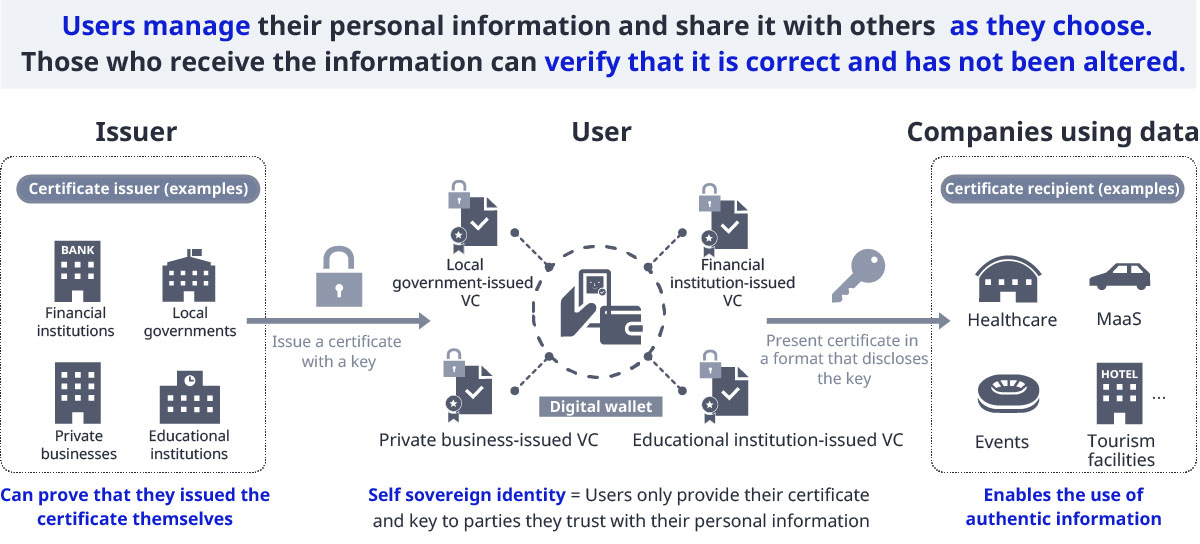
DID/VC is a system that combines two technologies—decentralized identifiers and verifiable credentials (VC)—enabling individuals to selectively disclose their identity information to specified parties over the internet, while allowing the recipient to verify the authenticity of the information (Fig. 1).
Identity information can be managed on an individual’s smartphone or cloud service contracted by the individual, allowing users to disclose their information at their own discretion without relying on centralized authorities such as government agencies or platform providers. As generative AI and digitalization become more pervasive in society and businesses seek increasingly detailed customer data, DID/VC is emerging as a promising new approach to identity management that enables both privacy protection and personalization.
 Click to Enlarge
Fig. 1 Overview of DID/VC.
2.3 Overview of FaceVC
Generally, verifiable credentials (VCs) are stored in a digital wallet on a device like smartphones. When using these credentials, users disclose or share them with businesses and other entities at their own discretion. However, when VCs are presented online, there is a risk that, depending on the device’s security settings, third parties could illicitly access and disclose them. Furthermore, businesses receiving VCs have no way to confirm who is presenting the credential, making it difficult to detect impersonation or unauthorized use. To address these risks, NEC offers a solution for issuing FaceVC, a VC that leverages NEC’s face recognition technology.
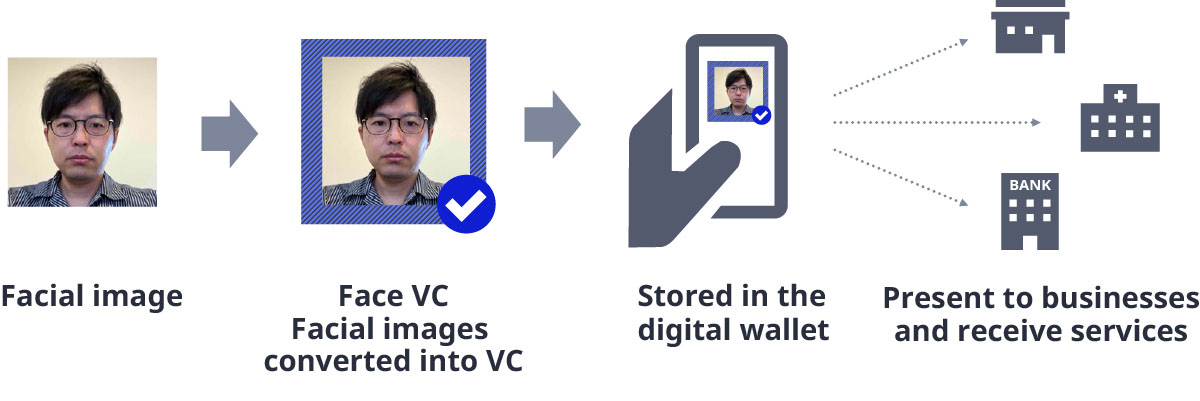
FaceVC converts the user's facial image into a verifiable credential (VC), which, like other VCs, can be stored and managed in a digital wallet. When a user presents their VC to a business or organization, they also provide their FaceVC, and face recognition is performed by comparing the facial image stored in the FaceVC with a live image of the user captured at that time. This process confirms that the presented VC actually belongs to the user, helping prevent impersonation and unauthorized use. Additionally, this mechanism not only guarantees the authenticity of the VC holder but also enables the provider to offer more personalized services based on the securely disclosed information. (Fig. 2).
 Click to Enlarge
Fig. 2 Issuing and using a FaceVC.
Because FaceVC allows verification of the business that performed the identity confirmation at the time of disclosure, once a trusted business has confirmed the user's identity, other organizations do not need to reconfirm it. This reduces both registration steps and operational burden.
3. Overview of NEC Digital Identity VCs Connect
NEC Digital Identity VCs Connect is a solution that utilizes DID/VC to issue and verify various types of information as verifiable credentials. By integrating NEC’s face recognition technology and the My Number Card authentication service, it not only enables the issuance of highly reliable credentials but also streamlines identity verification during the validation process. The main features are outlined below:
(1)FaceVC
By using FaceVC and performing face recognition when utilizing VCs, impersonation and unauthorized use can be prevented, enabling the provision of services based on trust.
(2)Integration with official IDs
Information from official ID cards, such as the My Number Card in Japan, can be converted into a VC together with the user’s facial image and stored on their smartphone. When disclosed during service use, this enables identity verification using a facial image that has been confirmed to belong to the individual through the My Number Card. This approach reduces initial implementation costs for real-world deployment and allows for flexible adaptation to a wide range of use cases.
(3)Integration with secure computation solutions
Secure computation solutions provide an environment where processing can be performed while data remains encrypted. Using the ID and personal information stored in the VC as keys, it accurately integrates and links data and identities across companies and organizations in an encrypted state for analysis. This approach achieves both privacy protection and effective data utilization.
4. Implementation Examples of DID/VC
4.1 Vaccination Certificates
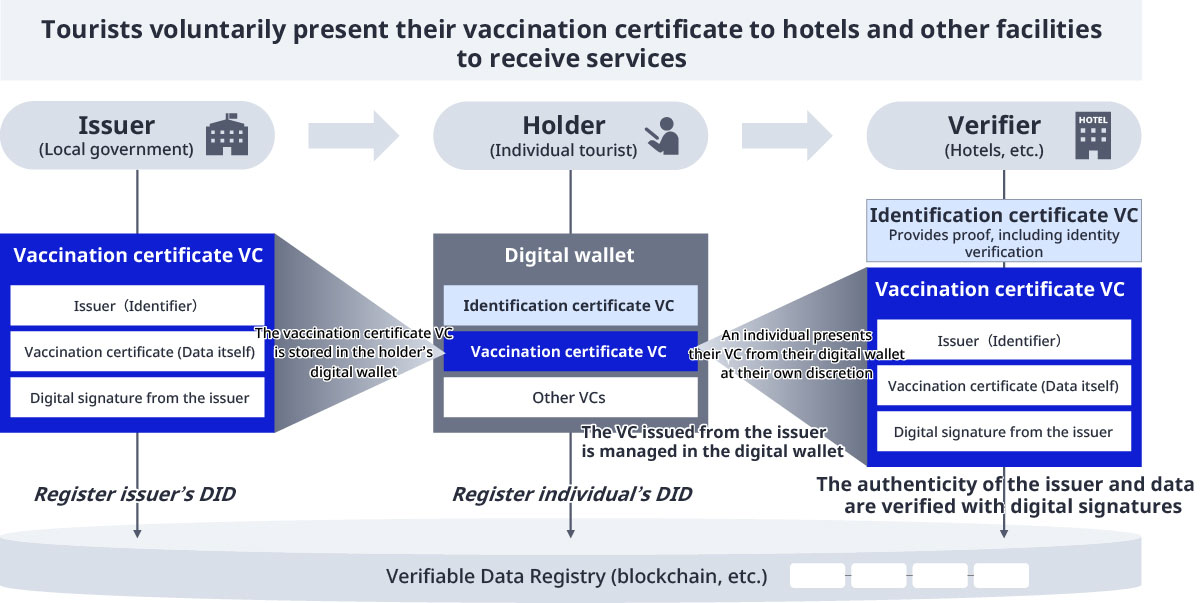
Vaccination certificates are often issued in paper form, which creates challenges for both managing them and verifying their authenticity. In this example, tourists can keep a digital vaccination certificate—issued by local governments or other authorities—as a VC in their own digital wallet. When needed, they can voluntarily present both their vaccination certificate VC and identity verification VC to hotels or other facilities, allowing them to access various services smoothly. With VCs, the issuer and the authenticity of the data are guaranteed, enabling secure and highly reliable proof (Fig. 3).
 Click to Enlarge
Fig. 3 Overview of implementation of VCs for vaccination certificates.
4.2 The “null2” signature pavilion at Expo 2025 Osaka, Kansai, Japan
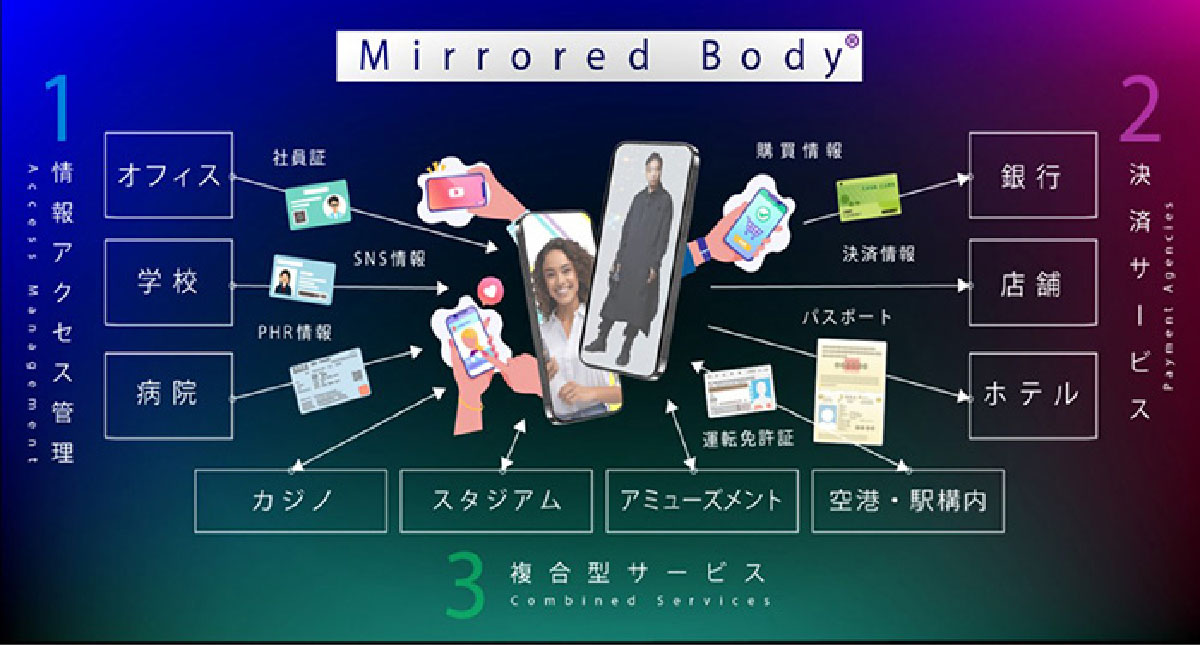
Between April 13 and October 13, 2025, at the Expo 2025 Osaka, Kansai, Japan, held in Yumeshima, Konohana Ward, Osaka City, NEC provided its FaceVC-based identity verification technology to the “null2” signature pavilion produced by media artist Yoichi Ochiai1). When pavilion visitors used the dedicated application to create and share their digital alter ego (avatar), called “Mirrored Body®,” with other users, FaceVC was used to verify that the person who created the avatar was indeed the rightful user, thereby preventing unauthorized use of avatars (Fig. 4).
©Sustainable Pavilion 2025 Inc. Inc. All Rights Reserved.
©Expo 2025
Fig. 4 Business domains where "Mirrored Body®" is utilized.
5. Future outlook and anticipated use cases
As the social implementation of DID/VC advances, various procedures such as identity verification, qualification certification, contract processing, and employment eligibility verification can be conducted more efficiently and securely, paving the way for widespread adoption across a broad range of fields. Below are some of the primary use cases envisioned by NEC.
5.1 Healthcare industry
In the healthcare industry, there is a growing demand for health promotion and monitoring. Various businesses are offering health-related services; however, many of these services are currently limited to fragmented data such as heart rate, sleep, and stress. By utilizing DID/VC, users can take control of managing and sharing their health data, which leads to greater convenience. Additionally, secure data utilization among multiple organizations can be realized, enabling more comprehensive support that meets users’ needs.
5.2 Area management and local government
In urban management, various digital services and initiatives are being implemented for residents and visitors, including transportation measures, event attraction strategies, and disaster response. Because these services are managed individually, users are often required to register separately and provide proof of activities or service usage for each one (for example, for school subsidies, child allowances, senior welfare services, or academic support). With factors such as the increase in inbound tourism, the rise of foreign workers, and a growing elderly population, these policies and services are expected to become even more complex and diverse. By utilizing DID/VC, it becomes possible to digitize the necessary proof information, enabling cross-organizational use by companies, organizations, and groups. This leads to greater automation and efficiency in administrative procedures, improved user convenience, regional revitalization, and increased business revenue.
5.3 Fan marketing
Event and concert venues are considered highly valuable spaces where fans can share time and experience with their favorite artists or athletes. For businesses, such venues offer opportunities not only to enhance fan experience and streamline operations, but also to maximize fan spending through merchandise and sponsor product sales. However, in the entertainment industry, individual businesses tend to manage their own data separately, making it difficult to capture and understand fan behavior across different services and events. By leveraging DID/VC, businesses can verify fans’ support activities across organizations and offer special experiences (such as loyalty programs) based on these proofs, thereby improving customer experience and encouraging greater fan spending.
6. Conclusion
Face recognition technology is now being adopted across a wide range of settings, including airports, offices, stores, apartment buildings, hotels, banks, hospitals, and schools, allowing many people to benefit from its safety and convenience. However, with most current face recognition systems, businesses are responsible for storing users’ facial data, which creates operational burdens for both organizations and users. The FaceVC solution introduced in this paper fundamentally transforms how identity information—including facial data—is managed. As the need for stronger personal data protection grows, driven by regulations like Europe’s GDPR, consent management issues, and concerns over third-party cookies, the way data is circulated is expected to change, with users increasingly holding and disclosing their own data at their discretion. Against this backdrop, the use of DID/VC in face recognition is expected to expand into various industries in the future.
Trademarks
- *Mirrored Body® is a registered trademark of Sustainable Pavilion 2025 Inc.
- *All other company names and product names that appear in this paper are trademarks or registered trademarks of their respective companies.
References
Authors’ Profiles
HIGUCHI Yuya
Director
Biometrics and Vision AI Department
Director
Biometrics and Vision AI Department
IWAHORI Yasufumi
Senior professional
Biometrics and Vision AI Department
Senior professional
Biometrics and Vision AI Department
MAEDA Hiroshi
Professional
Biometrics and Vision AI Department
Professional
Biometrics and Vision AI Department
ARATA Yuki
Professional
Industry DX Department
NEC Communication Systems
Professional
Industry DX Department
NEC Communication Systems