Global Site
Displaying present location in the site.
Intelligent Hybrid Cloud for Management Support in the AI Era
Vol.19 No.1 Special Issue on NEC BluStellar: NEC BluStellar Driving the Future of Digital Transformation — A Value Creation Model Pioneered by AI, Security, Data Management, and ModernizationWith the advancement of AI, managing ever-increasing volumes of data—including confidential information—has become more critical than ever, alongside the need to strengthen governance, ensure compliance with laws and regulations in each country, and optimize costs. Against this backdrop, hybrid cloud environments that integrate multiple clouds with on-premises systems have become mainstream. As a next-generation platform to support management in the AI era, NEC proposes the Intelligent Hybrid Cloud, which seamlessly connects cloud environments through autonomous operation and optimization enabled by AI. This paper highlights three key points essential to realizing this platform—cloud orchestration, data management, and integrated management—and provides a detailed overview of NEC’s specific initiatives in these areas.
1. Introduction
With the advancement of AI utilization, enterprises are managing ever-increasing volumes of data, including confidential information. To strengthen governance, optimize costs, and address data sovereignty requirements in each country, a shift away from exclusive reliance on public clouds is underway. Instead, hybrid cloud environments—which enable the selection and use of different clouds tailored to specific needs—are becoming the mainstream approach. In the era of AI-driven management, evolving IT infrastructure is essential to fully integrate AI into every aspect of business, from management to daily operations. As a platform to support management in the AI era, NEC proposes the Intelligent Hybrid Cloud, which seamlessly connects multiple cloud environments and achieves autonomous management and optimization through AI.
This paper provides an overview of the Intelligent Hybrid Cloud, outlines the key points for realization, and details NEC’s initiatives to bring it to fruition.
2. What is Intelligent Hybrid Cloud?
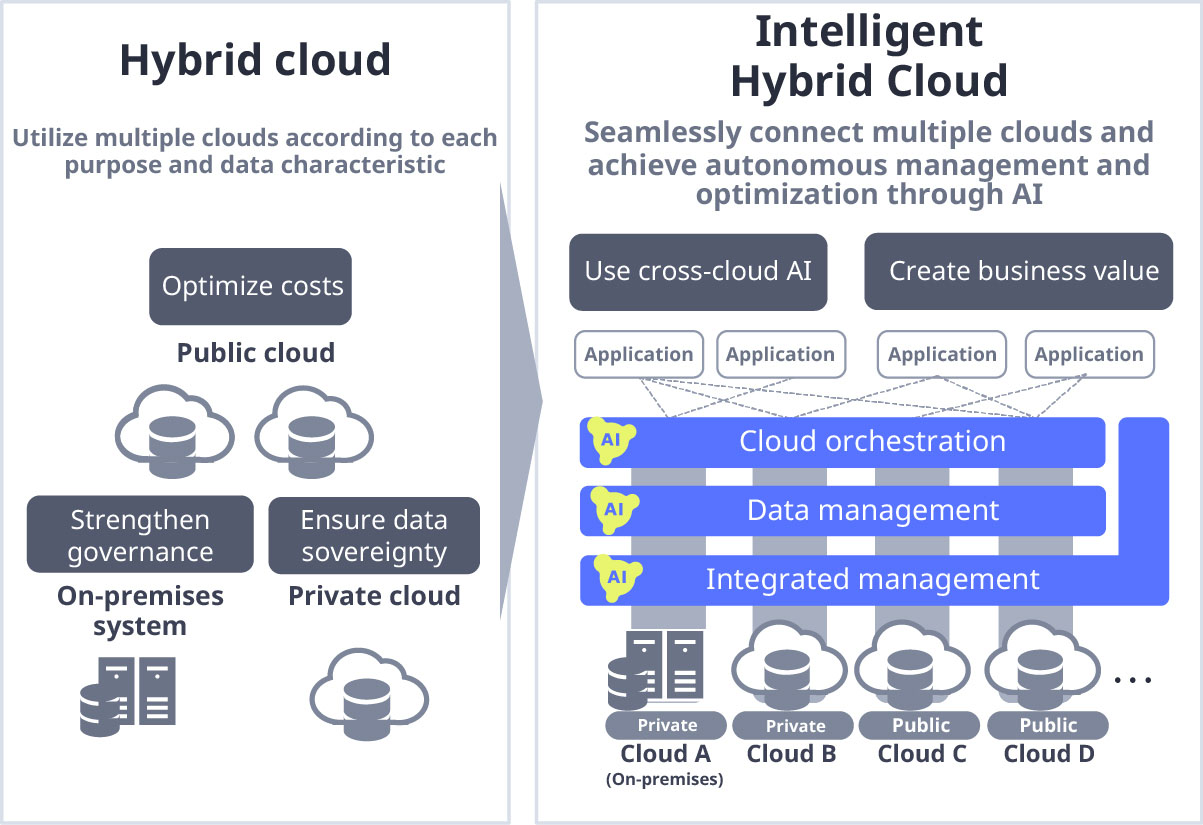
The Intelligent Hybrid Cloud is a platform designed for the AI era, seamlessly connecting multiple cloud environments and enabling autonomous management and optimization through AI operating across these environments (cross-cloud AI) (Fig. 1). Workloads distributed across multiple clouds are autonomously managed by cross-cloud AI, and are organically integrated and centrally controlled through orchestration technologies. This approach enables dynamic value creation in business and enhances management speed.
 Click to Enlarge
Currently, hybrid cloud environments are characterized by the selective use of multiple IT infrastructures—including on-premises systems, private clouds, and public clouds—based on objectives such as strengthening governance, addressing data sovereignty, and optimizing costs, as well as the specific characteristics of the data involved. To advance from this state to the Intelligent Hybrid Cloud, it is necessary to address the following key challenges as the utilization of multiple IT infrastructures and AI accelerates.
- Achieving system integration and orchestration across platforms, so users do not need to be aware of the underlying IT infrastructure
- Centrally managing and optimizing the total costs of customer systems that span multiple IT infrastructures
- Using AI to streamline and enhance increasingly complex and cumbersome operations management
- Standardizing data management frameworks to ensure data sovereignty and security, thereby maximizing the value of enterprise data
- Maintaining unified, high-level security standards and policies to protect business activities
To address these challenges, NEC is focusing on three key areas for realizing the Intelligent Hybrid Cloud: cloud orchestration, data management, and integrated management.
3. Key Points for Realizing the Intelligent Hybrid Cloud
Several key points are involved in realizing the Intelligent Hybrid Cloud. This section highlights the most essential points: cloud orchestration, integrated management, and data management.
3.1 Cloud orchestration
Cloud orchestration is an essential function for integrating multiple cloud environments and for developing and operating cloud-native applications.
Enterprises are expected to select and utilize the cloud services best suited to their requirements, without relying on any single cloud provider. However, technical differences between clouds present significant challenges, making it necessary to mitigate these differences in order to achieve seamless development and operation across environments. Traditionally, data communication between on-premises and cloud environments has relied on VPN or SSL-VPN connections over the internet, but instability and unexpected costs resulting from usage-based billing have posed serious issues.
These challenges have become major obstacles to realizing multi-cloud strategies and continue to hinder efficient cloud orchestration.
3.2 Data management
Data management for AI utilization is a crucial element at the core of systems that combine multiple cloud services. In recent years, it has become necessary for enterprises to efficiently integrate data stored across different cloud services and manage it in a way that enables AI to be leveraged. To make sound management decisions and fully utilize AI, organizations must comprehensively strengthen their data management frameworks, quality control, operational processes, and security measures. To realize data-driven management and decision-making, it is essential to establish organization-wide data management systems, promote data centralization and quality improvement, and actively encourage the practical use of data in daily operations.
3.3 Integrated management
In recent years, enterprise use of cloud services has expanded rapidly. As a result, multi-cloud environments have grown increasingly complex, leading to rising operational costs, heightened security risks, and more complicated management tasks. In particular, since each cloud service uses its own management interfaces and operational policies, unified operations are difficult, placing a heavy burden on administrators. Furthermore, as cyberattacks become more sophisticated, traditional, isolated approaches are no longer sufficient for adequate protection.
Additionally, as regulatory requirements tighten, ensuring governance and compliance has become more important, but manual management is unrealistic. The growing complexity of cloud pricing structures has also increased the risk of unexpected costs unless costs are visualized in real time.
To address these challenges, organizations need an integrated management framework that covers multiple environments, including both cloud and on-premises systems. First, unified security policies must be applied across all environments, with mechanisms to comprehensively visualize threats. Second, standardizing and automating operational tasks enables personnel to focus on higher-value work. Finally, ongoing cost optimization requires real-time cost analysis.
4. NEC's Initiatives
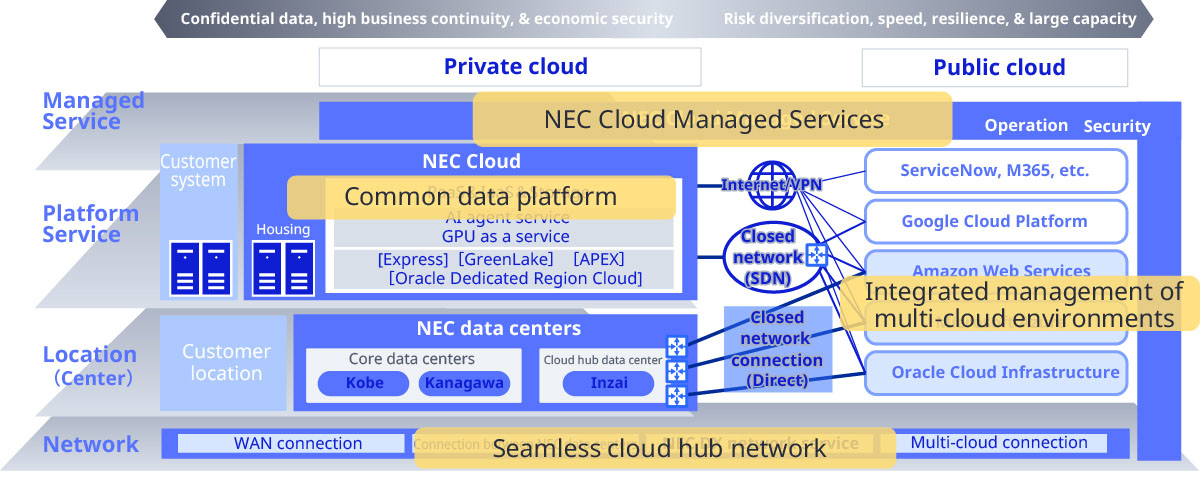
To achieve the three key objectives outlined in section 3, NEC is implementing a range of initiatives guided by the overall framework illustrated in Fig. 2, This section highlights four of the most significant initiatives.
 Click to Enlarge
4.1 Cloud orchestration: NEC Cloud Managed Services
NEC Cloud Managed Services provide an application platform and managed services for the development and operation of cloud-native applications across diverse cloud environments. By supporting every stage of the system lifecycle—from conceptualization and planning, through design and implementation, to operation and maintenance—these services help reduce the burden on enterprises related to cloud migration and operational management.
Drawing on NEC's long-standing expertise in system implementation and operations, the managed services standardize various environments—including operations, monitoring, testing, production, and hub networks—and enable efficient cloud orchestration with robust security and governance.
Furthermore, by implementing security guardrails as a core part of our managed services and automatically applying unified security policies across all cloud environments, we minimize risks caused by human error or configuration oversights. Additionally, a key feature is the monitoring of cloud costs, enabling ongoing optimization based on actual usage. This approach allows customers to easily manage their cloud budgets while concentrating resources on generating the business value that truly matters.
Through these capabilities, NEC Cloud Managed Services address the complex challenges of cloud operations—including security, governance, cost control, and operational workload—at the same time, accelerating the sustainable growth of our customers’ businesses.
4.2 Cloud orchestration: Seamless cloud hub network
NEC is developing a seamless cloud hub network to address challenges in cloud orchestration. Today, dedicated line services using Border Gateway Protocol (BGP) have become standard across various cloud services, enabling stable connections at a fixed, affordable rate. Leveraging these technological advancements, NEC provides closed network connection services between major data centers—centered on the Inzai Data Center in Chiba Prefecture—and cloud hub networks, offering stable connections at low cost and with short lead times.
Additionally, for SaaS offerings, as systems are deployed on cloud platforms, there is a growing need for cloud connectivity solutions beyond standard internet connections. NEC is responding to these trends by providing stable internet services for the highly demanded Microsoft 365 offerings, utilizing not only closed network connections but also direct peering. These initiatives address issues such as connection instability and unexpected costs associated with traditional approaches, enabling enterprises to operate multi-cloud environments more efficiently.
4.3 Data management: Unified data platform
NEC is advancing company-wide data-driven management by providing a common data platform. To address challenges in data management, NEC has centralized data management across the entire Group and established mechanisms to support data-driven decision-making. Under the Client Zero strategy, NEC is driving internal adoption of these practices, focusing on data centralization, standardization, quality improvement, and the promotion of data utilization. As a result, NEC has strengthened its frameworks for data management, governance, and security, enabling centralized management and provision of AI-usable data. Furthermore, by visualizing data through internal management dashboards, NEC has enabled organization-wide decision-making and action based on centrally managed data, fostering a culture of data-driven management throughout the company.
4.4 Integrated management: Centralized management of multi-cloud environments
To address the challenges of multi-cloud operations, NEC has implemented integrated management practices utilizing solutions such as Exastro and IBM Turbonomic. Exastro provides unified operations and configuration management functions for cloud environments, supporting the integration, autonomous management, and optimization of multiple clouds. IBM Turbonomic automatically monitors and analyzes resources across various clouds, helping to optimize costs. As part of its Client Zero strategy, NEC has applied Exastro and IBM Turbonomic to its own IT infrastructure and has confirmed the following benefits:
- Visualization and accelerated action through internal IT dashboards: By providing a unified view of IT operations data via dashboards, and sharing this information across all levels of the organization from management to employees, NEC has enabled faster decision-making and execution.
- Operational efficiency through integrated management of internal IT infrastructure: By using Exastro to centrally manage over 1,000 systems, NEC has accelerated incident detection and response, improving the productivity of operations teams. As a result, NEC reduced operational costs by 20%, and cut infrastructure development lead times by half.
- Resource optimization: Leveraging IBM Turbonomic, NEC visualizes resource usage and costs across multiple clouds, and regularly eliminates unnecessary resources, thereby optimizing both workloads and costs.
5. Conclusion
This paper provides an overview of the Intelligent Hybrid Cloud, outlines the key points for its realization, and describes NEC’s initiatives in this area. The Intelligent Hybrid Cloud enables the flexible use and seamless integration of multiple cloud environments according to specific objectives and data characteristics, and achieves autonomous management and optimization through AI. Drawing on its extensive experience and expertise in meeting diverse system requirements, NEC has established a common platform to deliver cloud services that address customer challenges quickly and flexibly. Going forward, NEC will further enhance these capabilities, integrate its technologies, and expand its cloud platform to solve customer issues and support business growth.
Trademarks
- *Microsoft 365 is a trademark or registered trademark of Microsoft Corporation in the U.S. and other countries.
- *IBM Turbonomic is a trademark or registered trademark of International Business Machines Corporation in the U.S. and other countries.
- *All other company names and product names that appear in this paper are trademarks or registered trademarks of their respective companies.
Authors’ Profiles
TAKAGI Kenki
Senior Director
Cloud Strategy Department
Senior Director
Cloud Strategy Department
NISHIMURA Takeshi
Executive Professional
Cloud Strategy Department
Executive Professional
Cloud Strategy Department
SAKAI Eiji
Director
Cloud Strategy Department
Director
Cloud Strategy Department
TSUJI Atsushi
Senior Manager
Cloud Strategy Department
Senior Manager
Cloud Strategy Department
KOTANI Tetsuro
Senior Manager
Cloud Strategy Department
Senior Manager
Cloud Strategy Department
OIKAWA Toyohide
Senior Professional
Cloud Strategy Department
Senior Professional
Cloud Strategy Department