Global Site
Breadcrumb navigation
Interview
NEC’s Trademark Strategy—Focused Choices for the Future
March 24, 2026
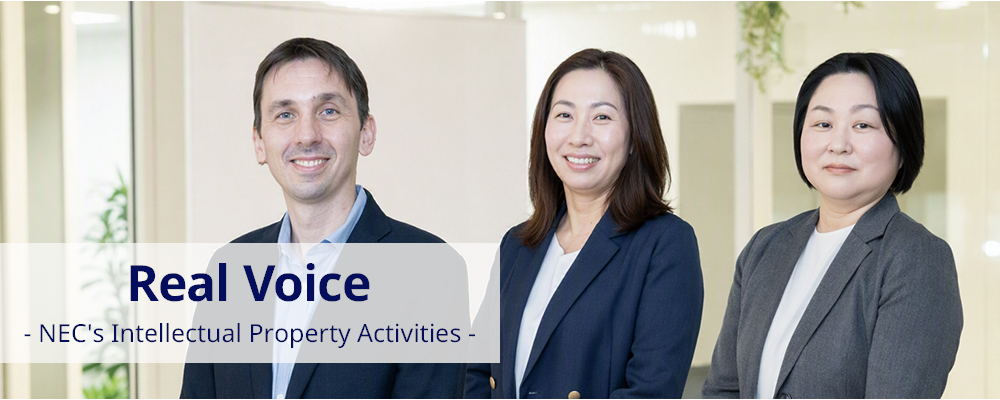
Trademarks are one form of intellectual property, alongside patents, utility models, and designs. At NEC, new initiatives are actively underway, including the launch of NEC BluStellar in 2024, a flagship brand that embodies the company’s DX value co-creation model, as well as NEC cotomi, a generative AI technology brand. What are the aims behind these initiatives, and what kind of long-term vision and challenges lie ahead? We spoke in depth with three employees who are leading trademark strategy across the NEC Group.
Profile
Romain Bouillaut
Senior Professional
Intellectual Property Portfolio Creation Department
After gaining experience in research work at a law firm and in brand rights enforcement at a company, including cease-and-desist requests and litigation, Mr. Romain Bouillaut joined NEC in June 2024. He is engaged in external affairs related to software licensing. Since April 2025, he has also been serving on the trademark team in addition to his previous responsibilities. His responsibilities include drafting license agreements, managing domain names, and providing advice on various matters. He is also involved in projects such as establishing hub offices to streamline trademark filings across multiple countries.
Mio Wakamatsu
Professional
Intellectual Property Portfolio Creation Department
After working at a patent firm, Ms. Mio Wakamatsu joined the NEC Patent Technology and Information Center (which is scheduled to integrate into NEC effective April 1, 2026) in September 2005. While also holding concurrent assignments with NEC’s intellectual property division on several occasions, she has handled trademark matters for the NEC Group. Her work includes trademark searches and registration, responses to various trial and appeal proceedings, trademark-related contracts and negotiations, and the review and development of internal rules on trademark. She has also been involved in formulating intellectual property strategy and advising on brand strategy development in collaboration with the branding team. In addition, she serves on the Trademark Committee of the Japan Intellectual Property Association (JIPA) and the Trademark Committee of the Japan Electronics and Information Technology Industries Association (JEITA).

Nobuko Sato
Assistant Manager
Intellectual Property Portfolio Creation Department
Since June 2005, Ms. Nobuko Sato has been engaged in trademark operations for the NEC Group at the NEC Patent Technology and Information Center (which is scheduled to integrate into NEC effective April 1, 2026). After also holding multiple concurrent assignments with NEC’s intellectual property division, she was seconded to NEC in April 2025. She works across a wide range of practical trademark matters, including overseas trademark searches, applications, and registration; collecting and reviewing evidence for the maintenance of overseas trademark rights, such as declarations of use; reviewing and responding to oppositions involving overseas trademarks; and handling trademark-related inquiries from business units.
Nurturing trademarks into becoming major brands
What makes trademarks so important?
Sato: The most important role of a trademark is to indicate the “source” of a product or service, so that customers can choose it with confidence. The basic function of a trademark is to allow people to look at a logo or brand name and recognize that it comes from a company they know. For companies, trademarks are also a means of protecting the trust, reputation, and brand value they have built up over time. If a third party uses a similar name or logo, it can cause confusion and undermine that trust. Trademark rights help prevent such situations and also make it possible to take action when necessary.
Wakamatsu: Our division is responsible for trademarks, such as logos, that form the foundation of a brand. While another team is responsible for the brand itself, we work closely with them to support branding strategy from a legal perspective. Our specific responsibilities include trademark searches, application and registration, contracts and negotiations, and the assignment and licensing of trademark rights.
Sato: One of the biggest challenges in trademark work is that the question of whether two marks are similar tends to be judged on a case-by-case basis. Much depends on the actual circumstances of business and whether there is a real likelihood of confusion in the marketplace. Another important issue is how to define the scope of goods and services to be covered by the rights—meaning the designated goods and designated services. If the scope is too broad, it may not reflect the actual business. If it is too narrow, additional applications may become necessary later. That is why close alignment with business plans is essential. Even when the initial assumptions are relatively clear, the areas or countries of use may expand over time. As such, determining the exact scope of the rights to be obtained is always a challenge.
Wakamatsu: It is not realistic to secure rights for every trademark in all of the one hundred plus countries around the world. The way a trademark is used differs from country to country, and both the cost of obtaining those rights and the cost of maintaining them would be enormous. That is precisely why it is so important for us to stay in close contact with the business divisions. We ask about everything: what kind of business plans they have, which markets they are targeting, even whether they have plans to exhibit at trade shows.
Bouillaut: That’s right. We organize our thinking by looking at what kind of product it is, who it is for, and what potential it may have in the future. Even if, at the present stage, we do not plan to offer a particular service or expand into a particular country, we still have to ask what the situation might look like two or three years from now. If there is any real possibility, we make decisions by balancing that potential against the risks of not securing the trademark. In that sense, trademarks are a form of intellectual property that requires us to think ahead to the future. Unlike patents, trademark rights are not especially “strong” rights at the moment they are obtained. They have to be strengthened over time by building recognition and reputation. In that respect, trademarks are almost like living things. One of the most interesting aspects of trademark work is nurturing a newly established trademark and helping it grow.
Focusing resources on NEC BluStellar, NEC cotomi, and other trademarks with future potential
What is NEC’s trademark strategy?
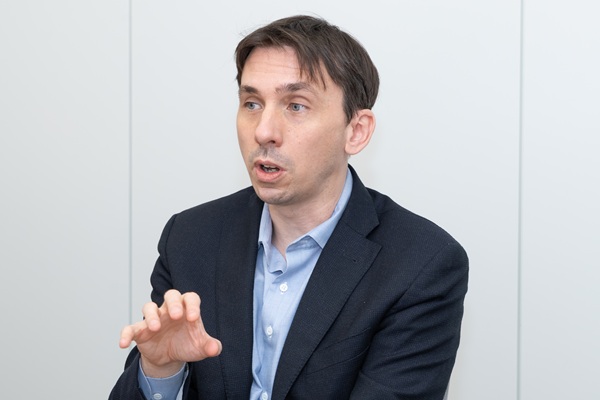
Sato: In recent years, we have generally chosen not to obtain trademarks for the names of technologies or services themselves and instead have mainly adopted the format ”NEC + generic name”. The reason is that by using the recognition and trust associated with the NEC master brand, it is easier to maintain a consistent corporate image. It also helps to communicate the function and role of a product or service more clearly, improves searchability, and makes it easier to explain in business discussions. On the other hand, when something is positioned as a flagship brand, when there are commercial distribution considerations, or when it is difficult to replace the name with a generic term, we proceed with trademark searches and applications. In the past, we also used an approach in which many products were given their own unique names. However, as the number of similar products increased, this became difficult for both customers and people within the company to understand. In addition, maintaining a large number of small brands did not always contribute to enhancing the overall value of NEC. Today, with NEC as the core, our approach is to focus on a select number of brands that we intend to nurture and strengthen. For the rest, we are organizing them into a product structure that is easy to understand. In this way, we are trying to optimize the whole portfolio and manage it efficiently.
Wakamatsu: Of course, that does not mean past product and service names will disappear completely. Many customers have used them for years and have come to associate those names with a sense of trust and familiarity.
Bouillaut: Even as we reduce the overall number of trademarks held across the company, our current key strategy is to focus on promising trademarks that we want to promote as a company, such as our flagship brand NEC BluStellar and the generative AI technology brand NEC cotomi. Many B2C companies need to manage a much broader portfolio. However, because NEC is a B2B company, we are able to narrow our focus onto a smaller number of trademarks and concentrate our resources on them. That allows us to manage trademarks in a highly cost-effective way.
Wakamatsu: Consolidating brands also allows us to carefully define the usage rules for each individual brand and trademark. It also makes it possible to respond more effectively to internal inquiries about how they should be used in practice. In order to protect proper trademark usage and foster brand growth, it is essential to build these kinds of systems in a solid and structured way. From this perspective as well, narrowing the number of trademarks carries very significant meaning.
NEC BluStellar has been rolled out quite extensively, hasn’t it?

Wakamatsu:NEC BluStellar is a value creation model that helps customers achieve transformation through cutting-edge DX technologies. By increasing the appeal and visibility of this brand across the entire NEC Group, we believe we can enhance brand value and provide greater value to our customers. As many companies develop their own DX brands, NEC launched this brand to offer services with DX positioned clearly at the forefront.
Through NEC BluStellar, we hope a wide range of stakeholders will come to recognize the NEC Group’s advanced technological capabilities and services, and thereby contribute to an increase in corporate value. Looking to the future, we even see the possibility that NEC BluStellar could establish itself as the leader in the field of DX and one day come to stand on its own as a DX brand with unique and powerful value.
If more people begin to say, “When it comes to DX, it has to be NEC BluStellar,” or “I want to use it because it’s NEC BluStellar,” that will not only increase the value of the services themselves, but also elevate the brand value of NEC as a whole. We believe creating mechanisms that allow trademarks like this to be used broadly and proactively is an important activity that will strengthen the NEC brand overall and contribute to the company’s sustainable growth in value.
The rewards of leading trademark strategy across the entire NEC Group
What do you think makes trademark work at NEC especially interesting?
Wakamatsu: When I previously worked at a patent firm, my role was mainly to help a wide variety of clients realize the policies and intentions they would communicate to me. At NEC, however, I can work directly with the business divisions, listen to their needs, and advise on more optimal approaches and present strategies while also keeping company-wide policy in mind. What makes the work especially interesting is being able to get involved at a much earlier, more upstream stage. In addition, because our group handles inquiries and responses regarding all NEC Group trademarks, we are in a position to gain a comprehensive understanding of company-wide trademark issues and consider appropriate measures. I also find it rewarding that, once measures are put into action, they can lead to improvements very quickly.
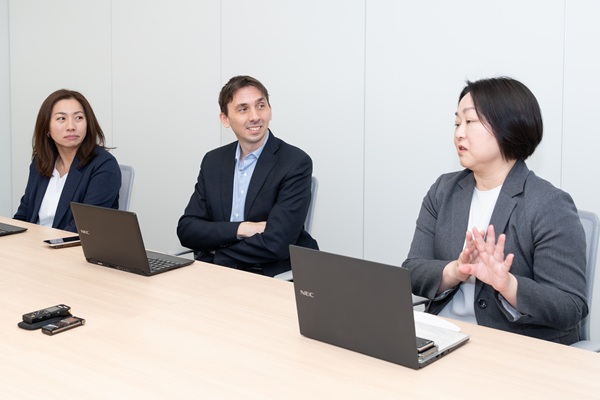
Bouillaut: I also used to work at a law firm, but my work there was mainly focused on technical matters such as similarity searches and prior trademark searches. In contrast, working in a corporate setting allows me to think about how to nurture a brand from an intellectual property perspective. Since joining NEC, I have been able to consider a wider range of issues, such as which countries to file trademark applications in, what policies should govern trademark licensing within the NEC Group and to third parties, and how we should defend trademarks against unauthorized use. This is only possible because NEC has narrowed down the trademarks it should focus on and invests sufficiently in each one. Practically speaking, I think it would be very difficult for a company to make this level of investment if it has to protect and promote a large number of trademarks.
Sato: I have spent my entire career at NEC, so it is difficult for me to make comparisons with other organizations. Still, when I see names like NEC BluStellar and NEC cotomi being used so prominently outside the company, I really feel like the work that I do is directly connected to the business.
Bouillaut: There are also large advertisements in places like Toranomon Hills and the underground area around Mita Station. It gives you a sense of joy to see them, doesn’t it?

Stable brand growth starts with thorough management
What are your goals moving forward?
Sato: Up until now, most of my work has focused on protecting trademark rights, but going forward I would also like to be involved in initiatives such as establishing trademark usage guidelines so that I can help ensure trademarks are used appropriately and effectively. In addition, NEC has many group companies, including overseas affiliates, so I hope to contribute to managing trademarks from the perspective of the group as a whole. I would like to help strengthen integrated brand management across the entire NEC Group.
Wakamatsu: Yes, the way trademarks are used can have a major impact on brand value, so managing their use is a very important issue. If we can manage trademark usage in a consistent and unified way, the value associated with those trademarks will properly accrue to the trademarks themselves and to the way they are used. As a result, this can contribute to enhancing both the value of the trademark rights themselves and the overall value of the brand. Furthermore, it should also allow us to add the value of brand strength and enhance the NEC Group’s outstanding products, services, and technologies. For example, as I mentioned earlier with NEC BluStellar, if the value of NEC BluStellar itself grows to the point where it rivals that of NEC, and people begin to say, “I want to use it because it’s NEC BluStellar,” then NEC BluStellar itself could become an investment target in its own right and contribute to the value of the company. For that very reason, it is important, first of all, to use trademarks correctly. That is why I would like us to continue developing clear rules for trademark usage and ensuring that trademarks are managed appropriately.
Bouillaut: Brands such as NEC and NEC BluStellar are the very image of our company. They are both the first and last interface between our customers and us, and they are directly connected to sales. That is why we have to nurture them with great care. Proper management is therefore critically important. That is why I believe it is essential for us, even as a B2B company, to continue raising awareness across the group of just how important branding is, while also ensuring that our brands are used in accordance with established guidelines and properly protected. That, in my view, is essential to building our future. I would like to help foster a shared mindset across the entire group about how to most effectively grow our brands and support them together.
- *Affiliations and titles mentioned were those at the time of the interview.