
Global Site
Displaying present location in the site.
NEC’s Environmental Initiatives During the New Mid-Term Management Plan Period
Note: The following dialogue was held on March 2026.
The NEC Sustainability Advisory Committee, which started in 2022, holds regular dialogues with outside experts with the aim of confirming the direction of the Company's sustainability management and improving its initiatives.
At this ninth session, CFO Fujikawa, responsible for sustainability promotion, explained the direction of the new Mid-Term Management Plan (starting in fiscal year 2026), followed by a presentation from CSCO Ide on approaches to environmental impact mitigation in the AI era. CRCO Tamefusa and Sugahara, Head of the Corporate Planning and Sustainability Promotion Division, also participated in the dialogue.
The experts suggested that to balance enhancing corporate value with addressing societal demands, it is essential to understand and implement fundamental challenges based on scientific evidence and a medium to long-term perspective, as well as to engage in strategic disclosure. ※The job title is as of the time the dialogue is held.
Approach to Climate Change Targets, Including Scope 3
The NEC Group is further accelerating its efforts to achieve its goals of becoming carbon neutral by 2040 and reducing greenhouse gas emissions by 50% by 2030. While we have been advancing the adoption of renewable energy and facility improvements within our own operations, strengthening collaboration with suppliers has become a critical challenge, as Scope 3 accounts for the majority of our emissions.
The comments received from experts are as follows:
- Scope 1 and 2 emissions should be steadily reduced as the company’s own responsibility.
- It is important to carefully explain the details of initiatives, their difficulty, and implementation plans.
- Since Scope 3 emissions depend on the actions of suppliers and customers, there are limits to what a single company can manage on its own. While continuing engagement with its own suppliers, the company should pursue cross-industry efforts, such as standardizing surveys and data exchange.
Connectivity between Initiatives for Climate Change and Corporate Value Enhancement
NEC positions climate change as a theme with significant environmental and social impact in its new mid-term management plan, which begins in April 2026. Regarding this positioning, we received the following comments from experts:
- Mr. Pedersen: “Shouldn’t you place climate change response at the center of your business strategy, taking into account scientific evidence as well as economic and business viability?”
- Mr. Nakajima: “Publicly listed companies have the capacity to develop technologies and products that address environmental challenges, including climate change mitigation. I encourage you to pursue initiatives that only large corporations-those with both technological capabilities and market influence-are uniquely positioned to lead.”
- Ms. Nagai: “Precisely because we are currently facing an ESG backlash, I hope you will identify what is truly necessary for your business strategy through medium- to long-term scenarios and develop businesses that leverage its strengths.”
- Mr. Horii: “It is crucial to view climate change as a factor that could erode future corporate value, examine both risk and opportunity scenarios over the medium to long term, and clarify the areas that should be prioritized.”
Reflecting on the “Mid-Term Management Plan 2025” Period
Fujikawa reflected on the sustainability initiatives undertaken during the “Mid-Term Management Plan 2025” period, which spanned five years from fiscal year 2021, as follows:
“Since assuming the role of CFO in 2021, as an executive also responsible for sustainability, I have been keenly aware of the connectivity between ESG initiatives and enhancing corporate value. Introducing the concept of materiality using a corporate value calculation formula was part of that effort. Furthermore, when formulating the new Mid-Term Management Plan, we redefined NEC’s desired future state through a backcasting approach. Although my role will change going forward, I will continue to carry out necessary tasks, such as ensuring compliance with legal and regulatory requirements regarding NEC’s ESG initiatives. At the same time, as the scope of AI applications and the pace of its evolution surpass our imagination, I am determined to transcend conventional thinking, proactively seize new opportunities to contribute to society, and further advance our corporate value.”
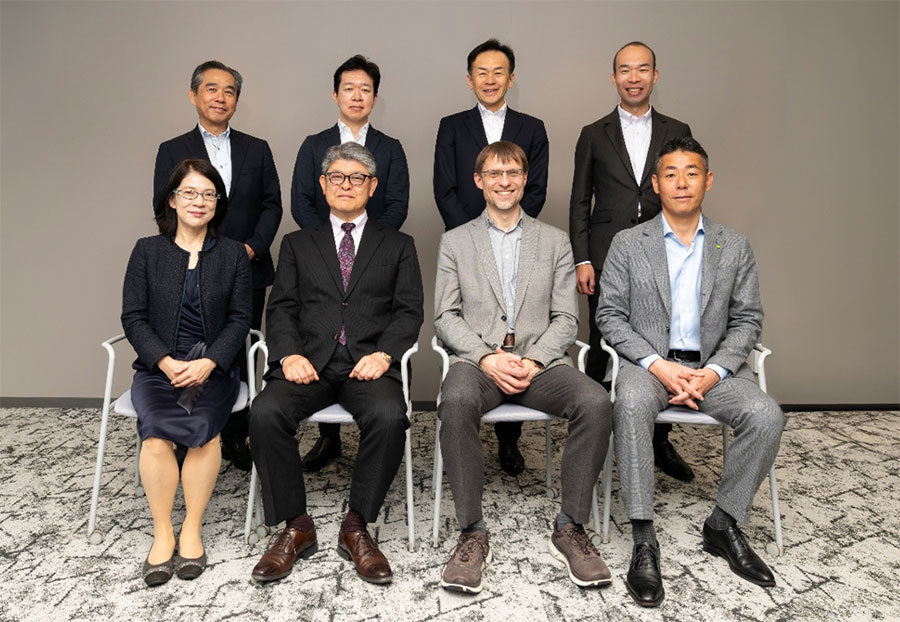
(Front row, left to right) Nagai, Horii, Pedersen, and Nakajima.
Guest member (outside expert)
Fumihiro Nakajima
Joined Deloitte Tohmatsu LLC in 2016, serves as a Director of ESG & Sustainability Advisory.
Experiences in the client projects include Materiality Assessment, Sustainability/ESG Strategy Planning, TCFD Scenario Analysis, External ESG Assessment Improvements, etc.