Global Site
Breadcrumb navigation
How can we create value that is uniquely our own in the age of AI?
— Students and NEC employees envision the future in 2035
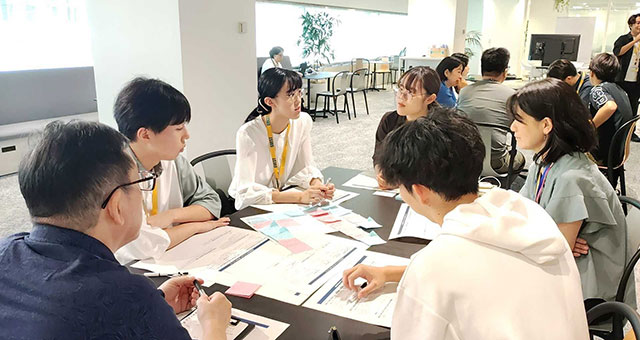
As generative AI continues to evolve, the way we learn and work is beginning to change dramatically. Against this backdrop, questions such as "What are the things that only humans can do?" and "What kind of value can I create in the age of AI?" are becoming increasingly important.
To provide an opportunity to explore these questions, the NEC Pro Bono Club, a volunteer group of NEC Group employees, collaborated with the Waseda Career Society, a student organization officially recognized by Waseda University, to convene a one-day workshop at NEC headquarters on careers in the age of AI in August 2026. This was the third collaborative event organized by the two groups since they began working together in 2025.
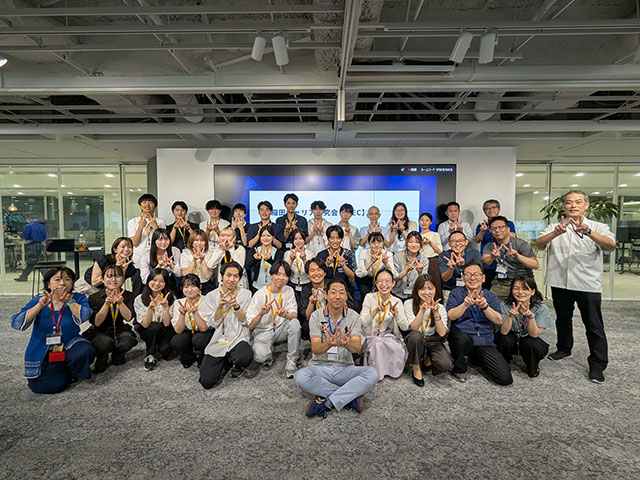
The workshop brought together 25 students and 16 NEC Group employees. The theme was "How will we live in 2035, when AI is part of everyday life?" Students and working professionals alike took part as people who will live in this future, exploring both the opportunities and challenges of an AI-driven society while engaging in deeper discussions about the value each of us can uniquely create.
Finding your own voice
This workshop aimed to help participants clearly articulate the role they will play in a future where AI is part of everyday life. The employees who took part were not there to offer answers. Rather, they focused on sharing their experiences and insights on harnessing AI while envisioning the future together with the students.
First, through an introductory presentation on NEC technologies, students were able to envision a future in which AI is the norm as an extension of the present. Then, in discussions with employees about the rewards and challenges of their work and how AI is currently utilized in the workplace, students explored what society and workplaces might look like in 2035.
Considering the respective roles of AI and humans
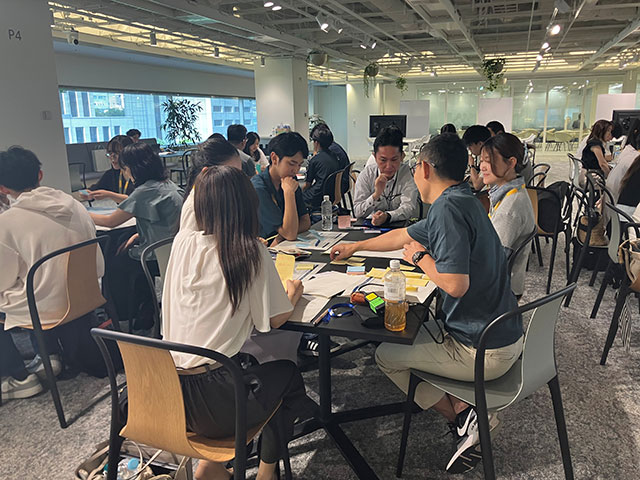
Workshop participants also discussed the respective roles of AI and humans in the era of AI, along with the kind of value people will be expected to provide.
During these discussions, some participants pointed out that while AI may take on tasks like processing information and streamlining operations, roles involving making final decisions, shouldering responsibility, and devising plans and concepts will become increasingly important roles undertaken by humans. Additionally, concerns were raised about how to evaluate AI-generated results, and the potential emergence of a new divide between those who are well-versed in using AI and those who are not. In terms of the types of value that only humans can provide, participants mentioned the ability to understand others through active listening, the capacity to align diverse opinions and build consensus, the creativity to brainstorm new ideas, and the ability to build trusting relationships.
In the latter half of the workshop, each group presented their visions and proposals for the future based on the theme, "What kind of future can we create through our awareness and actions today?" Listening to the presentations made by other groups, participants were exposed to various values and perspectives, resulting in an even more in-depth discussion.
Viewing students and employees alike as stakeholders in the future
Feedback received from employees following the event included: "This workshop allowed me to witness firsthand the real thoughts and values of students," "I gained a new perspective on navigating AI," and "This proved to be an excellent chance to rethink my own future and career path."
Meanwhile, students offered comments such as, "It was quite challenging to delve into a highly abstract theme like 'Coexisting with AI and defining uniquely human value,' but I found the process of exploring this theme and arriving at a single conclusion through group discussion with employees interesting," "Listening to the perspectives of working professionals was incredibly inspiring," and "Being able to hear employee insights and experience the NEC workplace firsthand was valuable for me."
This workshop was not one in which students merely learned from employees or employees provided support unilaterally. Rather, it allowed students and employees to grapple with questions and think more deeply about their own value and role as we approach a future in which AI will become a part of our everyday lives.
Toward a future where anyone can show their humanity
Even as AI continues to evolve, it is humans who must decide which roles should be undertaken by people rather than machines. It is in addressing the question of how to evaluate results, bridge diverse perspectives, and generate new ideas that we can discover the kind of value that only humans can provide.
NEC is a company whose Purpose is to "create the social values of safety, security, fairness and efficiency to promote a more sustainable world where everyone has the chance to reach their full potential." This workshop, in which diverse individuals engaged in sustained dialogue, leveraging their experiences and strengths to contemplate the future, perfectly aligns with this Purpose.
AI will become part of our everyday lives. Once that happens, what will constitute value for us as humans? This collaborative event between NEC and the Waseda Career Society allowed students and employees alike to address this question and consider not only their own potential but also their future.
Related Links
- Paving the way to a new future with industry-academia partnerships: A problem-solving workshop focused on personnel development and social value creation, held in collaboration with the Waseda Career Society (in Japanese only)
- Looking forward to an exciting future! Collaborative workshop on resolving societal issues held together with the Waseda Career Society (in Japanese only)
 Waseda Career Society (in Japanese only)
In 2010, NEC became the first company in Japan to launch a pro bono program. A decade later, in 2020, employee volunteers from the NEC Group established the NEC Pro Bono Club, a pro bono community helping to address challenges faced by local communities, NGOs, NPOs, educational institutions, and others. Today, the NEC Pro Bono Club comprises approximately 900 employees.