Global Site
Breadcrumb navigation
Digital skills and the hope they provide for the future: Untapping the potential of Ethiopia's youth in collaboration with IOM
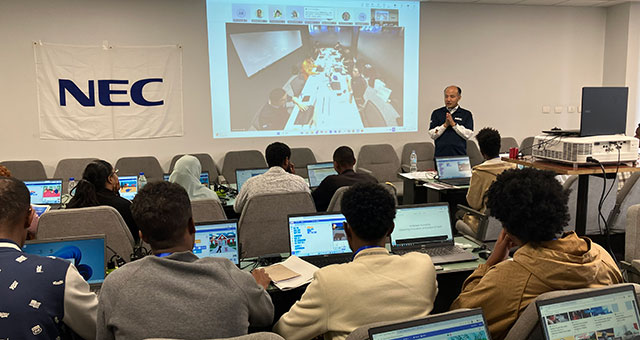
With the rapid advancement of AI and other digital technologies, digital skills are growing increasingly important. Having evolved beyond specialized knowledge into a catalyst for expanding career and learning opportunities, these digital skills are also unlocking future potential. Meanwhile, many youth lack adequate access to learning and employment opportunities. In particular, young migrant returnees face numerous challenges as they reintegrate into society and plan out their future career paths.
On World Youth Skills Day, celebrated on July 15, 2026, NEC held an educational support program for 30 young Ethiopian migrant returnees. This program is an initiative based on the Memorandum of Understanding (MoU) on Educational Support for Ethiopian Returnees concluded between NEC and the International Organization for Migration (IOM) in December 2025. Through this program designed to support youth as they reintegrate into society and plan their future careers, NEC employees provided educational opportunities by applying their digital skills and expertise.
Through its pro bono initiatives, NEC partners with various communities and organizations to create social value by leveraging the professional expertise of its employees. As part of these ongoing efforts, this recent program was a new challenge aimed at expanding future opportunities for every participant.
Digital education aimed at expanding future options for youth
World Youth Skills Day is an international day established by the United Nations to promote a deeper understanding of the importance of young people acquiring skills and engaging in vocational training. This recent program was held in accordance with this objective.
In Ethiopia, helping young migrant returnees reintegrate into society and expanding their employment opportunities have become important issues. With the growing demand for human resources in the digital sector in recent years, expectations for ICT and digital skills have also risen. In light of this, the IOM is undertaking an initiative to train young professionals as part of its efforts to support migrant returnees. Recognizing the importance of this initiative, NEC decided to provide educational support by leveraging its expertise and human resources.
What makes this initiative especially meaningful is that it goes beyond simply teaching knowledge and skills. Instead, it seeks to provide opportunities for participants to realize their own potential, contemplate their future, and embark on a new chapter. Acquiring digital skills not only leads to more employment opportunities but also broadens future options.
A 60-year history of trust built together with Ethiopia
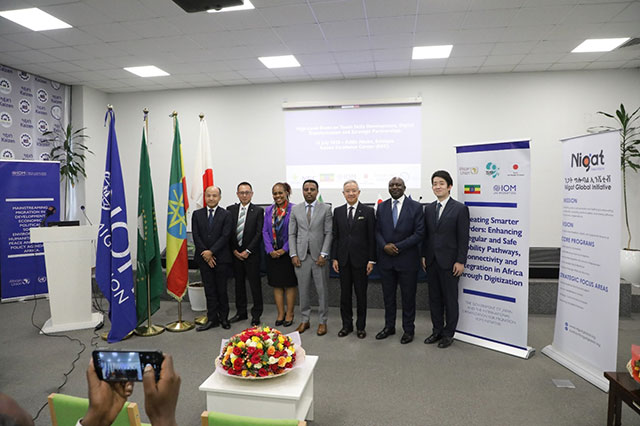
(Third from right) Ambassador Noboru Sekiguchi, Ambassador of Japan to the African Union
The delivery of telecommunication equipment to Ethiopia in 1963 marked NEC's first foray into Africa. Since then, NEC has partnered with various UN organizations to advance initiatives such as ICT-enabled agricultural support and livelihood recovery support utilizing an electronic voucher system. The experience and relationships of trust cultivated through these long-standing activities resulted in the signing of an MoU with IOM in December 2025 and the initiation of this recent educational support program.
NEC also took on this challenge in response to the newly emerging issues of social reintegration and career development for young migrant returnees by utilizing the expertise in ICT and human resource development it has cultivated over many years. This marked the first step toward co-creation aimed at unlocking new opportunities with the youth shaping Ethiopia's future.
Unlocking new opportunities through programming and space
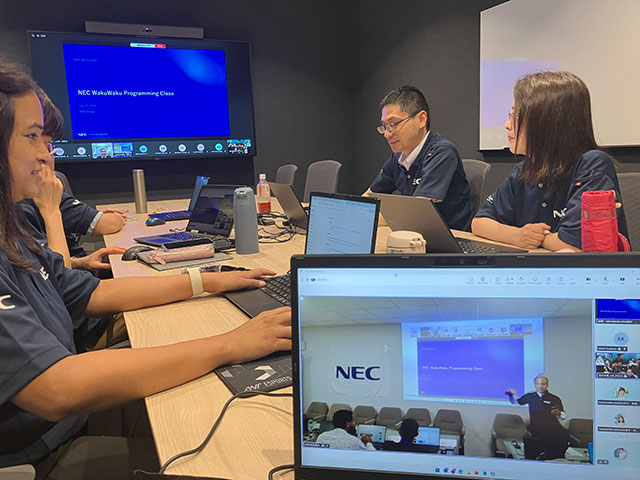
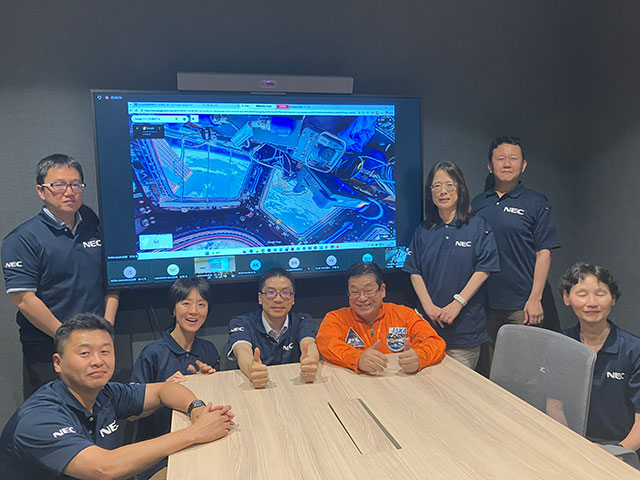
This program, run in collaboration with IOM and the JICA Kaizen Excellence Center (KEC), was offered in a hybrid format, connecting Addis Ababa, Ethiopia, with the NEC Tamagawa Office in Japan. Thirty young migrant returnees participated in the program.
Comprised of a Basic Programming Class and a Space Class, this program was organized and operated by NEC employees as part of a pro bono initiative in which they utilized their technical expertise and specialized knowledge to plan and deliver educational content, as well as to teach the classes.
In the Basic Programming Class, participants used Scratch to learn logical thinking and programming fundamentals. Participants enjoyed solving problems independently through trial and error while working on assignments as if it were a game.
Meanwhile, in the Space Class, participants learned about space development and the latest technologies, as well as the importance of international cooperation. By using space as a gateway to spark interest in science and technology, the class also aimed to encourage participants to think about their future learning and careers.
Programming and space may seem like topics from a distant world. However, exposure to new knowledge can inspire the realization that "I might be able to do this too." That small realization can be the first step toward a new future.
Providing an opportunity to envision the future
In a post-program survey, 93.4% of respondents said that the program had increased their motivation to learn. Participants also shared comments such as, "I want to learn more about programming" and "I want to become an engineer or scientist in the future."
The learning experience went beyond simply acquiring knowledge. For participants, it provided an opportunity to take a proactive approach to thinking about their futures and envisioning their own potential and possible career paths.
Kunikazu Akao, Programme Coordinator (Border Management) at the IOM AU Special Liaison Office, commented: "Digital education is important for the social integration of young migrant returnees. We are grateful for our collaboration with NEC and look forward to its further development."
Toward a society where everyone can realize their potential
NEC's Purpose is to create the social values of safety, security, equality, and efficiency and to realize a sustainable society where everyone has the chance to reach their full potential. Providing educational opportunities and contributing to the development of digital talent are among the ways NEC puts this Purpose into practice.
This program was about more than providing educational support to 30 young people. Building on the outcomes of this initiative, NEC and IOM are considering continuing educational support programs in Ethiopia and expanding new ICT and digital education content.
Each person's learning can lead to greater confidence, open up new possibilities for the future, and ultimately become a source of strength for society. NEC will continue to harness the power of technology and people to help create a society where everyone can realize their potential.
Related Links
 International Organization for Migration (IOM)
The International Organization for Migration (IOM), a United Nations agency, was established in 1951 and is the only UN organization that comprehensively addresses issues related to human mobility and migration worldwide. It works toward achieving "safe, orderly and regular migration for the benefit of all." Through direct assistance to individual migrants, support for host communities, technical cooperation with countries concerned, advice on regional cooperation related to human mobility, and related research, IOM works to address challenges associated with migration and human mobility.
In 2010, NEC became the first company in Japan to launch a pro bono program. A decade later, in 2020, employee volunteers from the NEC Group established the NEC Pro Bono Club, a pro bono community helping to address challenges faced by local communities, NGOs, NPOs, educational institutions, and others. Today, the NEC Pro Bono Club comprises approximately 900 employees.