
Global Site
Breadcrumb navigation
VDURA
NEC Corporation + VDURA: Modernizing Mission-Critical Data Infrastructure Across the Globe
Storage that keeps every GPU and CPU productive. The VDURA Data Platform combines flash-speed parallel file performance with cost-efficient capacity in a single global namespace, so research and AI infrastructure delivers more results per dollar and per watt. Designed, integrated, and supported worldwide by NEC.
Why NEC + VDURA
NEC brings decades of HPC systems integration, delivery, and support across research, government, and enterprise. VDURA brings a high performance data platform with more than 25 years of parallel file system innovation: founded in 1999 as Panasas by Garth Gibson, co-inventor of RAID, VDURA technology has powered over 1,000 production deployments across 50+ countries, including some of the world's most demanding research and defense environments.
Together, NEC and VDURA deliver intelligent, agile, and resilient storage for the most data-intensive workloads: AI training and inference, scientific simulation, genomics, and engineering design.
Fund More Compute from the Same Budget
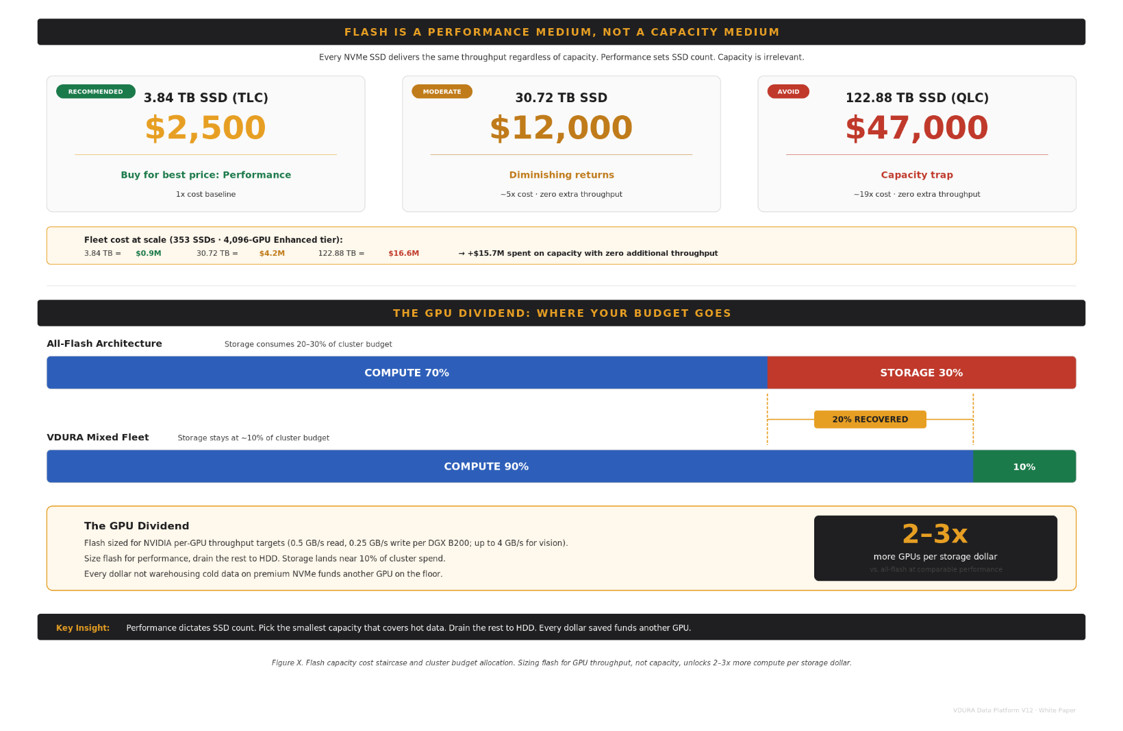
Enterprise SSD prices jumped 53 to 58 percent in a single quarter (Q1 2026, TrendForce), and NAND volatility shows no sign of settling. Organizations locked into all-flash storage absorb that volatility directly. Hyperscalers such as Google, Meta, and Microsoft avoid it by design: they treat flash as a performance medium, not a capacity medium, pairing a lean NVMe tier with high-density HDD capacity behind intelligent tiering.
The VDURA Data Platform brings that same playbook to every data center: NVMe flash and high-density HDDs in one global namespace, one control plane, and one data plane, with automatic data placement. The result is 60%+ lower total cost of ownership than all-flash architectures at similar performance, 2x+ performance per watt versus peers, and insulation from flash price swings. Every dollar and every watt saved on storage is budget that can fund more compute.
VDURA Data Platform V12
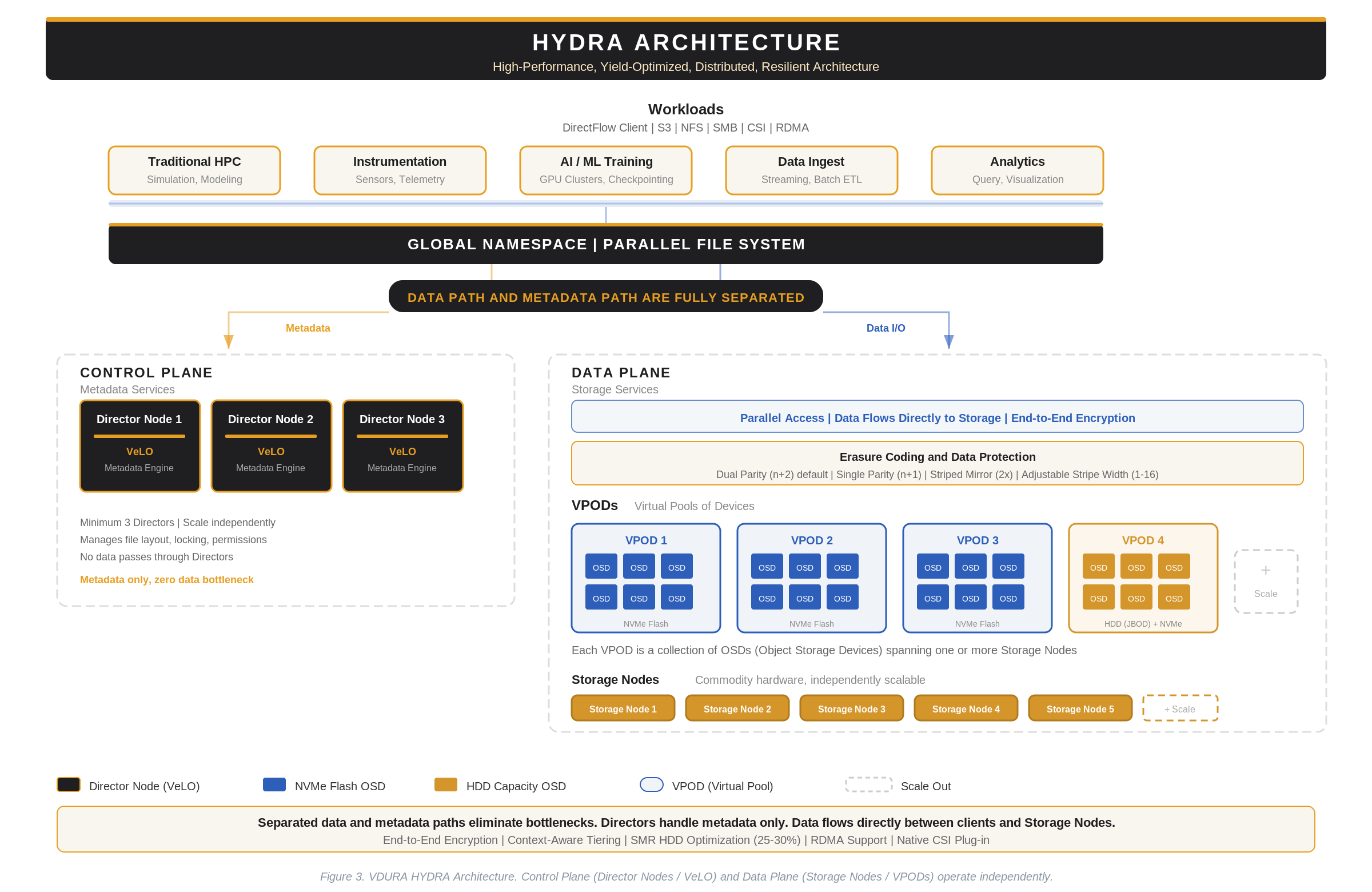
The VDURA Data Platform V12 is a fully software-defined, microservices architecture that combines the speed of a true parallel file system with the durability and cost-efficiency of resilient object storage. It is built on HYDRA (High-Performance, Yield-Optimized, Distributed, Resilient Architecture): the DirectFlow client library provides direct, parallel I/O from compute to storage; Director Nodes running the VeLO metadata engine form the control plane; and storage nodes hosting VPODs, self-contained protected object devices, isolate failures to a single virtual unit rather than a whole server.
What's new in V12:
- • Elastic Metadata Engine: up to 20x faster metadata operations, supporting billions of files and objects under active use
- • RDMA support (available now): GPU-to-storage data transfers that bypass the CPU entirely
- • Context-Aware Tiering: intelligent data placement for AI workloads, including KV-cache writeback for inference
- • Snapshot support: instantaneous, space-efficient point-in-time copies for checkpoints and recovery
- • SMR HDD optimization: 25 to 30 percent more capacity per rack without compromising throughput
- • End-to-end AES-256 encryption with KMIP key management, and a native CSI plug-in for Kubernetes
Platform Capabilities at a Glance
| Capability | Specification |
|---|---|
| Throughput | Terabytes per second potential with linear scaling; up to 2.7 TB/s per all-flash rack |
| Scalability | Exabyte capacity, up to 1,500 nodes per cluster; up to 26 PBe per rack with HDD expansion |
| Durability / availability | Up to 12 nines durability (all-flash), 11 nines (hybrid); six nines+ availability in production |
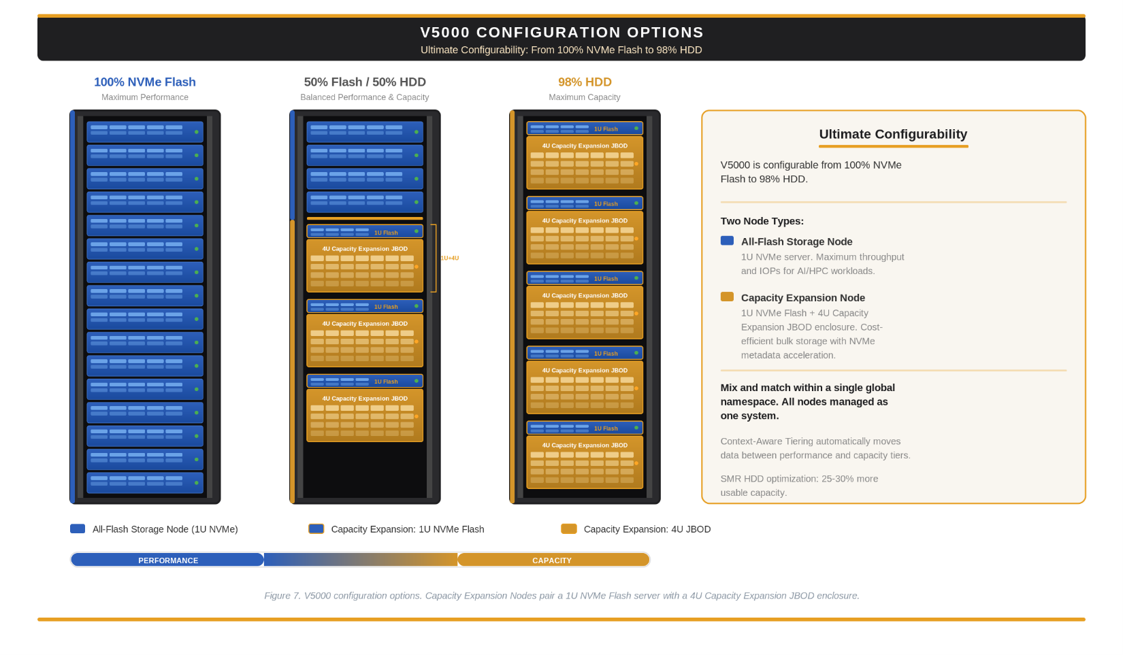
| Media support | NVMe SSD (TLC/QLC) + SATA HDD (CMR/SMR/HAMR/HBHDD); configurable 100% flash to 98% HDD |
| Protocols | POSIX/DirectFlow, NFS, SMB, S3, CSI, RDMA |
| Networking | 400/200/100 GbE, InfiniBand NDR/HDR, RoCE v2 |
| Security | AES-256 end-to-end encryption, KMIP key management |
| Operations | Self-healing, non-disruptive expansion, zero-downtime upgrades; GUI, CLI, or API |
Use Cases
AI and GPU Clusters
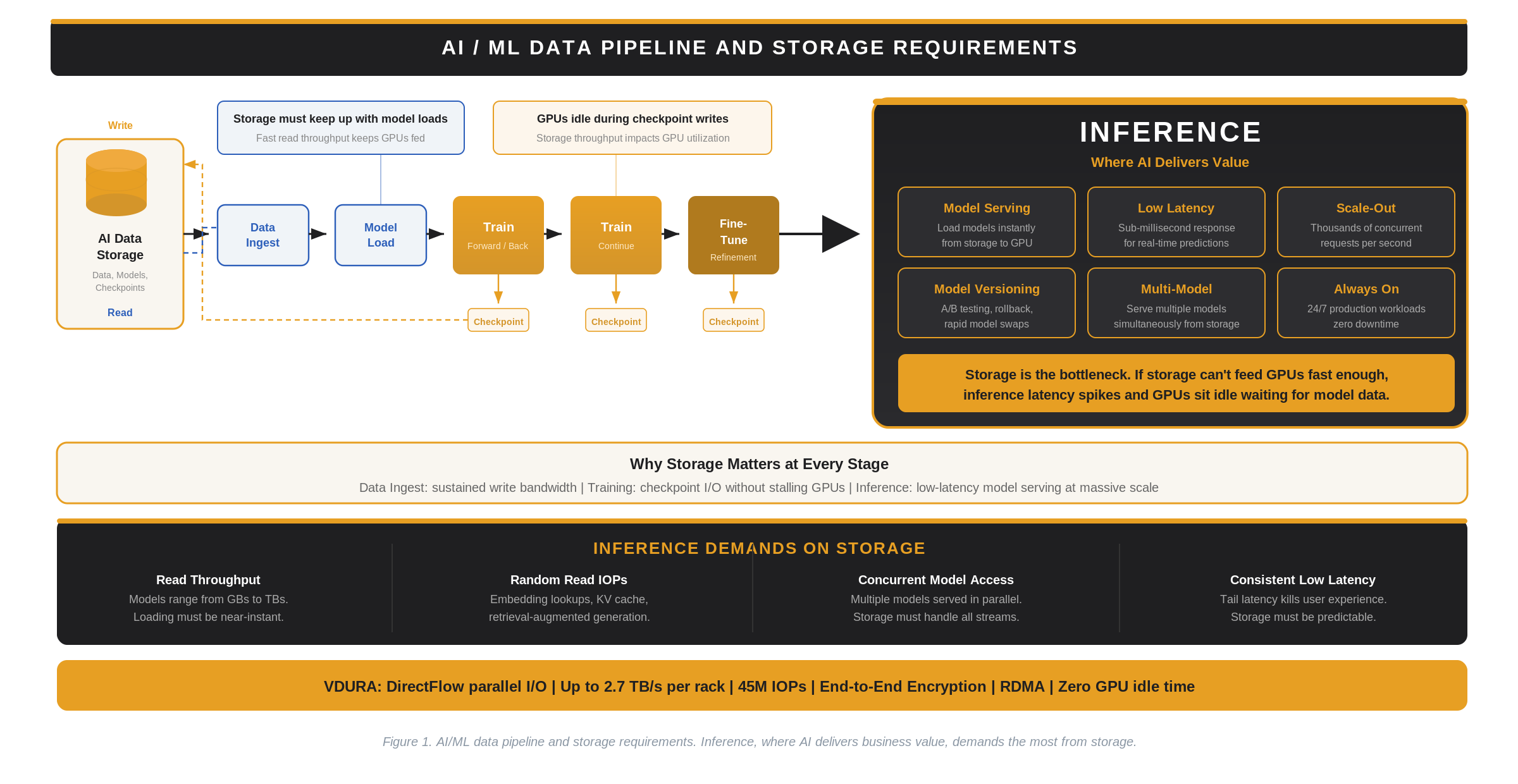
Idle GPUs are the most expensive waste in high performance infrastructure. VDURA keeps accelerators fed at every pipeline stage: parallel ingest, high-throughput model loading and training, burst checkpoint writes, and low-latency inference. RDMA moves data from storage to GPUs with no CPU in the path, VeLO sustains billions of metadata operations per second for small-file and high-concurrency workloads, and NVIDIA and AMD per-GPU throughput guidelines are met with linear scaling.
Scientific Research and HPC
From climate modeling to particle physics, research computing needs storage that scales with the science. VDURA delivers parallel throughput to thousands of concurrent clients in one global namespace, with proven deployments at national-lab scale, including a 20 PB+ federal environment sustaining more than 800 GB/s in production.
Life Sciences and Genomics
Cryo-EM instruments, sequencers, and AI-driven discovery pipelines generate relentless data streams that need high-throughput ingest and cost-efficient long-term retention. VDURA combines both in one encrypted namespace, with up to 12 nines durability, multi-protocol access, and deployments across leading research institutions, academic medical centers, and pharmaceutical companies worldwide.
Mechanical Design and Simulation
CAE and CFD workloads mix large sequential simulation files with metadata-heavy pre- and post-processing. VDURA's Dynamic Data Acceleration aligns each I/O pattern with the right media automatically, keeping engineers productive and clusters fully utilized.
Validated with the Leaders in AI Infrastructure
- • AMD: co-developed the industry's first scalable GPU storage reference architecture: 32-node Scalable Units with 256 AMD Instinct MI300 Series GPUs and 5 PB usable storage per rack. The V5000 platform is built on AMD EPYC 9005 (Turin) processors.
- • NVIDIA: deep ecosystem integration with ConnectX-7 networking and RDMA GPU-to-storage transfers; exceeds NVIDIA DGX B200 per-GPU throughput specifications.
- • Open and software-defined: runs on qualified commodity platforms (Dell, Supermicro, AIC, and others), avoiding storage appliance lock-in.
Proven in production: 1,000+ deployments across 50+ countries, exabytes under management, a world-record 282 PB data lift at SC24, and industry recognition including CRN's 50 Coolest Software-Defined Storage Vendors and HPCWire Readers/Editors Choice Top 5 Vendors to Watch.