
Global Site
Breadcrumb navigation
UDTS
NEC Ultra-High-Speed Data Transfer SystemStop waiting for transfers. Start waiting for results.The Challenge
As data volumes rapidly increase in research environments, data movement — not compute performance — has become the key bottleneck. Research data driven by observation, simulation, and AI has rapidly grown to TB- to PB-scale, yet transfer infrastructure has not kept pace.
| The Challenge | What UDTS Delivers |
|---|---|
| Transfer of large-scale datasets between HPC and storage systems takes significant time, and available network bandwidth is not fully utilized | Dramatically reduces transfer time for large-scale datasets by fully utilizing available network bandwidth |
| Data transfer across distributed research sites and international collaborations is slow and unreliable | Supports inter-institutional sharing, backup, and international collaboration across distributed research environments |
| Data movement relies heavily on manual operations by researchers or administrators, increasing operational overhead | Enables automated, workflow-integrated transfers — reducing manual intervention and freeing researchers to focus on their work |
Use Cases
UDTS is designed to address the most common and demanding data transfer scenarios in research environments.
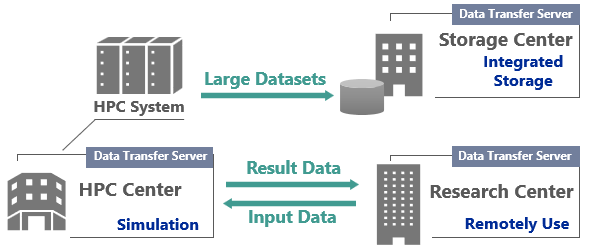
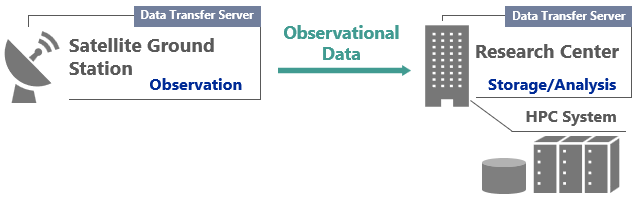

| Use Case | Research Setting | What UDTS Enables |
|---|---|---|
| HPC Data Transfer & Remote Use | HPC centers, research institutes, and storage facilities across multiple sites or national boundaries | TB-scale datasets moved rapidly between sites — distributed teams can work as if resources were local |
| Observational Data Transfer | Remote observatories, satellite ground stations transferring data to research centers or HPC systems | Large observational datasets transferred dramatically faster, enabling timely analysis |
| Secure Transfer of Sensitive Data | Research and medical institutions exchanging sensitive data such as medical images and genomic data | Fast, encrypted transfer without compromising data protection — speed and security in a single solution |
Features
UDTS achieves high performance through a combination of proprietary transfer optimization, flexible protocol support, and deep integration with research infrastructure.
Maximized Bandwidth Utilization
- Parallel processing — multi-threading and multi-session — fully utilizes available network bandwidth (e.g., 100 Gbps)
- Achieves high-speed disk-to-disk transfer that dramatically reduces the time required to move large datasets
Optimized Transfer for Mixed Workloads
- Large files are divided into fixed-size blocks and transferred in parallel to maximize throughput
- Small files are aggregated into blocks and transferred as a single batch to improve efficiency
Flexible Protocol Selection
- Supports both TCP and UDP-based transfer modes, allowing flexible selection based on use case and network environment
- Proprietary algorithms overcome inherent UDP limitations — including packet loss and congestion — for reliable high-speed transfer
Seamless Integration and Automation
- Can be used standalone or integrated with job schedulers and workflow systems
- Enables automated data transfer based on defined conditions, reducing operational overhead
Security and Data Protection
- Encrypted transfer protects data in transit
- Secure communication with certificate-based authentication
- Data integrity verification detects corruption during transfer
- Resume capability ensures reliable delivery — interrupted transfers continue from the last checkpoint
Architecture
UDTS consists of data transfer servers deployed at each site, connected via high-speed networks. Each server is equipped with high-performance NVMe storage and a 100GbE network interface, enabling high-speed disk-to-disk transfer between sites.
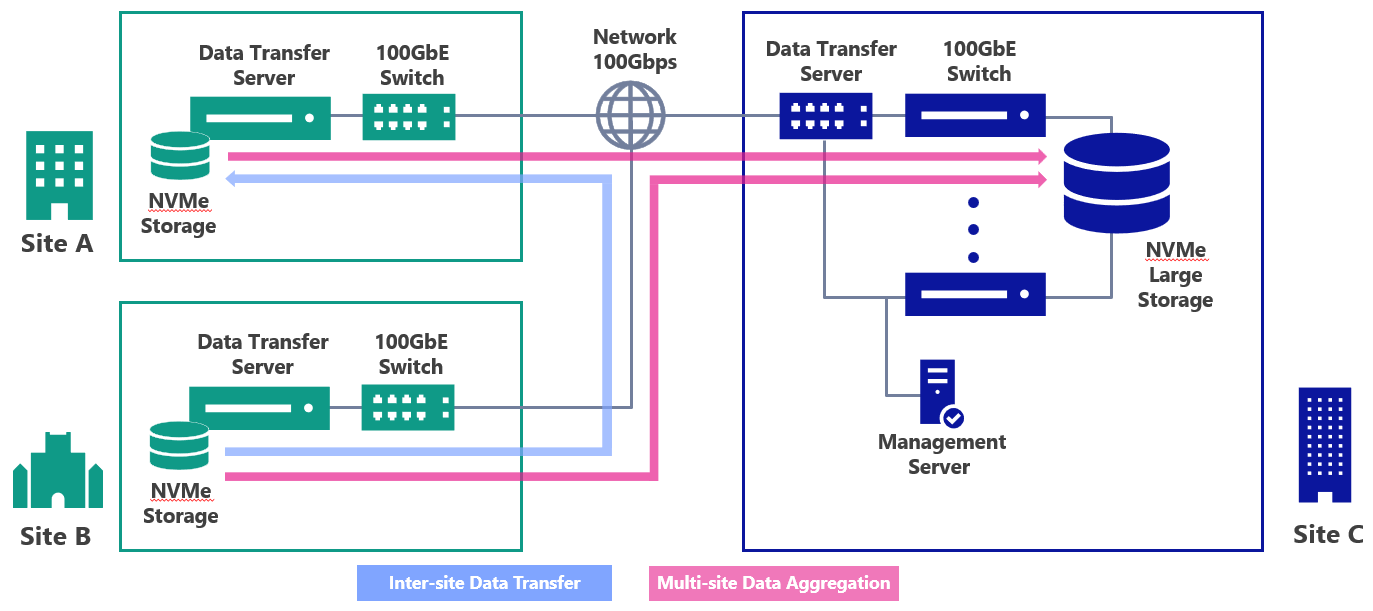
UDTS Architecture — Example of Multi-Site High-Speed Data Transfer
| Data Transfer Server | Provides high-performance data transfer with 100GbE NICs, NVMe storage, and UDTS software |
| 100GbE Network Switch | Provides high-bandwidth switching to connect transfer nodes |
| RoCE / InfiniBand Switch | Enables high-performance connectivity to external storage (configuration-dependent) |
| Management Server | Handles monitoring, logging, and access control (authentication and authorization) |
| External NVMe Storage | Provides shared, scalable storage capacity for multiple transfer servers |
Contact
To learn more about UDTS or discuss how NEC can support your research data transfer needs, please get in touch.