
Global Site
Breadcrumb navigation
Streamlining the entire IP process with generative AI and original AI:
IP DX transformation at NEC
Featured Technologies January 19, 2026

Generative AI is seeing a spread from general-purpose uses to application in technical areas. Since intellectual property operations primarily handle text data, it is very compatible with generative AI, making it an optimal domain for applying AI. Among IP DX promoted through research and development at different companies, what unique characteristics does NEC’s IP DX have? And how is it implemented? We spoke with the researchers about the details.
Reducing search time by up to 93.5% in internal trials
Professional
Data Science Laboratories
― Please tell us about the IP DX that NEC is promoting.
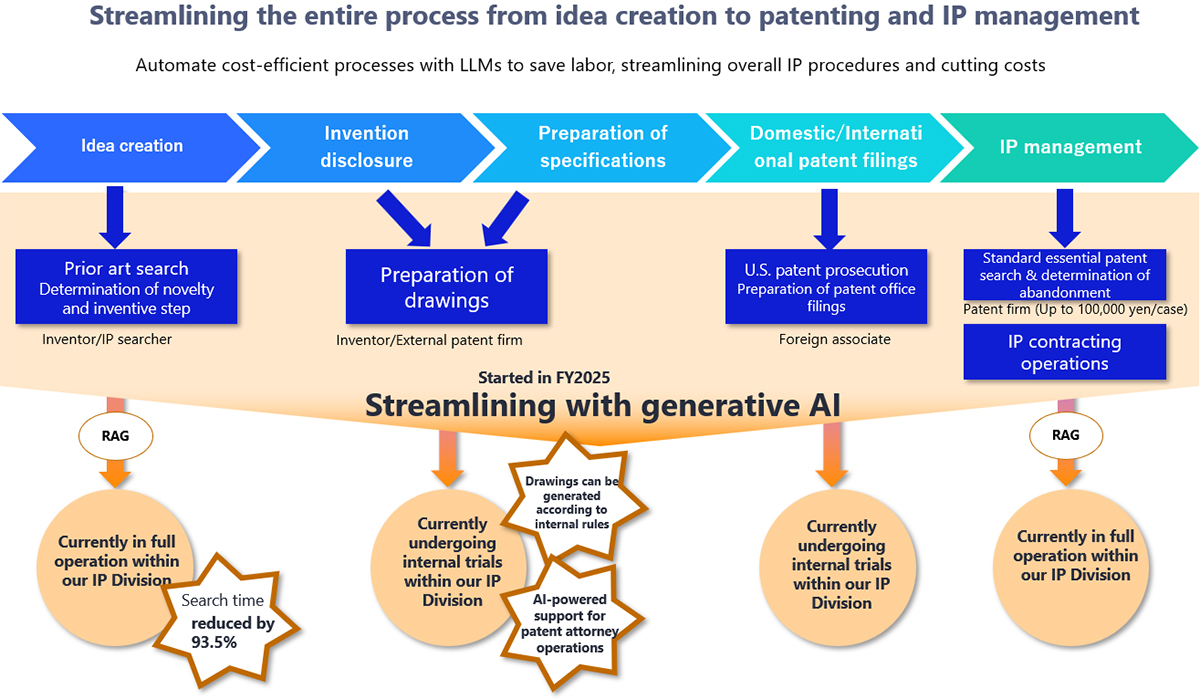
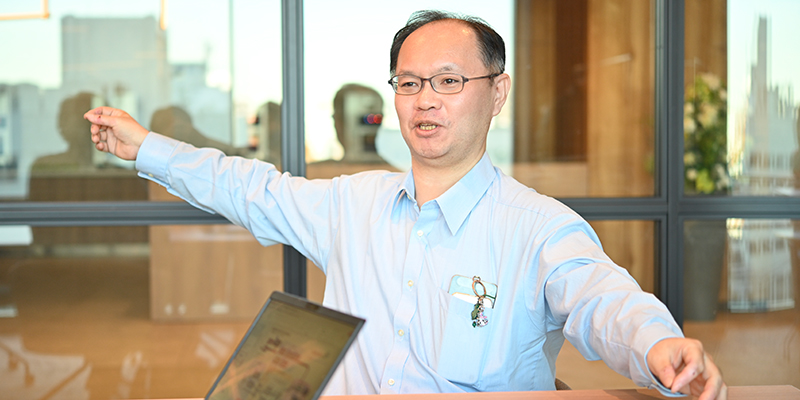
Kawada: It is an initiative to streamline IP operations using generative AI. While IP digital transformation is an area that various organizations are working on, what sets NEC’s IP DX apart is its extensive coverage of operations, including prior art search, preparation of specifications and drawings to be attached to those specifications, generating documents to be submitted for filing a patent with the U.S. Patent Office, and IP contracting operations.
Previously, professional personnel with advanced expertise spent hours on prior art search. This task will be supported by AI. The Intellectual Property Management & Rule Making/Standardization Division (referred to as “IP Division” hereafter) has already started applying AI technologies. For example, the IP Division managed to reduce prior art search time by 93.5% using AI while ensuring best practice in searching through the past 20 years’ worth of patents. AI supports and streamlines searches in documents over 1,000 pages long in the course of standard essential patent searches and contracting operations.
In preparing documents for submission to the U.S. Patent Office, we have employed a unique approach to instructing generative AI. This enables the AI to automatically generate documents from patent specification drafts in line with the strict format requirements of the U.S. Patent Office.
The AI also supports the creation of drawings, which are tasks undertaken by patent attorneys or other competent legal professionals, by generating flowcharts and illustrations to be included in the specifications and invention disclosures. Development is currently underway.
Sadamasa: Our group is dedicated to developing applied technologies for integrating generative AI into business operations. This R&D project was initiated at the request of the IP Division and is being conducted in close collaboration with them. Interestingly, the emergence of generative AI has made it so that technical expertise is no longer a strict requirement for leading development. The IP Division applied their expertise in developing applications using generative AI and no-code tools. This division of roles with the IP Division accelerated digital transformation across a wide range of tasks.
Generative AI is evolving at an unprecedented pace. That is why development speed is the key to business success. We have also adopted a rapid prototyping approach, continuously iterating through prototyping and refinement.
The latest RAG and know-how cultivated through many years of R&D are key
― Specifically, what kinds of technologies are used?
Kawada: While generative AI is an excellent tool, simply incorporating generative AI into your system doesn’t make it function as intended. Suppose you want AI to search for patent information―generative AI has only learned published data up to a specific point, so it does not have the most recent information. Furthermore, generative AI is not particularly well-suited to accurately pinpointing and citing specific data from its training set. Using data as-is may cause hallucination and result in frequent inappropriate outputs.
Sadamasa: To avoid this issue, we adopted retrieval-augmented generation (RAG). RAG is an approach that empowers generative AI to search external data to improve output accuracy. In building the RAG system, our team combined vector search that applies the latest embedding model with traditional keyword-based search techniques, and incorporated another information retrieval approach called the ensemble search, which ranks the obtained results based on the latest reranking model.
Vector search is a technique that captures semantic meaning and context during the search process. For example, if you searched for the word sakura (“cherry blossom”), 20 years ago you could only retrieve text that includes the keyword “sakura.” On the other hand, the vector search technique can mathematically convert words into coordinates in a vector space of several hundred dimensions, allowing you to search for words with similar meaning based on the distance from those coordinates. Specifically, the resulting RAG system can retrieve words like yaezakura (“double-blossom cherry tree”) and hana (“flower”) from the search word “sakura.”
Reranking means to reorder the search results in the order that suits the purpose. This allows for the consideration of relevance, so users can expect search results that are more in line with their intention.
Kawada: The rest is all persistent tuning. We developed a model specialized for patents by conducting additional training on a vast number of IP-related specifications. We made numerous other small improvements, including adjusting the prompts for reranking, to achieve NEC’s original RAG performance.
Director
Data Science Laboratories
Sadamasa: Documents submitted to the Patent Office are legal filings with a mostly fixed format. We cannot afford to make mistakes. To prevent hallucination, we designed the system to function on a programmed basis where traditional rule-based approach is effective. On another note, knowledge of English grammar alone is insufficient when preparing the format for U.S. patent filing. For example, patent documents have specific rules for the use of articles (“a,” “an,” “the”). You also need knowledge of intellectual property. We built a system that reflects such domain knowledge.
This owes to NEC’s know-how that has been accumulated through years of research in natural language processing, an area where NEC has been a front runner in the world.
Kawada: RAG is a widely used approach, and the combination of an embedding model and a reranking model is becoming a common trend. However, merely incorporating these techniques does not make it possible for generative AI to fully use the potentials. The AI system needs to adequately interpret users’ questions and return easy-to-understand answers. Achieving a good balance in combining multiple search models and using effective prompt writing also contribute to better performance and usability. These elements are infused with NEC’s original, “secret recipe” know-how.
Aiming for application to creative tasks beyond streamlining
― Please tell us about the future prospects and possibilities for this technology.
Sadamasa: The IP Division seems to have many more tasks that they want to use generative AI with. We will continue to drive and implement digital transformation of such tasks one by one. The IP Division may be eying a platform that supports IP operations not as individual tasks, but as connected work to be handled comprehensively.
Generative AI today tends to focus on reducing the time and effort spent on existing tasks. As our next step going forward, we hope to tackle the challenge of leveraging generative AI to create new value.
Kawada: Such as exploring ways to generate new inventions. Using RAG to create a different version of a prior invention is an example of what I mean. This is just a wild idea, but what I am trying to say is that this technology definitely has the potential for use in creative work.
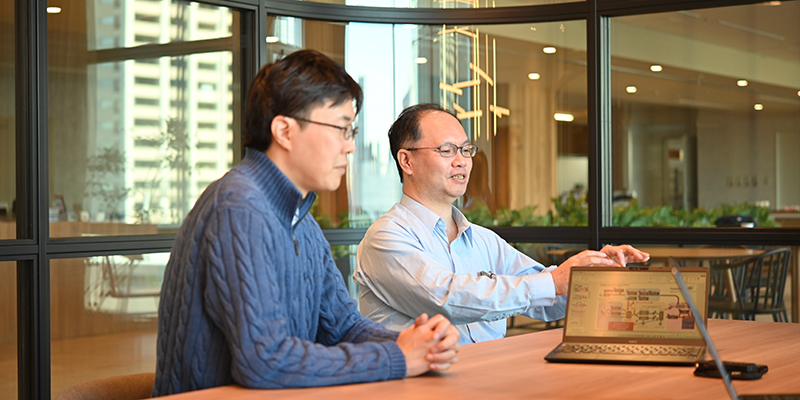
Sadamasa: We would also like to work on quality management when this technology is deployed as service. Generative AI is updated at an extraordinary pace, and some updates may be very different in specifications from the previous version. More often than not, users may enter the same prompt and get completely different results. Continuous quality management is critical to adapt to such environment.
Kawada: I agree. We are currently in the middle of building a platform for evaluating what changes can occur when the specifications of the generative AI model change. We hope to deliver reliable services by creating a framework that can efficiently adapt to changes in the case of a version upgrade.

NEC has been promoting IP DX operations to streamline IP tasks using generative AI. Internal trials have been conducted by our IP Division. While IP digital transformation is an area that various enterprises and other organizations are working on, NEC’s IP DX is characterized by its extensive coverage of operations, including prior art search, preparation of drawings to be attached to specifications, generating documents to be submitted for filing a patent with the U.S. Patent Office, and IP contracting operations. The IP DX initiative has been proven to be greatly effective; for example, when the NEC IP Division used AI-based prior art search, it was able to reduce search time by 93.5% in accordance with the best practice.
Prominent driving forces behind this achievement include: (1) Accelerated development by working closely with our IP Division and (2) NEC’s accumulated know-how of generative AI implementation. Development with the IP Division proceeded with a rapid prototyping approach. Digital transformation was achieved at a rapid pace in a range of tasks thanks to the IP Division itself making substantial use of generative AI and no-code tools. Implementing generative AI models requires meticulous adjustment of prompts and satisfactory search accuracy. NEC combined cutting-edge RAG techniques with its expertise and long years of experience in natural language processing to enhance performance and usability.
- ※The information posted on this page is the information at the time of publication.