
Global Site
Breadcrumb navigation
Behind the scenes: Developing the world's first walk-through face and iris recognition system using a single compact camera
July 6, 2026
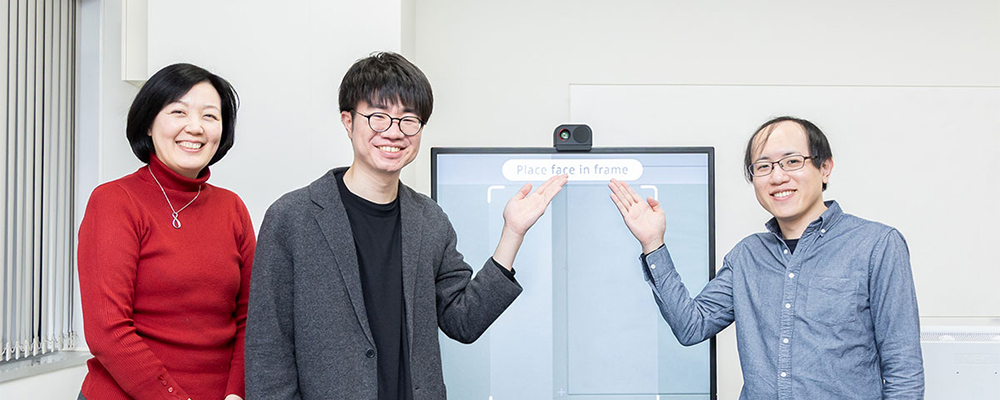
Researchers at the Biometrics Research Laboratories have combined NEC's face and iris recognition technologies, which are ranked No. 1 in the world in terms of authentication accuracy (*1), to achieve the world's first walk-through face and iris multimodal authentication system using a single compact camera (*2). We spoke with three members of the Laboratories about the development background and their thoughts on implementing this technology in society.
- *1:Ranked No. 1 several times in face recognition benchmark tests conducted by the U.S. National Institute of Standards and Technology (NIST).
https://www.nec.com/en/global/solutions/biometrics/evaluation/index.html - *NIST assessment results are not intended to recommend any specific system, product, service, or company by the U.S. government.
- *2:Based on research by NEC (as of December 3, 2025).
Reference:
https://www.nec.com/en/press/202512/global_20251203_02.html
Using the face and both irises as three "keys" for walk-through authentication
── Please describe your backgrounds and tell us about your current work.
Sasaki: I joined NEC in 2021 and have been engaged in the research and development of biometric authentication technologies, primarily iris recognition, at the Biometrics Research Laboratories. In my third year with the company, I began working on designing a system that uses a single camera to perform face and iris multimodal biometric authentication. I am currently responsible for software development and overall system design for a more compact version of this walk-through face and iris multimodal authentication (hereinafter "WT face and iris MM authentication") technology.
Funayama: When I first joined NEC, I was involved in the research and development of technologies such as automatic quality enhancement for color images, as well as image clarification. Later, after transferring to the Biometrics Research Laboratories, I conducted research on the lighting environment conditions suitable for face recognition, and I joined the iris recognition team in 2023. For the new WT face and iris MM authentication technology, I am mainly responsible for evaluating the system as a whole.
Akashi: I joined NEC in 2015 and have conducted research on technologies for improving the clarity of low-quality images taken under dark conditions. After the Biometrics Research Laboratories was established, I became involved in the research and development of sensing technologies for face and iris recognition. During that time, I worked on the development of walk-through iris recognition technology, which can be regarded as the predecessor of our WT face and iris MM authentication technology.

Chisato Funayama
── Could you give us an overview of WT face and iris MM authentication technology?
Sasaki: WT stands for walk-through, which means that people do not have to stop walking while authentication is performed, and MM stands for multimodal, which means that both face and iris data can be captured and processed together for authentication. The key feature is that, unlike conventional systems that require the use of multiple cameras, authentication can be performed using a single camera, allowing for a more compact design. Our technology can also be integrated with existing systems and equipment such as PCs and tablets, and its accuracy is sufficient to prevent unauthorized access and perform authentication across populations as large as 100 million people.
── NEC's face and iris recognition technologies have each been ranked the world's No. 1 in authentication accuracy (*3). What are the advantages of combining these two technologies?
*3: https://www.nec.com/en/global/solutions/biometrics/evaluation/index.html
Funayama: To verify a person's identity, our WT face and iris MM authentication technology uses three biometric "keys," namely the face and both irises. The combination of multiple strong biometric keys improves the security of operations, making this technology suitable for use at facilities that require high levels of security, such as data centers, as well as for official government authentication systems such as immigration control. Although fingerprint recognition, palm recognition, and various other types of biometric authentication are available, face and iris multimodal biometric authentication has the major advantage of being able to capture images of the face and both irises simultaneously by using a single sensor. This makes it possible to achieve simple yet robust authentication with just one camera.

Masato Sasaki
── This is evidently the world's first walk-through face and iris multimodal biometric authentication system to use a single compact camera. Could you tell us about the background leading to this technological innovation?
Sasaki: For conventional authentication based on the unique patterns in the iris, which is only about one centimeter in diameter, a dedicated camera is required, separate from the one used for face recognition. NEC is developing an authentication engine capable of recognizing irises even from somewhat lower-quality images. The engine makes it possible to authenticate users even when the captured eye images are not ideal. This has enabled us to consolidate the face and iris cameras into a single unit, resulting in a more compact design. The demo system we developed also has a wider field of view to accommodate greater differences in height. This also helps eliminate the need for multiple cameras, enabling us to perform authentication with just one.
Funayama: Another key point is that the entire camera system has been optimized. High-speed processing is achieved by quickly identifying the areas of interest within the images, and sending only the necessary data to the authentication engine.
Sasaki: A walk-through system needs to capture images at a high enough speed to keep up with the person's walking pace. To achieve this speed, it is important to optimize the processing.
Conducting demos that elicit a strong customer response

Ryuichi Akashi
* At the time of the interview, Akashi was affiliated with NEC Biometrics Research Laboratories.
── What are some situations where walk-through biometric authentication can be used?
Akashi: Demand is growing for its use in situations that require both high security and reduced congestion, such as immigration gates at airports and access control at sensitive facilities. By contrast, biometric authentication systems that require users to stop are often selected for applications such as ATMs and payments at commercial facilities. NEC is developing both walk-through and stationary face and iris multimodal biometric authentication systems in parallel.
── Could you tell us about the background of how the WT face and iris MM authentication technology was developed?
Sasaki: We began developing our WT face and iris MM authentication technology in the middle of 2025, but the underlying walk-through iris recognition technology dates back to 2018.
Akashi: As of 2018, people generally needed to remain still for the camera to capture images of the fine patterns in their irises. There was demand for iris recognition that could be performed on people while walking, which led us to begin developing our walk-through iris recognition technology. During the initial development stage, we used large equipment to verify the technical feasibility and business potential of the technology. The results confirmed the effectiveness of our system, but the size and complexity of the equipment emerged as clear challenges to address. From there, we started working to downsize the system, and we also transitioned to a multimodal approach by incorporating face recognition for even greater security.
Sasaki: By 2024, the technology for performing authentication with a small camera had already been developed, and we only needed to make a few minor modifications to have a complete stationary system. However, we shifted our focus to developing a walk-through system, which raised the bar significantly.
Akashi: We then had two new challenges to address, since authentication needed to be performed at a distance and while people were walking. This made the development schedule quite difficult. However, both the customers and the business units were very enthusiastic about the project, and we at the Laboratories were equally determined to meet their expectations.
── Which aspects did you focus on in particular?
Akashi: I was responsible for device control. We had to determine how to illuminate moving subjects at a distance for iris recognition, and how to adjust the camera parameters to capture clear images of both the face and the irises. We had to go through a process of repeated trial and error before finding the optimal solution.
Sasaki: Our work did not end once we developed the technology. We also focused our efforts on creating a demo that would allow customers to experience the value firsthand. We worked with the design divisions to repeatedly refine the demo interface, and I am proud to say that we created a demo that works well and clearly conveys the value of the technology.
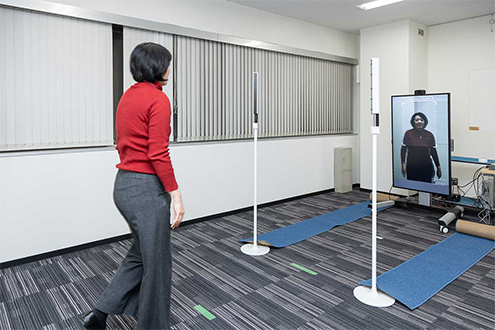
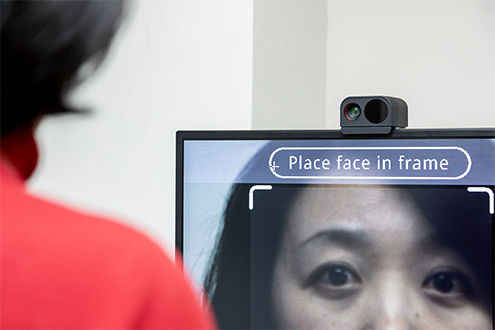
The demo WT face and iris MM authentication system uses a compact camera to authenticate the subject's face and irises from a distance of three meters.
── How did customers react after trying the demo?
Sasaki: They were genuinely surprised by the system's ability to authenticate them while walking, as well as by how quickly it recognized their faces and irises. It was a valuable experience not only to hear directly from customers, but also to see how excited they were immediately after trying the demo. I was pleased that their response was far more positive compared to when we explained the technology using presentation materials.
Funayama: It was clear that the customers really enjoyed the experience. At the same time, once they saw what the technology could do, they started making new requests about additional features and capabilities they want to see next. These requests delighted us, but we also started to worry that the development work might never end (laughs).
── Please tell us about some of the challenges you took on, what you achieved, and what you learned through this project.
Akashi: This project reminded me of how important it is to not just pursue technology, but to create things that are truly useful in real-world settings. I learned that it is extremely important to develop technology that makes customers think, "This is useful" or "I want to use this." Seeing the customers' reactions firsthand really drove this point home for me.
Aiming for a future society where WT face and iris MM recognition provides seamless and unobtrusive authentication
── What social issues can be resolved by implementing walk-through face and iris multimodal biometric authentication in society, and what vision do you hope to achieve?
Akashi: The use of walk-through authentication can reduce the waiting times at locations such as immigration checkpoints, allowing people to move through more smoothly. There is also significant value in terms of how easy it is to use, because there is no need to learn how to operate a terminal, and authentication is completed simply while the subject is walking. By eliminating the need for people to perform actions such as holding up a card key or taking out a passport for verification, our technology can improve efficiency in a variety of everyday situations.
Sasaki: Whenever complicated operations or procedures are required, a burden is inevitably placed on the user. If walk-through authentication can allow people to complete such processes without any friction, it could lead to a society where more people can enjoy greater convenience.
── Could you tell us about your ambitions in relation to bringing this technology into practical use and your thoughts on this effort?
Funayama: We hope to keep working toward practical application while addressing the various requests we receive from customers. As a researcher at a corporate research laboratory, I do not want my work to end with research. I want to remain involved until the technology is brought to market as a product.
Sasaki: From among the many requests we have received, I want to identify the issues that could have the greatest impact from a technical perspective, and focus our efforts there first. It is difficult to solve everything at once. I believe that by steadily addressing key issues one by one, we can apply the technology to a wide range of use cases.
NEC has been working on biometric authentication for half a century, and our authentication accuracy ranks among the best in the world. In particular, there are high expectations for multimodal biometric authentication technology that combines NEC's face recognition and iris recognition technologies, both of which have achieved world-leading results. By making our system smaller, we have resolved the issues that previously hindered its adoption, clearing the path toward practical application. In the future, the technology may become more widely used in a variety of locations, including airports, office buildings, and commercial facilities. Keep an eye out for future developments.
- *The information posted on this website is the information at the time of publication.
Related information
 December 3, 2025