
Global Site
Breadcrumb navigation
NEC exhibits at the 32nd ITS World Congress, a conference and exhibition focused on mobility
~ Advancing digital twins and leveraging physical AI for the intelligent transformation of regional road networks ~Tokyo, October 14, 2026 - NEC Corporation (NEC; TSE: 6701) has announced its participation in the upcoming 32nd ITS World Congress as an exhibitor at the ITS Japan Pavilion, which will showcase public- and private-sector exhibitors affiliated with ITS Japan. Additionally, NEC will present a technical paper during a session at the event. This five-day conference and exhibition, which brings together experts from industry, government, and academia, focuses on intelligent transport systems (ITS) and will be held in Gangneung, Korea, from October 19 (Monday) to October 23 (Friday), 2026 (ITS Japan Pavilion; Booth number: S25).
The ITS World Congress, which aims to solve road traffic problems through the widespread adoption of ITS and to create business opportunities, is the only world congress co-organized annually by three key ITS organizations from around the globe (Europe: ERTICO; the Americas: ITS America; the Asia-Pacific region: ITS Asia-Pacific). This event features a vast variety of technical sessions, exhibits, panel discussions and more, serving as a forum for participants to exchange information from diverse perspectives on a wide range of topics, including technological development and market trends.
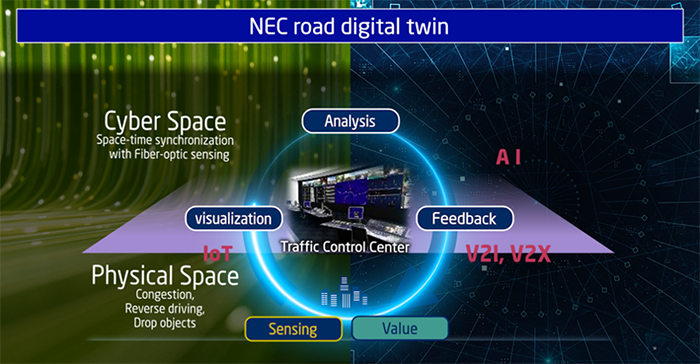
Exhibit Overview
Based on the concept of “Shaping the Mobility of Tomorrow,” NEC aims to harness ICT and utilize road infrastructure and related data to create new environmentally friendly mobility services that ensure safety, security, and convenience. Moreover, the data collected through these services will be integrated and used to facilitate smarter, more sustainable and efficient transportation.
At this year’s ITS World Congress, NEC will use domestic and global case studies, videos, and panels to introduce a solution that combines three core technologies to achieve next-generation traffic control integrated with physical AI on expressways: (1) digital twin data-fusion technology, (2) wrong-way driving detection utilizing fiber-optic sensing, and (3) individual vehicle monitoring technology using long-range LiDAR for driving safety support.
These technologies will advance the evolution of social infrastructure, including distributed edge AI processing platforms, by enabling spatiotemporal synchronization of sensor data collected across wide areas using fiber-optic sensing.
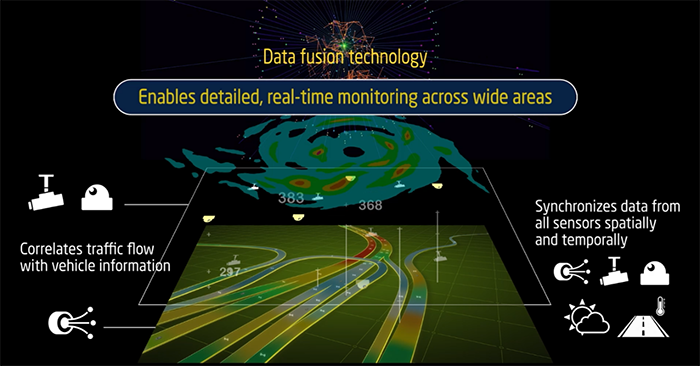
(1) Road State Monitoring with Multimodal Sensing
On a digital twin platform with real-time spatiotemporal synchronization, data fusion technology enables both real-time, detailed monitoring of road environments and the intelligent transformation of regional road networks.
(2) Wrong-way Driving Detection Using Distributed Fiber-Optic Sensing
By utilizing continuous sensing along an entire route, monitoring blind spots can be eliminated. This allows for the collection of early warning information, enabling early detection of unforeseen circumstances, such as vehicles traveling in the wrong direction or obstacles on the road. In addition, traffic flow and safety are improved by alerting following vehicles to take evasive action.
(3) LiDAR Sensing Technology for Driving Safety Support on Expressways
Capable of capturing 3D expressway information in real time, LiDAR technology is used to detect and track moving vehicles while quickly providing traffic condition updates to autonomous and other vehicles, thus promoting safe driving. The results of field trials conducted on expressways will also be presented during the poster presentation and at the booth exhibit featuring the accepted technical paper.
Going forward, NEC will leverage its ICT infrastructure technology and proprietary analytical AI to deliver digital infrastructure for the AI Transformation (AX*) era. This infrastructure will enable the deployment of physical AI across regional road networks through digital twins that are spatiotemporally synchronized in real time.
***
Note:
- (*)AI Transformation (AX) refers to initiatives that go beyond simply implementing AI as a tool. Instead, AX involves reshaping business processes, business models, and organizational culture based on AI.
About NEC
The NEC Group leverages technology to create social value and promote a more sustainable world where everyone has the chance to reach their full potential. NEC Corporation was established in 1899. Today, the NEC Group’s approximately 110,000 employees utilize world-leading AI, security, and communications technologies to solve the most pressing needs of customers and society.
For more information, please visit https://www.nec.com, and follow us on  LinkedIn and YouTube.

NEC is a registered trademark of NEC Corporation. All Rights Reserved. Other product or service marks mentioned herein are the trademarks of their respective owners. © NEC Corporation.