
Global Site
Breadcrumb navigation
Successful Demonstration of Stable, High-Capacity mmWave Communications for Multiple High-Speed Vehicles for the 6G Era
— A major step toward real-world deployment, including mmWave-enabled autonomous driving and enhanced in-vehicle experiences —NTT DOCOMO, INC. ("DOCOMO") and NEC Corporation ("NEC"), in collaboration with NTT, Inc. ("NTT"), have developed a technology (the "Technology") that enables multiple vehicles traveling at high speed to simultaneously maintain stable communications using high-capacity millimeter-wave (mmWave) communications in the 40 GHz band, which is expected to be leveraged in the 6G era. The Technology combines distributed MIMO (Note 1), in which multiple antennas are distributed and deployed from a base station, with a technique that pre-compensates the transmit frequency and transmit timing of signals.
In a demonstration trial conducted in March 2026 at a full-scale tunnel test facility installed at Japan’s National Institute for Land and Infrastructure Management (NILIM), Ministry of Land, Infrastructure, Transport and Tourism, multiple vehicles equipped with mobile terminals traveling at high speed in opposite lanes maintained stable, high throughput, achieving approximately a 1.3x improvement in average throughput compared to the conventional method. This result represents a major step toward social implementation of 6G-related technologies—including implementation in new base stations—such as autonomous driving utilizing mmWave and improved in-vehicle user experiences.
Video of the demonstration:
https://www.nec.com/en/global/onlinetv/en/mmwave_b5g_en.html
Background
When communicating in high-frequency bands such as mmWave in high-mobility environments (e.g., automobiles and trains traveling at high speed), frequent base station switching occurs, causing abrupt changes in Doppler frequency (Note 2) and propagation delay, which degrades communication quality. DOCOMO, NEC, and NTT have been working to address this challenge, and in March 2025 successfully demonstrated (Note 3) a technology that stabilizes communication quality for a single vehicle traveling at high speed by compensating the transmit frequency and transmit timing on the base station side.
In the present demonstration, the March 2025 technology was further advanced to develop a method that suppresses communication-quality degradation for multiple mobile-terminal-equipped vehicles even under complex conditions, where multiple mobile-terminal-equipped vehicles traveling at high speed in opposite lanes communicate simultaneously.
Key Features of the Technology
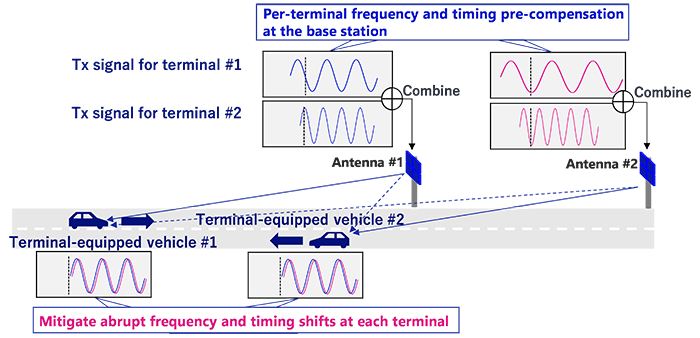
Using uplink reference signals transmitted from each mobile-terminal-equipped vehicle, the Technology pre-estimates, for each base-station antenna, the appropriate transmit frequency and transmit timing for each vehicle. It then pre-compensates each vehicle-specific signal and then combines (multiplexes) the signals for transmission. This eliminates differences in received frequency and received timing that occur during antenna switching for multiple mobile-terminal-equipped vehicles simultaneously, thereby stabilizing high-capacity mmWave communications for multiple vehicles.
Demonstration Trial and Results
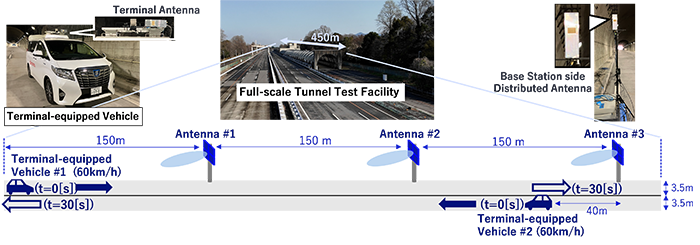
From March 26 to 27, 2026, DOCOMO, NEC, and NTT conducted a demonstration trial of the Technology at the full-scale tunnel test facility at NILIM. To emulate a high-mobility environment, three distributed antennas of a base station were installed along one side of a road at 150-meter intervals. A downlink transmission experiment was then conducted with two mobile-terminal-equipped vehicles traveling at 60 km/h in opposite lanes.
Under more complex conditions than the March 2025 demonstration, the conventional method (in which only the terminal side compensates received frequency and received timing) was compared with the proposed Technology (which additionally applies per-vehicle pre-compensation on the base-station side before combining and transmitting the signals). The comparison used the combined (sum) throughput of the two mobile-terminal-equipped vehicles.
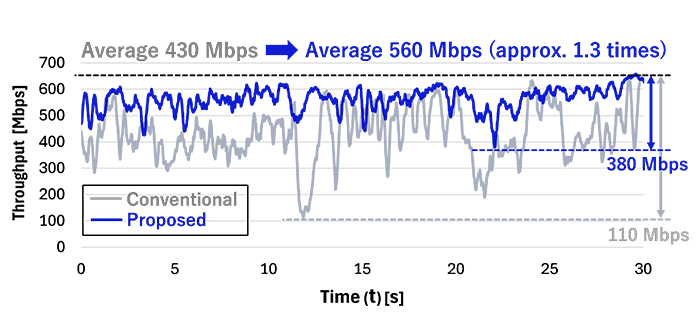
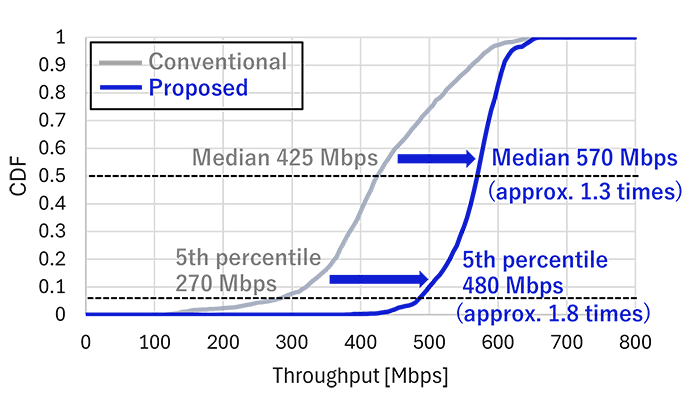
To validate performance in a more complex radio propagation environment, the experiment was conducted inside a tunnel, where radio waves reflect and antenna switching occurs frequently while driving. When only the conventional method was applied, the combined throughput dropped significantly during antenna switching—from 550 Mbps to approximately 110 Mbps—and the average throughput over 30 seconds of driving was approximately 430 Mbps. In contrast, when the Technology was applied, throughput degradation during antenna switching was suppressed, maintaining a stable throughput of at least 380 Mbps, and the average throughput improved to 560 Mbps, representing an approximate 1.3x increase over the conventional method. In addition, the 5th-percentile throughput value in the cumulative distribution function (CDF) improved from 270 Mbps (conventional) to 480 Mbps (proposed), an approximate 1.8x increase.
between the conventional method and the proposed Technology
Future Development
This demonstration confirmed that high-capacity and stable communications using mmWave distributed MIMO are possible even in high-mobility environments where multiple automobiles and trains travel at high speed, representing a major step toward real-world deployment. With the success of this demonstration, the use of mmWave communications is expected in applications such as immersive services including in-vehicle XR (extended reality), real-time translation and guidance leveraging generative AI, and sensor-data coordination for cooperative autonomous driving.
Going forward, DOCOMO, NEC, and NTT will conduct further trials assuming various real-world environments such as high-speed railways, conventional railways, and arterial roads, and will contribute to realizing stable high-capacity communications in the 6G era.
The trial and its results will be exhibited at Wireless Japan × Wireless Technology Park (WTP) 2026 (Note 4) (May 27–29, 2026; Tokyo Big Sight, West 3 & 4 Hall; XG Mobile Promotion Forum exhibit area) and Tsukuba Forum 2026 (Note 5) (May 27–28, 2026; NTT Tsukuba R&D Center, R-1 Area; NTT Exhibits).
***
- (Note 1)Distributed MIMO(Multiple-Input Multiple-Output):
A technology in which a large number of antennas are distributed from a single base station within an area for MIMO transmission between each antenna and a mobile terminal within the area. - (Note 2)Doppler Frequency: A frequency shift that occurs when a radio transmitter is moving. The received frequency increases when approaching the receiver and decreases when moving away.
- (Note 3)
- (Note 4)Wireless Japan×Wireless Technology Park (WTP) 2026:
 https://wjwtp.jp/2026/en/
 - (Note 5)Tsukuba Forum 2026:https://www.rd.ntt/e/as/tforum/
About NTT DOCOMO
NTT DOCOMO, Japan's leading mobile operator with over 93 million subscribers, is one of the global leaders in 3G, 4G and 5G mobile network technologies. Under the slogan "Bridging Worlds for Wonder & Happiness," DOCOMO is actively collaborating with global partners to expand its business scope from mobile services to comprehensive solutions, aiming to deliver unsurpassed value and drive innovation in technology and communications, ultimately to support positive change and advancement in global society. https://www.docomo.ne.jp/english/
About NEC
The NEC Group leverages technology to create social value and promote a more sustainable world where everyone has the chance to reach their full potential. NEC Corporation was established in 1899. Today, the NEC Group’s approximately 110,000 employees utilize world-leading AI, security, and communications technologies to solve the most pressing needs of customers and society.
For more information, please visit https://www.nec.com, and follow us on LinkedIn and YouTube.

NEC is a registered trademark of NEC Corporation. All Rights Reserved. Other product or service marks mentioned herein are the trademarks of their respective owners. © NEC Corporation.