
Global Site
Breadcrumb navigation
NEC Launches Orbital Transfer Vehicle Development Project Aiming for Asia’s First Vehicle Deployment through JAXA’s Space Strategy Fund Program
Tokyo, May 13, 2026 - NEC Corporation (NEC; TSE: 6701) has launched a project to develop an Orbital Transfer Vehicle (OTV) following its selection by the Japan Aerospace Exploration Agency (JAXA) and the agency’s decision to award NEC with a grant for the technology development theme "Technologies for Realizing Flexible Mobility in Space: (A) Development of Inter-Orbital Transportation Vehicles." Through this project, NEC aims to achieve the first implementation of OTV in Asia (*1).
 Larger view
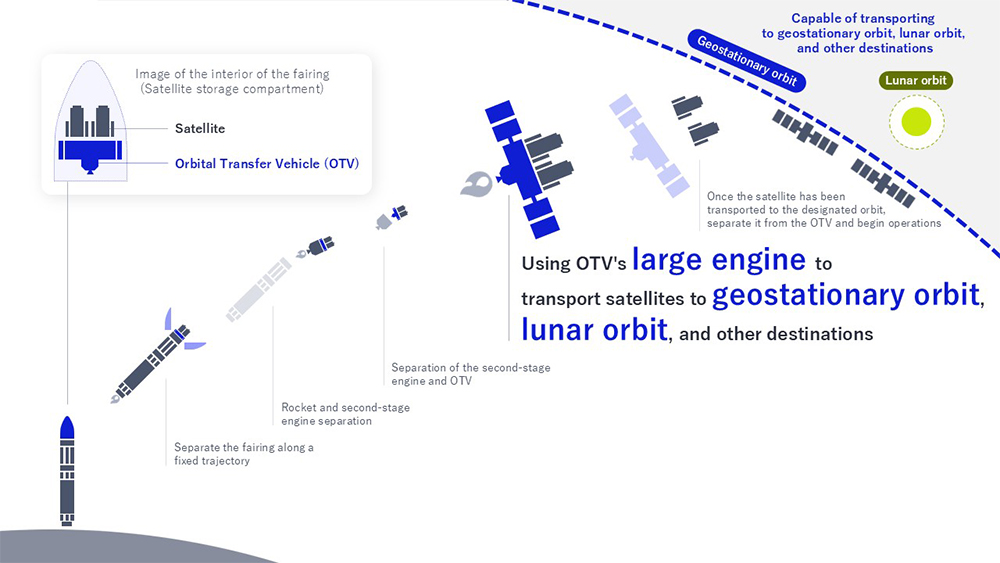
An OTV is a spacecraft designed to transport satellites to their intended orbits, such as a geostationary or lunar orbit, after they have separated from their rockets. Typically, after a rocket places a satellite into an initial orbit, the satellite must use its own large engines and a significant amount of fuel to reach its destination. However, by having an OTV perform this transport, even small satellites without large engines can be deployed to distant orbits. Furthermore, since OTVs can simultaneously transport multiple small satellites to geostationary or lunar orbits, they also contribute to improved transport efficiency.
As a result, OTVs are expected to make important contributions to accelerating all aspects of space development. Not only will they promote the development of future space economies—such as the utilization of geostationary orbits and cislunar space (*2)—but by lowering the barriers to space utilization, they will also encourage the entry of new operators into the sector.
NEC has over half a century of experience in the development and manufacture of spacecraft, including the geostationary satellite "Kizuna" (WINDS), the lunar orbiter "Kaguya" (SELENE), and the deep-space probe "Hayabusa2." Drawing on its development technologies and operational expertise for spacecraft designed for these diverse orbital environments, NEC is undertaking the OTV development project. Moving forward, NEC plans to conduct market feasibility studies, conceptual design, and demonstrations for OTVs by the end of fiscal year 2027 to clarify the required functions and other specifications. Following this, NEC plans to begin development of a demonstration model in fiscal year 2028, with the goal of launching it and conducting in-space demonstrations in fiscal year 2032, and aims to bring the technology to practical use in the future.
NEC is developing highly competitive OTVs to expand the market through the growth of Japan’s space industry, realize missions that deliver social benefits, and deepen research activities aimed at exploring new frontiers.
***
Note
- (*1)As of May 13, 2026, research by NEC
- (*2)The vast expanse of space between Earth and the Moon.
About NEC
The NEC Group leverages technology to create social value and promote a more sustainable world where everyone has the chance to reach their full potential. NEC Corporation was established in 1899. Today, the NEC Group’s approximately 110,000 employees utilize world-leading AI, security, and communications technologies to solve the most pressing needs of customers and society.
For more information, please visit https://www.nec.com, and follow us on  Instagram, Facebook, YouTube, and LinkedIn.

NEC is a registered trademark of NEC Corporation. All Rights Reserved. Other product or service marks mentioned herein are the trademarks of their respective owners. © NEC Corporation.