
Global Site
Breadcrumb navigation
New Horizons - Career Change Research:Tsukasa Matsuo
February 9, 2026
Research environment and culture for successful commercialization
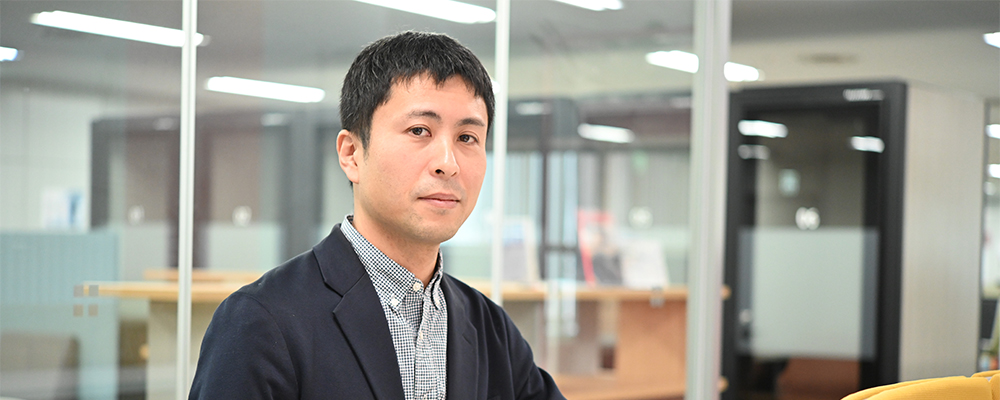
Tsukasa Matsuo
Principal Researcher
Visual Intelligence Research Laboratories
After researching and developing microscopes based on the principles of holography (recording and reproduction of three-dimensional object information using light interference and diffraction) at a Japanese manufacturer, Matsuo changed companies to work on the development of analysis technologies for microscopic images of tissue sections. Since joining NEC in February 2023, he has utilized his expertise in 3D and image processing technologies to develop technologies for automatically aligning 3D data from LiDAR (Light Detection And Ranging) with 2D images from digital cameras as well as SAR-related technologies. His goal as a Principal Researcher is to commercialize research technologies.
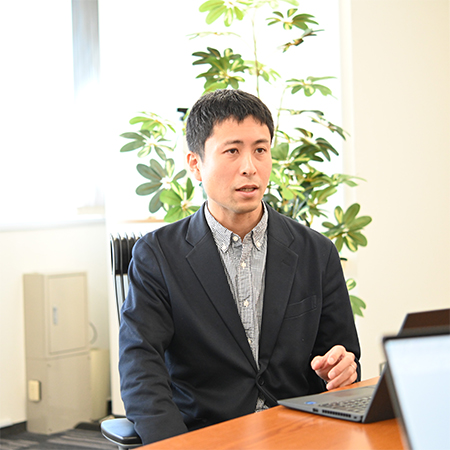
Diverse customer base and researcher awareness lead to successful commercialization
After researching optical measurement using lasers as a student, I joined a Japanese manufacturer where I worked on the research and development of microscopes using holography technology. However, despite my continued research efforts aimed at achieving commercialization over a period of nine to ten years, the project ultimately fell short of commercialization. The exploration of promising markets where the developed technology could be applied and the securing of internal resources did not go as planned. Management decided that “although the technology is interesting, it does not work as a business,” and the project was shut down.
This led to a strong personal desire to experience the post-commercialization phase, and I decided to change jobs. The company that I transferred to had just launched a new business at the time, and I was involved in developing analysis technologies for microscopic images. I found the dynamic daily changes in the environment that are unique to a new business to be stimulating. However, the overall business policy unfortunately shifted, which resulted in a reduction in resources allocated to technology development for image analysis. When it became inevitable that my work would shift to other areas outside of image processing, I decided to change jobs once again after considering my future career and joined NEC, a company that I was linked by fate.
After joining NEC, I realized that it has a massive scale and relationships with a diverse range of customers and businesses. Consequently, even if a newly created technology cannot be used in one area, you can readily attempt to propose it to a different area or industry. After previously working at companies that were one-tenth or one-third the size of NEC, I feel very fortunate to be in such an environment.
I was also amazed by the fact that each individual researcher has a vision for commercialization from the initial stages of research. I strongly feel that every researcher is consciously thinking about how they will propose their technology to a specific customer from the initial research stages. In the highly uncertain activity of research, everyone is carefully thinking about how to efficiently achieve tangible output. As a result, I believe that this fosters an awareness of efficient means of social value creation, such as advancing the development of a design that can be proposed to more than one company, which is used to accelerate and successfully commercialize results.
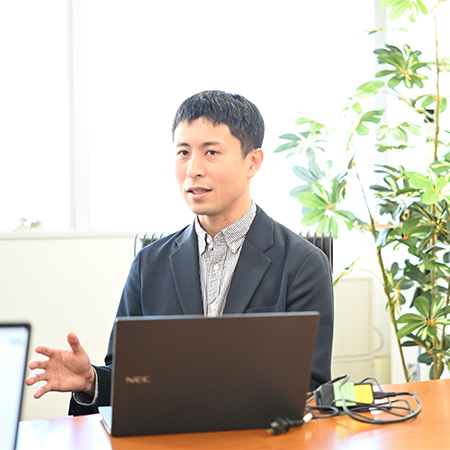
An awareness of results accelerates independent research
My current research focuses on a technology that automatically aligns 3D data built using LiDAR laser-based ranging technology with 2D images such as digital camera photographs. In addition to proceeding with a demonstration experiment for infrastructure inspection, I have recently been engaging in activities aimed at expanding the research to other applications.
Furthermore, in an interesting development, the synthetic aperture radar (SAR) that I have recently been working on was called “microwave holography” during the initial development stages, and it is based on the same holographic principles as the microscope that I researched and developed at my first company. Despite the vast difference in scale between microscopes and satellite remote sensing, having the opportunity to apply my past experience feels strange even to me. I also currently serve in a management position as a Principal Researcher. As a matter of fact, I was entrusted with this role when I joined NEC even though I did not have any management experience at my first two jobs. In a managerial position, there is a strong demand for results that link research results to business. While this might sound harsh, it also means that you have freedom as long as you produce results. The fact that everyone works under the guiding principle of producing solid results rather than working unnecessarily long hours is essential to creating a healthy workplace. In fact, NEC offers flexible work styles and locations, and many people work remotely.
Reaching commercialization with my own technology
My primary goal going forward is to achieve commercialization of a technology that I worked on and follow it through to the point where it generates revenue. Naturally, after spending nine to ten years at my first company on a project that failed to reach commercialization, my goal is to make that happen no matter what. Furthermore, once I have achieved that goal, I would like to launch a research theme from scratch on my own and take it all the way to productization and commercialization in the same way.
Currently, the core of my research consists of 3D and image processing, but I would like to become the kind of expert in a particular field such that everyone would know that I am the right person to ask about that technology. To that end, I believe that I need to link a research technology to a massive business, so I intend to work by starting from a focus on commercialization.
Moreover, when I look at society more broadly, I hope for a sustainable world for my child. After joining NEC, I was actually assigned to the Decarbonization Resource Circulation Research Group for a short period of time and participated in COP28 (28th UN Climate Change Conference) held in Dubai, United Arab Emirates. While I am still exploring how to align my technical expertise with global warming mitigation and adaptation, I hope to eventually contribute to the realization of such social value.
- *The information posted on this website is the information at the time of publication.