
Global Site
Breadcrumb navigation
New Horizons - Career Change Research:Masashi Kotera
February 19, 2026
Aiming to play an active role on the frontier between informatics and life sciences
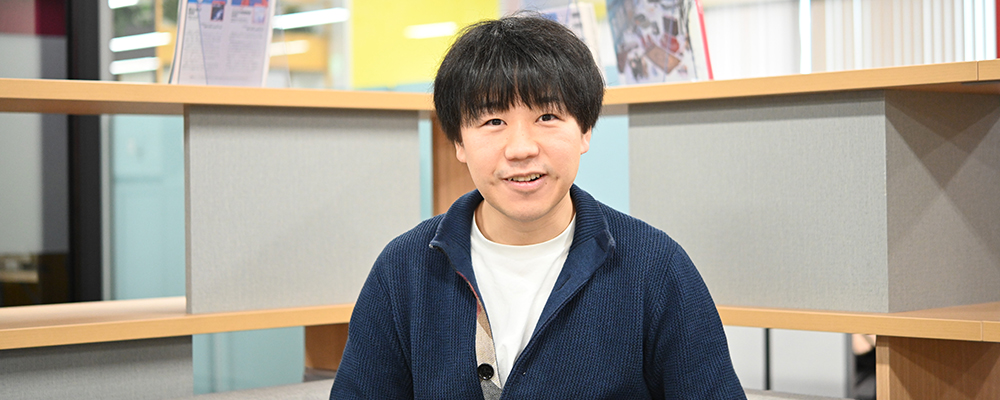
Masashi Kotera
Researcher
Secure System Platform Research Laboratories
After working at a major systems integrator, Kotera joined NEC in October 2020. He is involved in researching and developing machine learning acceleration technologies. Following a change in the team’s research theme, he has been engaged in bioinformatics research and development since fiscal year 2025. Kotera is conducting research and development on the frontier between informatics and life sciences including collaborative research with the division in charge of life and bioscience areas.
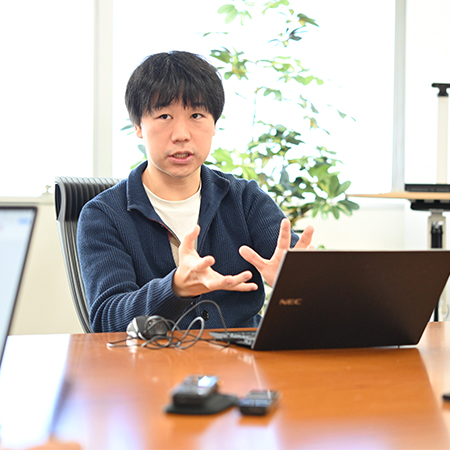
Becoming a hands-on researcher
After completing my master’s program in March 2020, I joined a major systems integrator as a developer. While I had the desire to pursue a career in research, I hesitated due to the impression at the time that positions in corporate research laboratories were for people with PhDs, which led me to choose a development position. I felt that in a development role I myself might be able to do work that was closely related to research.
The work in my assigned area consisted mainly of tasks similar to those of a systems engineer. Moreover, the actual programming and coding work was performed by outside contractors, so my primary duty as a new graduate was program testing. Of course, this was also important work. However, I expected to be more involved in tasks such as algorithm design. Feeling a mismatch between the job and my goals, I quickly decided to change jobs and joined NEC in October of that year after interviewing and receiving job offers from several companies.
I chose NEC because I was excited by the vision shared by the interviewer who later became my boss. I was moved by the compelling description of the job responsibilities such as applying mathematical skills, writing programs, and authoring research papers.
That being said, the work was really difficult when I first joined the company. The project that I was assigned to required me to use C++, which I had never used before, and I lacked basic knowledge of algorithms. For example, even though I could call and use a sort function, I had no idea what was going on inside the function. My knowledge of GitHub and Linux operations was also insufficient. In the midst of all this, my boss, who became my mentor, patiently guided me.
At the same time, having a clear understanding of my weaknesses enabled me to actively tackle challenges while learning on the job. About a year after I joined the company, my understanding of the work had deepened, and I was able to contribute to the authoring of research papers and patents.
Another aspect that surprised me when I joined the company was the office environment. The desks were spacious with two monitors per person. Perhaps it was because computing resources are important for our work on machine learning acceleration, but I felt that the infrastructure needed to focus on research was well resourced. This included the dedicated use of a large server for each person and access to expensive cloud and cutting-edge GPU systems.

Determining the team’s research theme based on one’s own proposal
After joining the company, I began conducting research on machine learning acceleration. I was involved not only in improving algorithms but also focused on maximizing computer performance based on the hardware characteristics, which broadly included everything from computational parallelization and acceleration to implementation.
As we continued this research for several years, the theme that I was involved with was commercialized, and the team began considering the next research theme. NEC has a culture where the researchers themselves can propose new research themes. I seized the opportunity to consult with my boss about wanting to tackle the challenges of the AI field in the life and biosciences area. I believed that we should focus our efforts on the drug discovery field, which has a particularly significant social impact within the “AI for Science” trend that has been attracting attention in recent years.
It was also a time of growing interest in the entire field as highlighted by the awarding of the 2024 Nobel Prize in Chemistry to AlphaFold2 for results achieved in the interdisciplinary area of informatics and life sciences. Backed by such tailwinds, the research theme that I proposed was officially accepted.
I went to medical conferences and gathered information to create a proposal that considers the future business scale. However, I was truly surprised that the company took such decisive action based on the initiative of a single team member without a management title. Subsequently, the human resources department leaped into action to bring in new team members from other locations such as NEC Laboratories Europe.
Furthermore, we began conducting research as needed in collaboration with NEC OncoImmunity, an NEC subsidiary in Norway specializing in bioinformatics.
While so-called “traditional Japanese companies” are often thought to be slow-moving and reluctant to listen to the opinions of younger employees, I believe that for my team at least, the reorganization was carried out in a flexible and speedy manner. I was amazed by the dynamism of the process.
Since the initial studies of software acceleration in bio-related fields only started during this fiscal year, we are doing our best to support related business units with the acceleration technologies that we have cultivated to date. We hope to advance to more in-depth research starting next fiscal year.
Actively acquiring knowledge in the life sciences
When it comes to research, I do not always strongly adhere to the notion that researchers must create new technologies. If there is a problem that you want to solve and it can be addressed by combining existing theories and technologies, then I believe that there is no need to force the creation of new technologies for the sake of research. What is important is not the novelty of the method but whether an effective solution can be presented to address the problem.
On the other hand, there are times when you face a problem that just cannot be solved with current technologies or existing frameworks. In such cases, there arises a need to explore new methods and approaches as research for the first time. It is from that stance that I view research.
My current aim is to contribute to the health and happiness of people through technology. Viewed from that perspective, I feel that my current knowledge regarding drug discovery and life sciences is still significantly lacking. While I am able to face problems from the computational side, that alone is not enough to solve the essential problem. Recently, I have become acutely aware of that frustration. For that reason, I am committed to actively acquiring knowledge in such areas going forward.
One option that I am considering is studying at a graduate school. Since I do not currently hold a PhD, I am considering enrolling in a doctoral program in a related field in the future. NEC has a “domestic graduate school study” system where the company supports your student life for two years if you pass the selection process. Depending on the future progress of my research, I will consider taking advantage of this system.
I will continue to focus on research and development with the goal of becoming the kind of researcher who can generate value at the frontier between informatics and life sciences.
- *The information posted on this website is the information at the time of publication.