
Global Site
Breadcrumb navigation
Chief AI Transformation Officer Hiroshi Kodama: Pioneering AI transformation at NEC with the creation of a new division where even the managing director is an AI agent
November 20, 2026
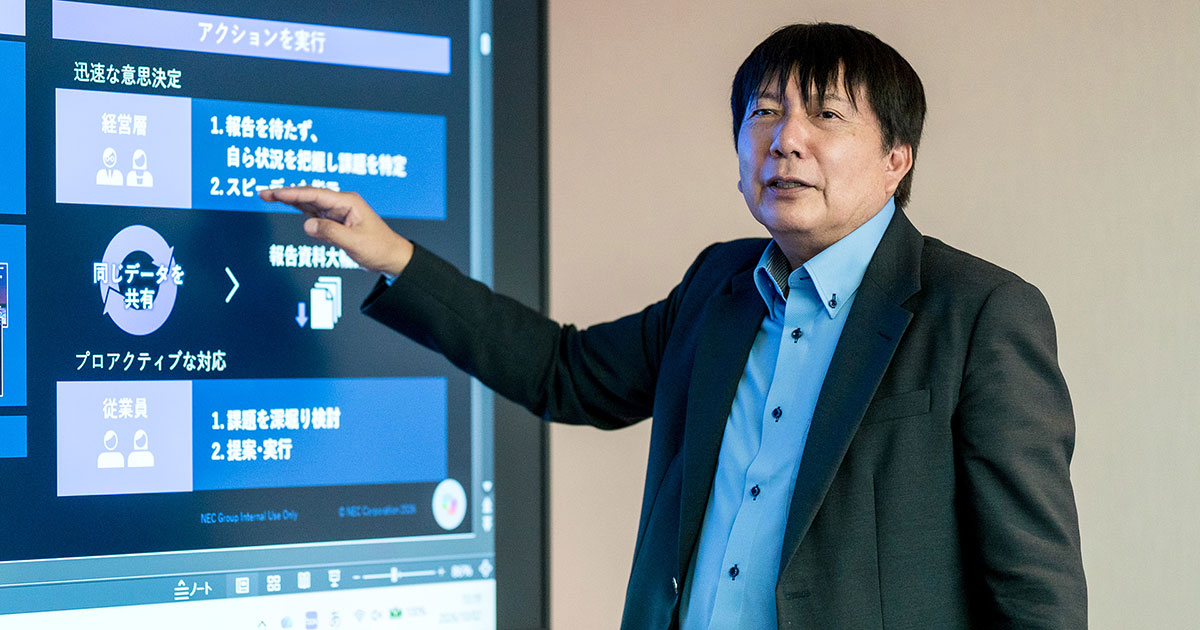
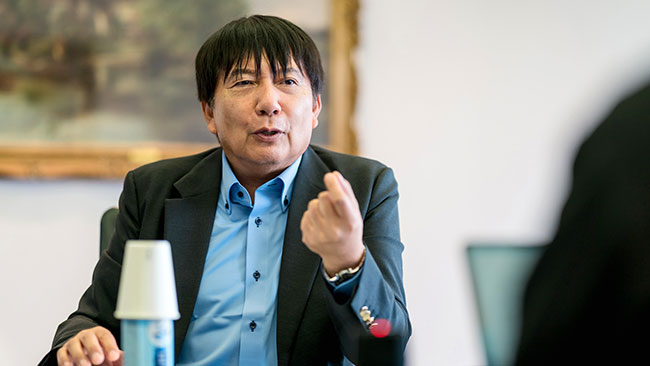
The managing director of NEC's newly established  Corporate AI & Workforce Division, AI ZENTAI OSAMU, is actually an AI agent. This past summer, all eyes were on NEC as it became the first major corporation in Japan to launch an AI-autonomous organization staffed solely by AI agents ranging from a managing director to regular employees. This initiative is a prime example of how the NEC Group is implementing its Client Zero strategy, in which the company positions itself as its own first customer. In this interview, NEC's Chief AI Transformation Officer (CAXO), Hiroshi Kodama, discusses the changes emerging inside NEC and the externally focused transformation initiatives it is undertaking.
Employee expectations for the newly launched AI organization:
"I'd like to give something like this a try"
This AI-autonomous organization, which was officially launched in August 2026, has a hierarchical structure consisting of a managing director, managers, and regular employees, each with roles based on their respective duties. Members of this organization are assigned to their roles only after passing safety and suitability screening and completing the required training. Additionally, they undergo performance evaluations and participate in one-on-one meetings just like their human counterparts.
According to Kodama, "The system NEC has refined over many years for human organizations is now being applied to this AI-autonomous organization. There was even an instance in which an AI agent we believed would function as a manager performed so poorly that we had to reassign it to an employee role."
Kodama emphasized that humans retain final decision-making authority, saying, "You simply cannot generate speed or value unless it is a human who makes the final decision."
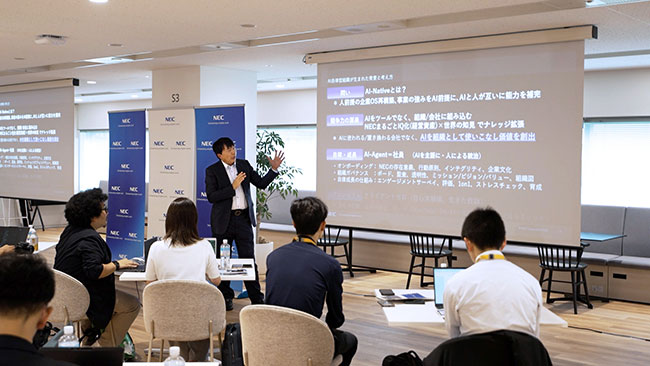
Alongside growing interest from outside the company, internal enthusiasm is also increasing. After seeing the results produced by AI employees, human employees have begun submitting a steady stream of ideas they would like to pursue.
Regarding this positive response, Kodama says, "We've had so many employees step forward and say, 'I'd like to give something like this a try.' It has been a bit overwhelming, but in the best way." He also mentioned that the company is working to integrate ideas generated internally into the new division. Additionally, plans are underway to scale the division to several hundred AI agents.
Using Client Zero to create compelling topics that drive customer engagement
This AI-autonomous organization is just one of the Client Zero initiatives of the NEC Group, which is comprised of approximately 100,000 personnel. It was Kodama who spearheaded the Client Zero strategy in 2021 when he was appointed the first head of the Transformation Office, an organization tasked with driving corporate transformation.
"Customers are unlikely to seek support from a company that has not achieved results itself. That is why we must lead by example. Our goal was to learn from both our successes and our failures as our own first client and share that firsthand knowledge with customers and society," explains Kodama.
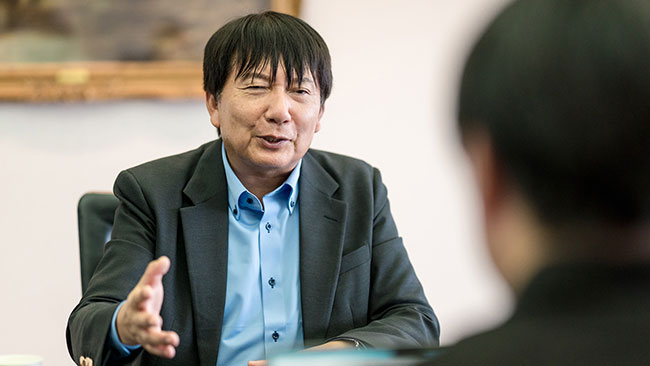
NEC currently has approximately 50 AI-driven internal transformation projects underway across seven transformation themes. These projects include the reviewing of proposals by AI agents designed to emulate key client personnel and the consolidation of a staggering number of internal regulations.
"Customers are unlikely to meet with you unless you can offer a compelling topic that resonates with their management team. Client Zero has proven effective in this regard. Everyone from company presidents to Chief Information Officers has expressed interest immediately," says Kodama.
In fiscal year 2025, Kodama spoke with more than 100 corporate executives. To date, Client Zero has been utilized to provide sales support in nearly 1,500 instances.
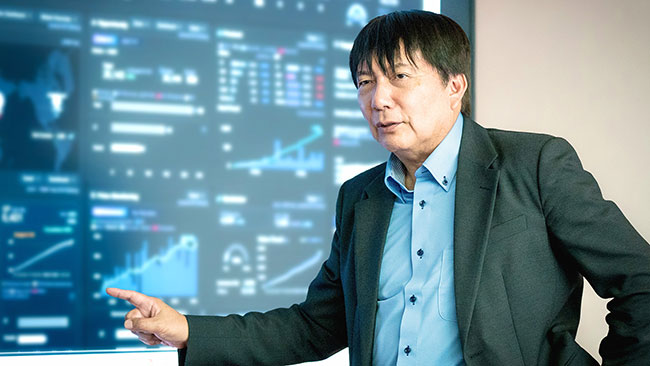
One typical Client Zero solution is the "NEC Management Strategy Support Cockpit," which visualizes management data such as financials, order and sales data, and IT and security status. By visualizing processes and creating systems to facilitate action, this solution has increased NEC's gross profit margin by 5.5%. The NEC Management Strategy Support Cockpit was launched for commercial deployment in 2026.
Kodama has chosen to focus less on the system itself and more on transforming how organizations approach data. "Once the data is visible, there is a tendency to use it to critique decisions that were made in the past. However, facts are facts. When reflecting on the past, we should focus on the actions needed to build a better future. That's what really matters," says Kodama.
In addition, the decision was made to prepare data based on priority. According to Kodama, "Had we waited until we had the perfect data, we never would have been able to move forward with our transformation. If you start with only 50% of the data, you will quickly identify what information is missing. Even that can deliver significant results."
Using AI to tap into the collective intelligence of the world
The convictions held by Kodama can be traced back to his days as a new employee.
When he joined NEC Software, Ltd. in 1982, the first project he was assigned to involved Seven-Eleven's systems. Seven-Eleven had already begun implementing data-driven management, placing tremendous importance on not only mastering the fundamentals and embracing change but also conducting hypothesis testing.
"I was told that even when sales increase, you won't be given credit for it unless those results are supported by a clear hypothesis. Conversely, if sales decline, what matters is being able to explain what was learned from testing the hypothesis and how those insights will lead to a better approach next time," says Kodama, reflecting on what was drilled into him at the time.
"The lessons I learned as a new employee still form the foundation of my work today: mastering the fundamentals, testing hypotheses, and adapting to change. Ultimately, those same three principles are vital to transformation," says Kodama.
Kodama continues to embrace and adapt to the changes being brought about by AI while pushing forward with NEC's transformation initiatives. "I increasingly have opportunities to speak with people from companies overseas, but I am not a fully fluent English speaker. Today, however, my avatar can speak clearly in English while replicating my voice and movements, helping me overcome the language barrier," says Kodama. "One person's IQ is limited, but with AI, you can harness the collective intelligence of people around the world," Kodama continues.
So, what should we do with these enhanced capabilities? "The important thing is to ask questions," he emphasizes, adding, "Whether it is a challenge in your everyday work or a problem facing society, anyone can formulate a question."
As a practical opportunity to formulate questions and quickly turn them into something tangible, NEC held an AI agent development training program for approximately 1,000 employees in its Corporate IT Division. The challenge was to build an AI agent from scratch in just two hours, without consulting anyone, that could solve a problem based on a question the participant had formulated themselves.
"Until now, defining requirements for something like this would have taken months. I wanted people to experience firsthand just how much could be accomplished in two hours, and to feel that sense of speed," explains Kodama.
"What matters most is for each person to gain a deep understanding of the core issue and to formulate questions based on that understanding. Then, AI can be used to swiftly turn them into something tangible, allowing us to drive progress by achieving small but solid results (i.e., quick wins). By turning each of these quick wins into part of NEC's IQ, we can leverage the synergies with the capabilities of the NEC Group and translate them into significant value for our customers and society."