
Global Site
Breadcrumb navigation
A behind-the-scenes look at how JAXA and NEC worked together to enable Hayabusa2 to set a world record for closest approach during its flyby of the asteroid Torifune
November 25, 2026
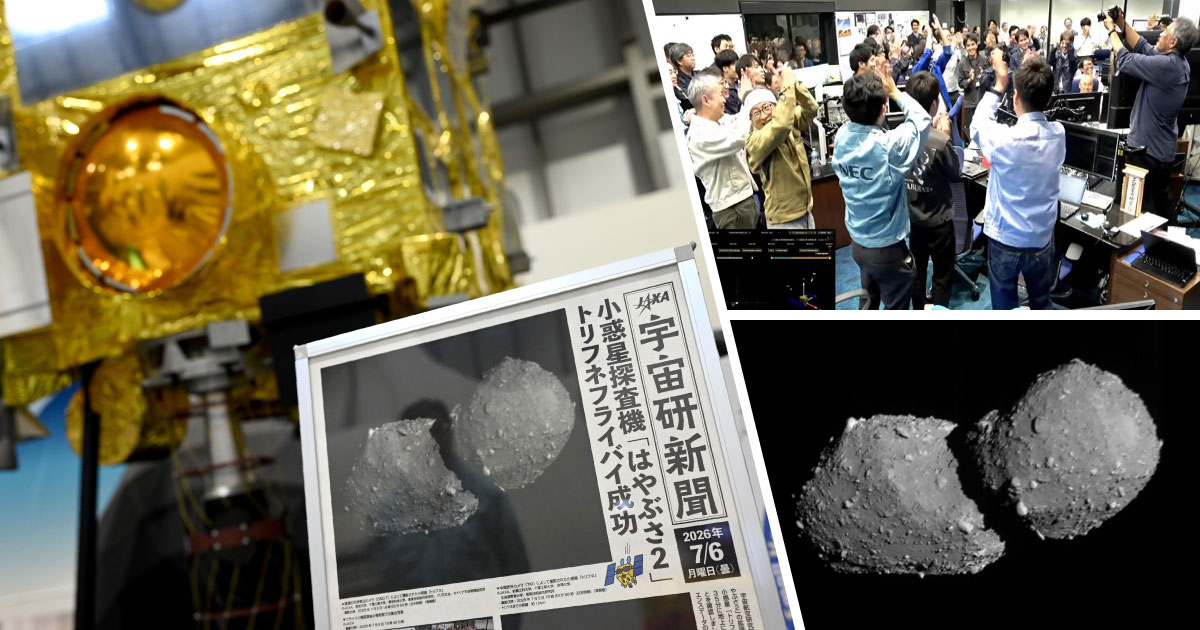
As we carry on with our daily lives here on Earth, a spacecraft is continuing its mission hundreds of millions of kilometers away in space. This spacecraft is Hayabusa2, an asteroid explorer developed by the NEC Group in collaboration with the Japan Aerospace Exploration Agency (JAXA). In July 2026, Hayabusa2 accomplished a new feat. In this edition of NEC Stories, we provide a behind-the-scenes look at this recent accomplishment by sharing the reflections of two NEC employees who supported this challenging mission. They discuss the last-minute changes to mission requirements, the extreme attitude control needed to complete the mission, and the strong bond that developed between NEC and JAXA.
In 2020, Hayabusa2—the asteroid explorer launched 12 years ago in 2014—sent back to Earth a capsule containing samples collected from the surface of the asteroid Ryugu. The asteroid explorer then entered a new phase of its mission, known as the Hayabusa2 Extended Mission.
In July of this year, Hayabusa2 conducted a flyby mission to observe the asteroid Torifune. At its closest approach, the asteroid probe came within approximately 744 meters of the center of Torifune and around 400 meters from its surface. This achievement set a world record for the closest approach to a celestial body among all flyby exploration missions to date. Furthermore, it represents a major advancement toward developing planetary defense technologies, such as those capable of altering the orbits of asteroids on a collision course with Earth.
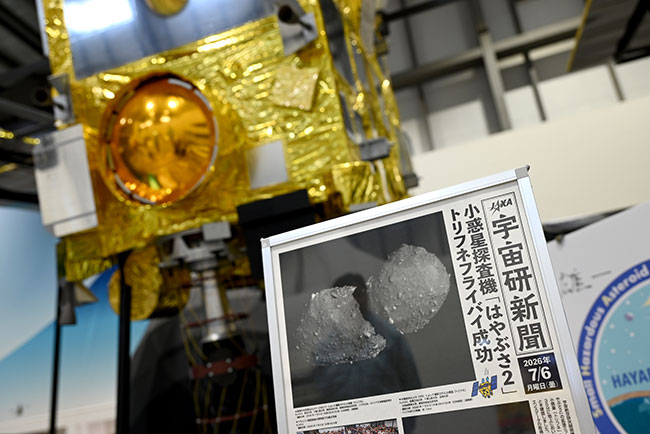
NEC's technologies supported this mission, which required advanced spacecraft control to observe the asteroid as it passed just 400 meters from the surface at an ultra-fast speed of 5 kilometers per second.
Choosing to take on the difficult challenge of skimming past Torifune
"Someone from JAXA actually came to me and asked, "If you had to choose between a mission in which Hayabusa2 collided with an asteroid and a perilously close flyby, which would you choose?" This revelation came from Akira Kawaguchi, who oversees the Hayabusa2 project for NEC.
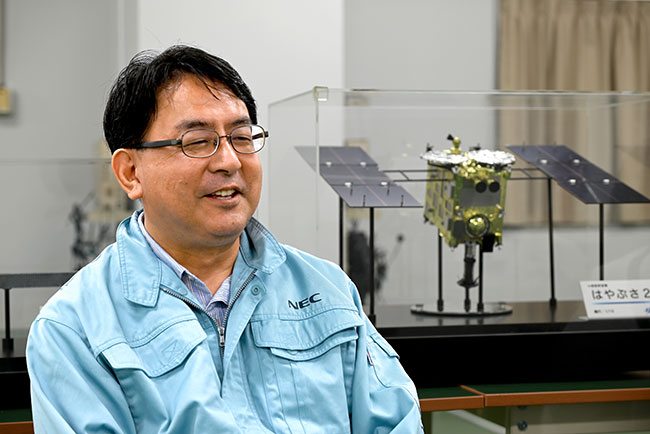
"Colliding with the asteroid would immediately end Hayabusa2's mission. Although it would be a difficult task, I believed it would be much more interesting to attempt to just barely miss it. That is why I proposed that we skim past the asteroid," explains Kawaguchi.
The next step was to determine how close the flyby should be. Initially, safety was the main priority, leading the project team to consider options ranging from one to ten kilometers. However, things took a sudden turn. JAXA's strong determination and NEC's unwavering resolve ultimately led to the decision to aim for a flyby as close as 800 meters from the center of Torifune.
Looking back on this decision, Kawaguchi says, "We knew we could set a new world record if we came within one kilometer. However, this would also significantly increase the level of difficulty, and everyone involved felt responsible for successfully completing the mission. Despite these conflicting emotions, we all pushed forward together."
The process of revising the limits that continued right up until the morning of the big day
For Hayabusa2, a spacecraft originally designed for carrying out touchdown missions, capturing high-speed images as it passed an asteroid at close range was an unexpected mission.
Securely mounted on the spacecraft, Hayabusa2's cameras cannot be rotated. To keep the asteroid explorer in the camera's field of view, advanced attitude control was required to tilt the asteroid explorer at just the right timing.
According to Naomi Suto, who was responsible for technical coordination of the program to achieve this mission, "If we missed the split-second window that we had, there would be no turning back. We only had one shot at making this happen."
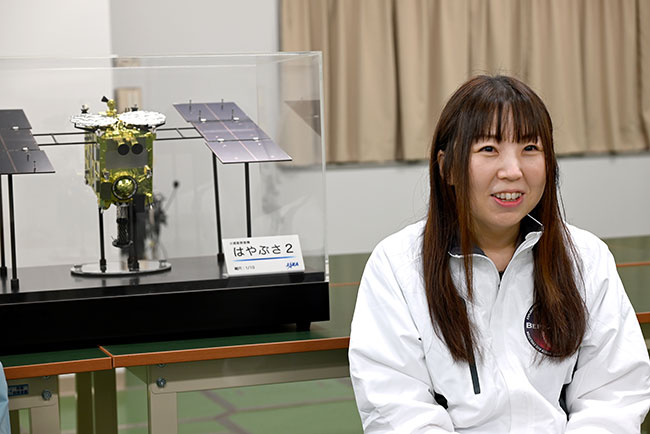
The schedule was planned down to the last detail, taking into account numerous constraints, including communication quality and capacity for sending high-resolution data back to Earth and the orientation of the spacecraft. According to Suto, "Even a one-second overlap in executing commands, such as those for attitudinal changes or capturing images, would result in errors. Therefore, the schedule was carefully structured to ensure that there were no gaps. Every detail was specified, including the precise hour and minute when the image would be captured and by which camera."
The revisions also continued. The plan, initially scheduled for finalization a week before its execution, was revised up until the day of the mission as project team members scrambled to adapt to the constantly changing space environment.
The finalized commands were sent to the asteroid explorer just one hour before attempting its closest approach. This was indeed a countdown in which every minute and every second was critical.
The project team also created scenarios for emergency situations. If you combine potential anomalies, such as camera malfunctions, with their anticipated timing, there were as many as several hundred recovery procedures. "I'm truly glad we never had to use them," said Suto with a sigh of relief.
A signal of survival from the darkness: "Ah, there was no collision"
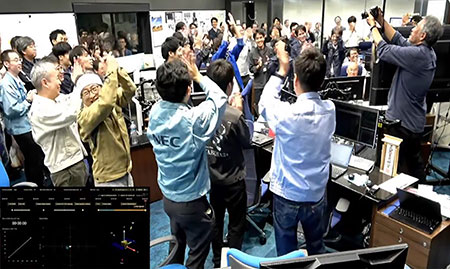
On July 5, the moment of truth had finally come—Hayabusa2 was ready to make its closest approach. A sense of quiet tension filled the entire command center.
"Around five minutes after Hayabusa2 made its closest approach, we received a signal. The moment I saw the data, I said to myself, 'Ah, there was no collision. Hayabusa2 is still intact.' It was then that a wave of emotion came over me," recountsSuto. The camera had successfully captured a clear image of Torifune.
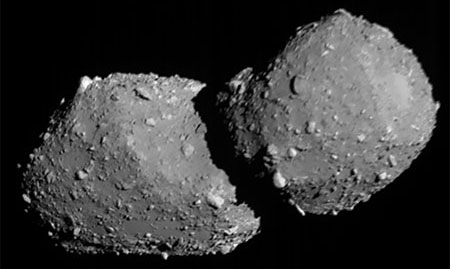
©JAXA
"In that moment, organizational boundaries ceased to exist. We put our arms around each other and celebrated. When a JAXA member told me, 'It's very grateful to NEC,' my heart swelled with emotion at having been able to witness this historic moment," says Kawaguchi.
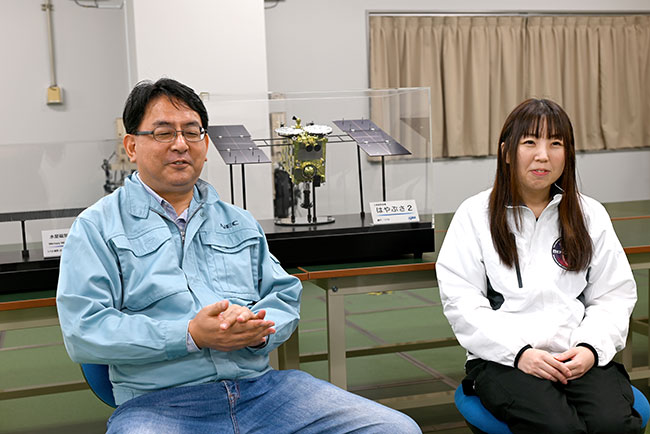
Over time, JAXA and NEC have built a relationship based on solid trust. Kawaguchi explains, "We already had a relationship where we felt comfortable consulting each other about anything and everything. This is why we were able to remain united and keep pushing forward even under extreme pressure."
Hayabusa2 is currently making its way toward its ultimate destination—1998 KY26, a tiny asteroid. The asteroid explorer is scheduled to make its arrival in July 2031. Efficient injection planning for NEC's ion engine will be pivotal in ensuring its successful arrival. And so the journey continues.