
Global Site
Breadcrumb navigation
Powering global communications with technology packed into the width of a single strand of hair: How NEC's submarine cables are evolving in the AI era
November 12, 2026
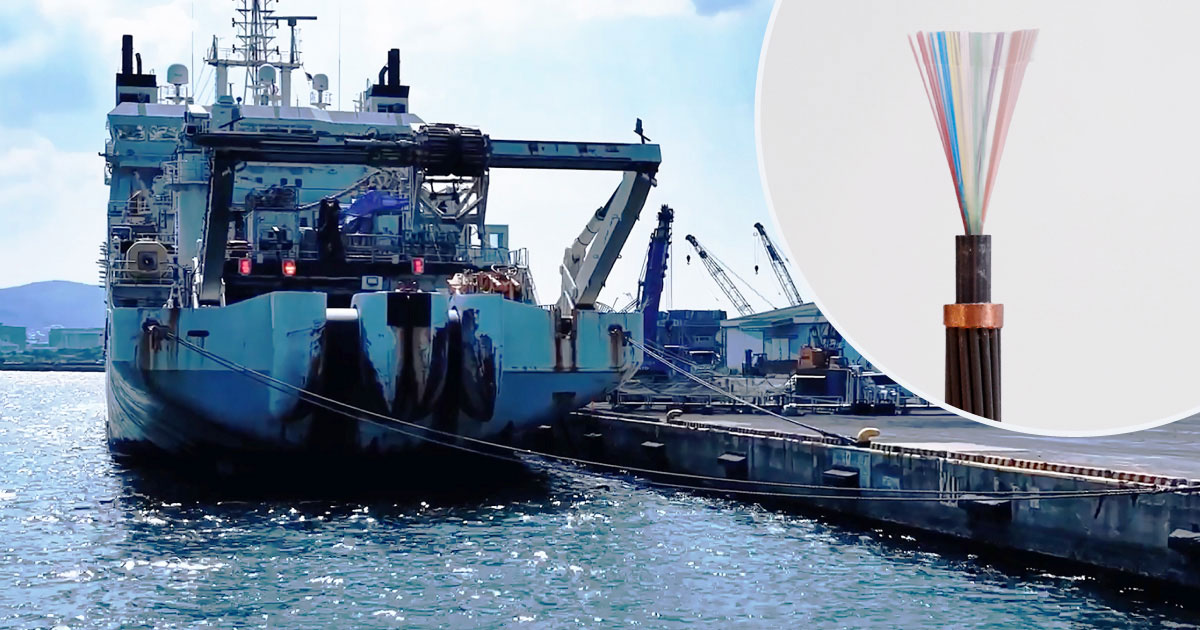
In our daily lives, we use various digital services to browse social media, watch videos, and utilize AI. Submarine cables span the depths of the world's oceans, supporting the exchange of massive amounts of data. As data traffic continues to surge with the widespread use of AI, submarine cables are being called upon to deliver even greater capacity. However, submarine cables face a unique constraint: they must transmit more data while maintaining a specific cable diameter. NEC and its ever-evolving technologies are helping to ensure this exchange of data around the globe.
Rising demand for communications and the presence of submarine cables
"Global demand for communications is doubling every two and a half years," says Alan Mauldin, a Research Director at TeleGeography, a company that conducts research and analysis in the global telecommunications sector, regarding recent growth in data traffic.
Behind this is intensified demand for cloud services and AI. The expansion of AI shows no signs of stopping, with individuals, corporations, and governments using it for applications ranging from everyday life to ventures in outer space.
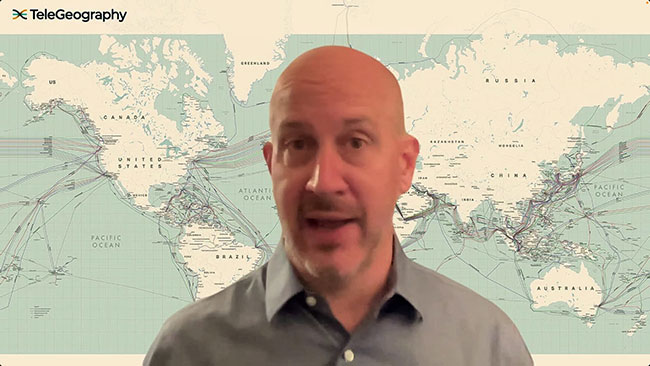
When discussing this rise in communications demand, one factor that cannot be overlooked is the presence of hyperscalers, such as Google and Microsoft. For these hyperscalers, who are expanding their data centers to keep pace with AI demand,
Mauldin says, "Submarine cables are like the oil that drives their businesses."
Nearly 600 of these submarine cables stretch out across the floor of the world's oceans. As geopolitical risks grow, these cables are becoming increasingly important. At the same time, simply adding more cables has its limits in meeting growing communications demand. How, then, can this demand be met? NEC, ranked as one of the world's top three submarine cable providers offering installation, is tackling this challenge head-on.
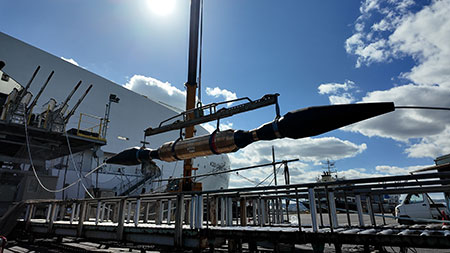
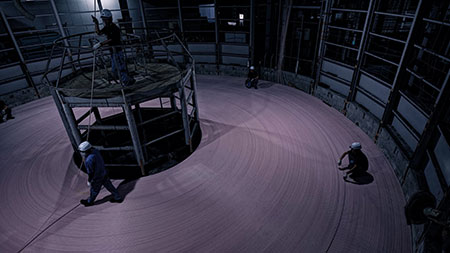
Even if adding more cables is not an option, more data can be transmitted by increasing the number of optical fibers housed in each cable. NEC has made progress toward increasing capacity by adding more optical fibers, but there is a limit to the number of fibers a cable can accommodate.
While one might think that you could increase the fiber count by increasing the cable diameter, even this has its limitations. Yoshikazu Takahashi, Senior Director of NEC's Submarine Project Department, explains, "Although this is possible from a technical standpoint, it is cost-prohibitive." Additional materials are required to increase the diameter of the cable, which also impacts the cable installation process. "The amount of cable each vessel can carry decreases, which means a deployment that previously required three cable-laying vessels would require four. As a result, cable installation costs also rise," says Takahashi.
Incorporating multiple optical signal paths within a single fiber.
To expand the potential for increasing transmission capacity without having to change the diameter of cables, NEC has pioneered research and development on multicore technology. Kohei Hosokawa, who is engaged in research and development of communications technologies using submarine cables and serves as Director of NEC's Connected Infrastructure Research Laboratories, explains: "In conventional single-core fibers, there is only one optical signal path—known as a core—within a single optical fiber. In comparison, multicore fibers contain multiple optical signal paths, be it two, four, or more."

Naturally, there are also technical challenges involved. "When there are multiple optical signal paths within an optical fiber as thin as a strand of hair, the signals interfere with one another, resulting in noise."
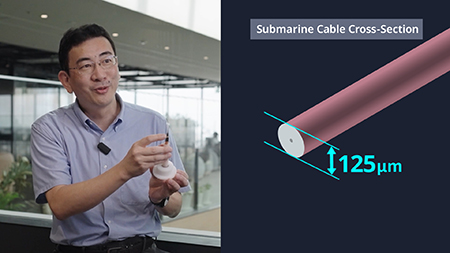
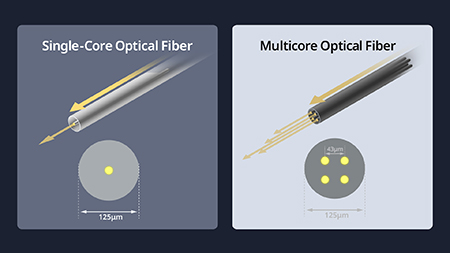
Rather than preventing signal interference, the key to resolving this issue is to use Multiple Input Multiple Output (MIMO) technology—a type of signal processing technology commonly used in wireless communications and other applications—to separate the interfering signals.
According to Hosokawa, this is how MIMO works: "We embed predefined signals as markers at the transmitting end. At the receiving end, we use those markers to identify signals from each core and then separate the interfering signals."
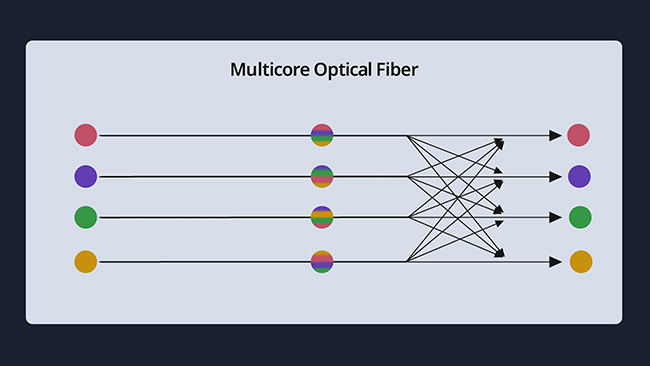
In high-speed, high-capacity optical communications, such as with submarine cables, the scale of MIMO signal processing also increases. The more cores present, the greater the degree of technical difficulty. NEC has engaged in the research and development of multicore technology for practical application, and successfully conducted a transoceanic-class (7,280km) transmission experiment using a coupled 12-core multicore fiber in 2024.
NEC's submarine cables: Supporting our everyday lives
"When I think about how NEC's submarine cables are used behind the scenes whenever we check our email or use AI, it motivates me to keep working on research and development." The multicore technology being developed by Hosokawa and his colleagues at NEC is steadily progressing toward practical implementation.
In September 2026, NEC announced that it had been awarded Petal, a submarine fiber-optic cable project by Meta in the United States. The project aims to develop the world's first submarine cable with a transmission capacity of one petabit per second (1,000 trillion bits per second). It will use two-core multicore fiber, with NEC responsible for the overall system design and construction. This will be only the second case worldwide of the practical deployment of a submarine cable using multicore fiber.

Leading projects like this is NEC's Submarine Project Department, headed by Takahashi. A submarine cable installation project is a major undertaking that takes years, encompassing everything from manufacturing and obtaining the necessary permits to the actual installation work. When asked what he finds most rewarding about his work, Takahashi emphasizes, "Connecting people around the world."
Submarine cables connect people and bring the world closer together. As one of the few companies worldwide capable of providing an integrated, end-to-end service spanning development, manufacturing, and installation, NEC will continue to support people's everyday lives.