
Global Site
Breadcrumb navigation
Newly appointed Chief Human Resources Officer Shiori Nagata on the transformation of people and organizations in the AI era: "NEC has cultivated a culture of open communication"
August 20, 2026
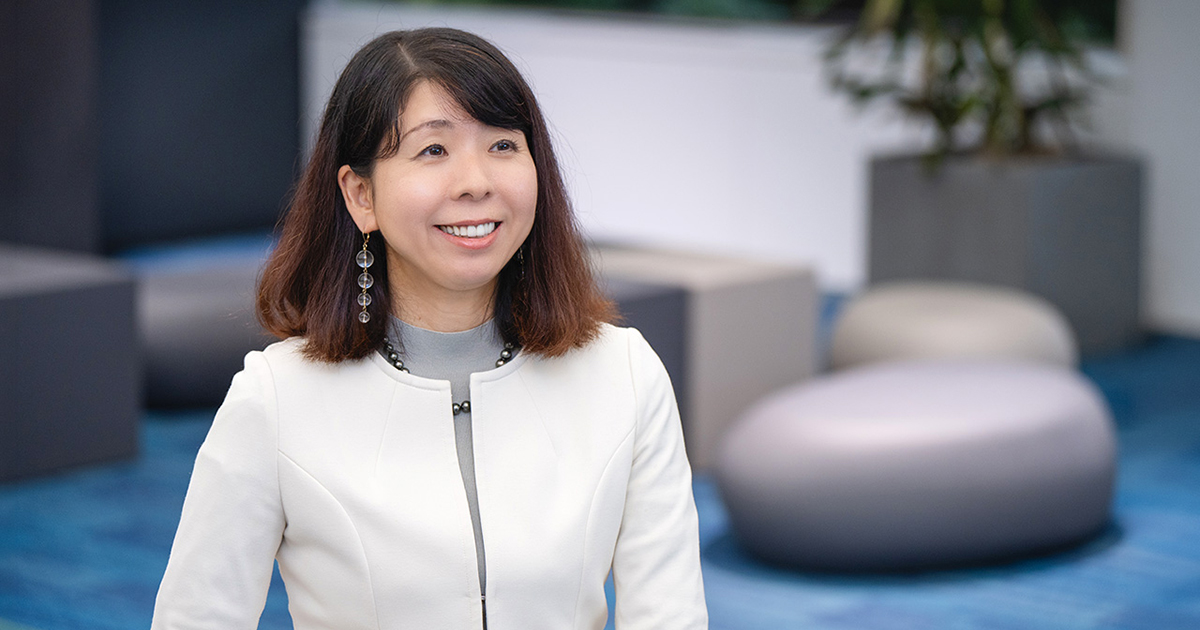
Through its expansion of mid-career recruitment and mergers and acquisitions (M&A), the NEC Group has assembled a workforce with diverse backgrounds and values. This has made the role played by the Chief Human Resources Officer (CHRO) more important than ever as they are tasked with transforming the individuality of each member into a powerful force supporting NEC's growth. After serving as an outside director for NEC, Shiori Nagata was appointed as Corporate Executive Vice President and CHRO at NEC in April 2026. We sat down with Nagata to ask her thoughts on the transformation of people and organizations as we enter the age of AI.
Identifying the challenges facing Japanese companies as someone without an HR background
The relationship between NEC and Nagata actually began three years ago. At the time, Nagata—then Chief Strategy Officer (CSO) and Director at Yanmar Holdings Co., Ltd.—was serving as a panelist alongside Takayuki Morita, President and CEO of NEC, at an event held at the official residence of the British ambassador to Japan.
"That day, I shared my thoughts on diversity with Mr. Morita. Perhaps he came away from that initial conversation thinking, 'She seems like an interesting person.'"
This meeting also gave Nagata the opportunity to discover a few things about NEC. "It was at that event that I learned NEC was passionately working to improve diversity and employee engagement," recalls Nagata, who also says it was this very impression that led her to accept the position of outside director with NEC.
Nagata herself has built a career rich in diversity. The first career choice she made, which happened to be at the height of what is known in Japan as the "Employment Ice Age (Shūshoku Hyōgaki)" (i.e., a period from around 1993 to 2004 following the collapse of the country's economic bubble in which there was a serious job shortage), was to become a management consultant. She later engaged in the corporate restructuring of Tohato, Inc., and gained experience in investment fund operations at two different companies. While at Yanmar Holdings Co., Ltd., where she aspired to work overseas, Nagata served as President of the company's Dutch subsidiary and Chief Strategy Officer (CSO) at its headquarters in Japan.
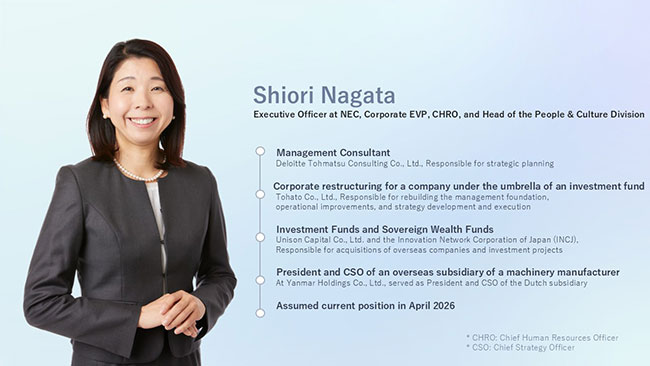
Despite not having an HR background, Nagata has built a solid foundation that enables her to view the challenges facing people and organizations through a broad lens. Pointing out the structural challenges commonly facing Japanese companies, she says, "The HR systems developed by Japanese companies over the past 50 years have been based on the premise of maintaining the conventional model. That is why it is so difficult for companies here to adapt to sudden paradigm shifts like AI."
Likening HR transformation to "a monumental task akin to gradually tearing down the home you have long cherished and lived in, then rebuilding it based on new blueprints while still residing there," Nagata went on to add, "It is by no means easy for those who created something to change it on their own. That's why there are certain things I can tackle because of my experience with different companies and cultures."
Turning collaboration between AI and humans into an advantage for NEC
Now that three months have passed since she was appointed CHRO, Nagata says she is making a concerted effort to "walk the talk" and rebuild the "house" NEC has grown accustomed to; that is, to achieve HR transformation.
"Regardless of how loudly executives proclaim the need to 'take swift action' or 'embrace new challenges,' employees won't fall in line if decisions are not made quickly and those who do undertake challenges are not duly recognized. Instead of simply proposing ideals, executives must narrow down what actually needs to be done. I believe it is vital to follow through on your decisions, ensuring that you persist until the changes are evident in policies, evaluations, and daily actions."
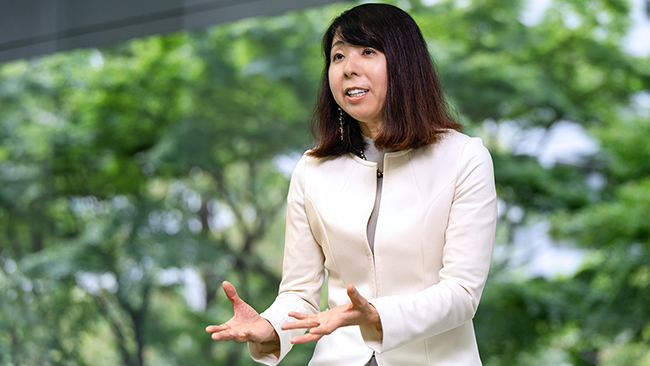
HR transformation will also play a crucial role in the achievement of the Mid-term Management Plan 2030 that NEC announced in May of this year. As it strives to become an AI-native company, NEC will be focusing on collaboration between AI and people in the HR realm.
According to Nagata, "Our goal is to ensure that AI is not reserved for only a select few but rather accessible to all employees. We want everyone to utilize it effectively in their work and continue their learning journey. What is important is for employees to be able to catch the wave of change and ride it out. By establishing AI-driven operations in the HR domain, we hope to provide customers with the valuable expertise we gain."
As for learning, Nagata equated it to engaging in intellectual workouts, explaining, "If you continue to build your learning muscle, you'll build stamina that allows you to adapt to whatever change comes your way." This is why the NEC Group is gradually expanding its AI human resource development programs and supporting employees seeking to embrace the challenge of becoming AI specialists, even if they start out with limited experience.
The keys to improving engagement: Trust and the ability to engage in open and honest dialogue
In addition to AI, boosting engagement scores is a key theme of NEC's Mid-term Management Plan 2030. Over the medium- to long-term, NEC aims to reach the global top tier for engagement.
According to Nagata, "The average engagement scores of Japanese companies are lower than those of their counterparts in Europe and the U.S. For NEC, reaching a top quartile ranking globally is a very lofty goal."
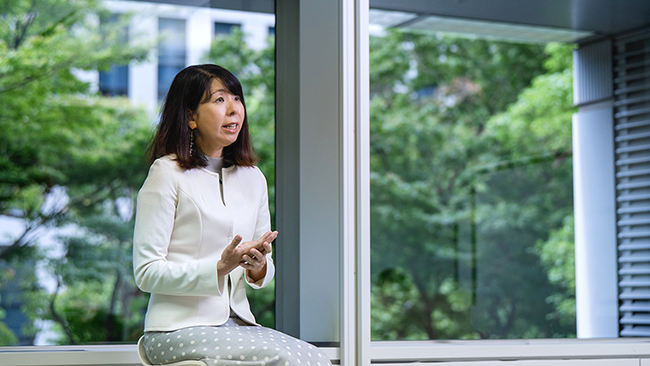
Having said that, she also made sure to add, "Superficial measures taken solely to improve scores do not resonate with employees."
"My goal is to create a culture in which employees on the front lines can honestly voice their opinions to executives. To achieve this, executives must keep their promises in order to earn the trust of their employees. I encourage our employees to speak up if they feel there are inconsistencies between what they hear executives saying and the reality they experience from day to day. By doing so, we can identify these inconsistencies sooner and make changes more swiftly. As a result, engagement scores should naturally improve."
Nagata feels NEC has already built the foundation for a culture in which those on the front lines feel comfortable expressing their honest opinions directly to executives. Since her appointment as CHRO, Nagata has experienced for herself NEC's culture of open discussion.
"Up until now in my career, I primarily devised plans on my own and then shared them with colleagues. However, there were also times when I would take everything on by myself. Now that I am at NEC, I have peers who are willing to brainstorm, make decisions, and shoulder the responsibility of taking action together with me, even though I was just recently appointed to this position. Knowing that I do not have to go it alone has made me genuinely happy. I consider one of NEC's biggest allures to be that its employees, including executives, hold workshops where participants thoughtfully discuss the future of the company or their teams."
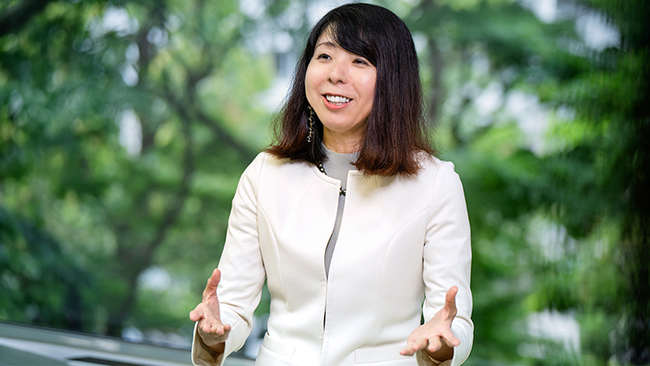
Nagata also believes that being willing to accept different viewpoints is necessary for engaging in meaningful discussions, saying, "Once you have grown accustomed to the rules or the atmosphere, there is a tendency to unintentionally limit what you want to do or lose your motivation to embrace new challenges." Finally, she quoted Malala Yousafzai, winner of the Nobel Peace Prize in 2014.
"In her Nobel Lecture, Malala said, 'Thank you to my father for not clipping my wings and for letting me fly.' If you spread your wings, there is always a chance you may hit something. However, if you don't at least give it a try, you'll never know what might happen next. I'm not one to shy away from something new, and I want to take on various challenges. Moreover, I look forward to cheering on the NEC Group as it undertakes its own challenges."