
Global Site
Breadcrumb navigation
Visualizing the Economic Benefits of Disaster Prevention: NYU and NEC Partner to Create New Value
July 22, 2026

Damage caused by natural disasters has become a critical global challenge, affecting communities in Japan and around the world. Urban areas, in particular, face an immense economic toll. When Hurricane Sandy struck New York City in 2012, it severely impacted public infrastructure, with some estimates putting the economic loss in the trillions of yen (tens of billions of dollars). While calls for disaster preparedness are growing, the massive cost involved often hinders progress. To encourage the necessary investments, NEC is spearheading initiatives to visualize and quantify the financial benefits generated by disaster prevention measures.
Attracting investment to disaster prevention projects
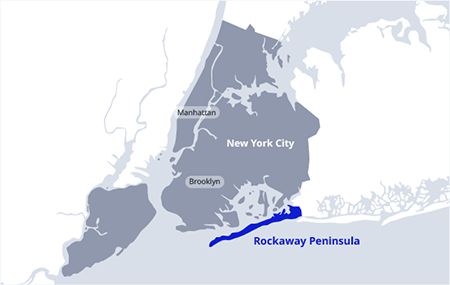
In May 2026, NEC, in partnership with New York University (NYU), released the results of a joint study analyzing the economic impact of a flood protection project on the Island of Manhattan. The study revealed that under certain scenarios, the project could prevent up to approximately $800 million USD in potential losses. A key feature of this study is its granular approach: it categorized benefits into five themes—including transportation infrastructure, housing, and residents' mental health—clearly demonstrating who actually benefits from disaster prevention measures and to what extent.
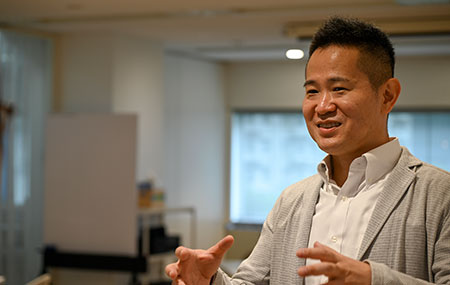
Visualizing and quantifying these complex, interconnected benefits makes it easier to explain the value of such projects not only to taxpayers but also to the businesses and shareholders who stand to benefit. "This opens up possibilities for leveraging private capital to fund public disaster prevention projects," says Ryutaro Adachi of NEC's GX Business Development Division, who is leading the initiative. The goal is to develop a financial framework that encourages those who benefit from disaster mitigation to also invest in it.
For instance, when building a levee for river flood control, the traditional view has been that the project should be funded entirely by taxes because its primary goal is public safety. However, if there are factories or other facilities in the basin, local businesses also benefit directly from flood prevention. Quantifying this economic impact provides a compelling rationale for these corporations to co-invest in the construction costs.
What drove NEC to embark on this journey?
Climate action generally falls into two categories: mitigation (reducing greenhouse gas emissions to slow global warming) and adaptation (preparing for and reducing the impact of natural disasters and other climate-related changes). Investment in adaptation has lagged behind, largely because the return on investment (ROI) is difficult to visualize.
To address this, adaptation finance—a mechanism designed to attract capital by assessing how much damage is prevented through disaster prevention measures—is gaining traction. Historically, the ability to quantitatively demonstrate and monitor the effectiveness of disaster prevention has presented significant challenges, largely due to the broad range of stakeholders who benefit from it.
In response, NEC has launched the NEC Digital Adaptation Finance initiative. To visualize the benefits of adaptation measures, NEC uses remote sensing, AI, digital twins, and other technologies to collect and analyze data essential for risk assessment. By clarifying how the benefits of disaster prevention and mitigation are distributed, this framework provides a solid foundation for discussing who should bear the costs and how they can recoup their investment.
From major metropolises to Japan and other developed countries: Scaling the impact
"Quantifying value that was previously invisible is a major milestone," says Yuki Miura, Assistant Professor at the NYU Tandon School of Engineering, reflecting on the Manhattan project. Assistant Professor Miura first learned of NEC's work in 2025. At the time, she was pleasantly surprised to find that a technology company was working in the same research field. "When I realized NEC was seriously pursuing adaptation finance, I saw massive potential in connecting my academic research with NEC's technological capabilities and business vision."
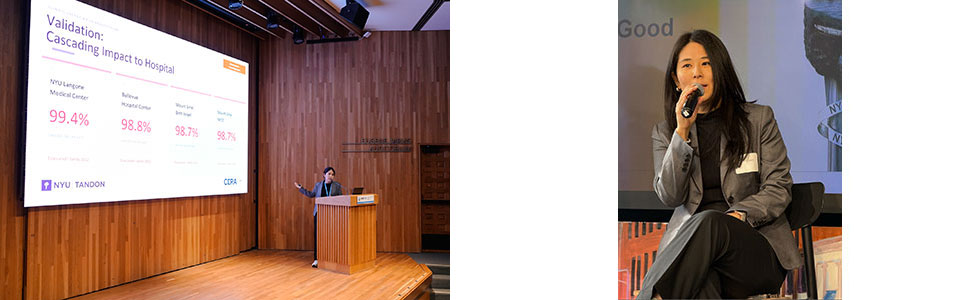
According to Miura, climate change research rests on three pillars: Identification (understanding risk), Measurement (quantifying risk), and Management (mitigation and decision-making). While specialists exist for each pillar, few researchers address all three simultaneously as Miura does. Her cross-disciplinary expertise—spanning urban infrastructure, flood risks, economic impacts, and decision support—proved invaluable for this joint evaluation.
"Most disaster prevention research focuses on bringing a negative situation back to zero, so the concept of using resilience to generate new value is seen as highly innovative," Miura explains. Currently a member of the New York City Panel on Climate Change (NPCC), Miura advises and provides information on urban climate risks and adaptation strategies to city agencies, including the Mayor's Office, as well as the private sector. Recently, she has seen a surge in interest, receiving inquiries from private developers and other commercial entities.
Conducting this evaluation in New York, one of the world's leading economic hubs, carries profound significance. "Developed countries with larger economies suffer greater financial damage from natural disasters, which conversely means they stand to gain the most from disaster prevention," explains NEC's Adachi. "Consequently, they have a stronger motivation to engage in adaptation finance."
In recent years, the rapid evolution of AI and cloud services, combined with dramatically lower computing costs, has made it much easier to run simulations involving massive datasets. Looking at Japan, many corporations operate critical infrastructure—such as transportation networks, power plants, factories, and warehouses—in areas highly vulnerable to floods and other hazards. "Going forward, we would also like to reach out to enterprises here in Japan, an archipelago prone to natural disasters," Adachi says, sharing his vision for the future.

Viewing risk management not as a mere cost, but as the creation of new social value, aligns closely with NEC's corporate Purpose. This approach can also be applied to threats beyond climate change, such as cybersecurity.
If a company falls victim to a cyberattack, leading to data leaks or operational shutdowns, the resulting financial losses can be staggering. By simulating and quantifying the future value of robust cyber defense, cybersecurity expenses cease to be viewed as a sunk cost. Instead, they are recognized as a strategic investment that yields returns by preventing opportunity losses and strengthening business competitiveness, serving as a key performance indicator for sound executive decision-making.
At first glance, financial frameworks like adaptation finance may seem far removed from our daily lives. However, in an era where climate change and rapid technological innovation continuously spawn new risks, these pioneering efforts may ultimately prove vital in ensuring our lives remain safe and secure.