
Global Site
Breadcrumb navigation

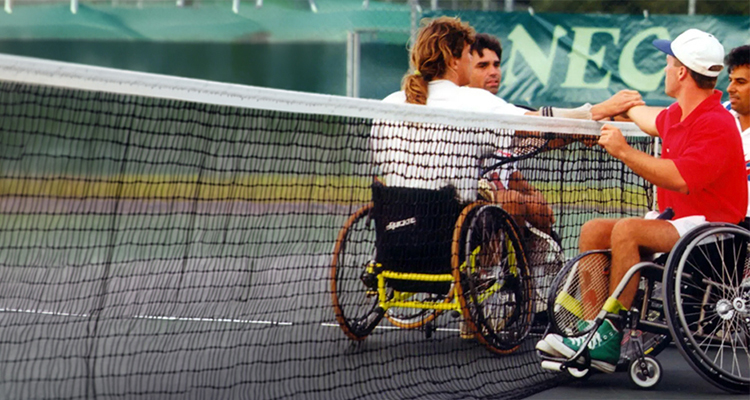
Tracing the 50-year history of wheelchair tennis
No Borders for Dreams Vol.6

In pursuit of realizing a society where everyone can dream and take on challenges, NEC has been supporting wheelchair tennis for over 30 years.
In the “No Borders for Dreams” series, together with Shingo Kunieda, we explore the appeal of wheelchair tennis and the people who dedicate themselves to challenging the limits.
Through these stories of taking on challenges, we hope to inspire everyone to pursue their own dreams.
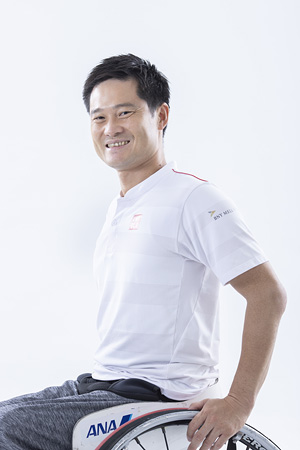
Shingo Kunieda
Born in Kashiwa, Chiba Prefecture, Japan, in 1984.
Kunieda discovered wheelchair tennis at the age of 11 and won a doubles gold medal at his first Paralympic Games in Athens in 2004. He went on to win singles gold medals at the Beijing, London, and Tokyo Paralympic Games.
Kunieda discovered wheelchair tennis at the age of 11 and won a doubles gold medal at his first Paralympic Games in Athens in 2004. He went on to win singles gold medals at the Beijing, London, and Tokyo Paralympic Games.
In 2026, wheelchair tennis will celebrate its fiftieth anniversary as a sport. Having begun as a form of rehabilitation, wheelchair tennis has since grown into a global sport, now featured in both the Grand Slam tournaments and the Paralympics. In Volume 6 of this series, we explore the evolution of the sport, which NEC has championed for 35 years, and reflect on where it is today.
How wheelchair tennis has evolved in the 50 years since its advent as a competitive sport
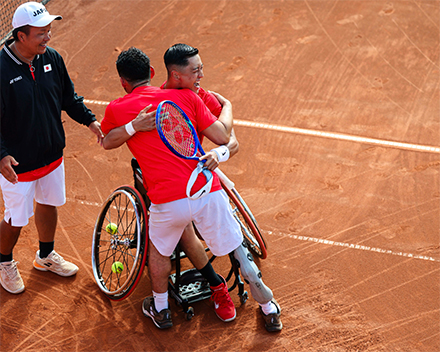
In the global sport of wheelchair tennis, a number of world-class Japanese players have left their mark. Among them are Shingo Kunieda, who became the first male wheelchair tennis player to complete a career Golden Slam by winning all four Grand Slam singles titles (Australian Open, French Open, Wimbledon, and U.S. Open) and a Paralympic gold medal, Yui Kamiji, who won her first Wimbledon title in July 2026 to become the first Japanese woman to achieve the same feat, and Tokito Oda, who became the youngest player ever to claim a career Golden Slam in 2025. Their achievements are a testament to how wheelchair tennis has evolved into a competitive sport that captivates audiences around the world.
However, wheelchair tennis did not achieve its current status and recognition overnight. Originally enjoyed primarily as a form of rehabilitation, wheelchair tennis was established as a competitive sport in 1976. In 1992, it became an official sport at the Barcelona Paralympic Games. Then, in the 2000s, wheelchair and mainstream matches began being held alongside each other at all four Grand Slam tournaments, widely regarded as the pinnacle of professional tennis. Over the decades, wheelchair tennis has built its own history as a competitive sport while steadily bridging the gap with mainstream tennis.
Video: The 50-year journey of wheelchair tennis
What obstacles did wheelchair tennis overcome on its journey to becoming the global sport it is today? Together with wheelchair tennis legend Shingo Kunieda, we look back at the history of the sport and the challenges it has overcome.
35 years ago, wheelchair tennis faced an invisible divide
NEC began its journey alongside wheelchair tennis in 1992. At the time, the sport was gradually gaining popularity in Japan, but the playing environment was not nearly as well developed as it is today. Against this backdrop, NEC has supported domestic and international tournaments and the challenges faced by athletes, in line with its pursuit of realizing a society where everyone can dream and take on challenges.
In the early 1990s, Kunieda was still in elementary school. Looking back on the environment at the time, he recalls: "When I was a child, wheelchair tennis was generally taught by instructors specializing in adaptive sports, rather than professional tennis coaches. There were very few places where players could receive the same level of technical instruction as mainstream tennis players."
However, at the Yoshida Memorial Tennis Training Center, where Kunieda trained, wheelchair tennis players could receive the same high-level, specialized instruction as mainstream players. It was still rare, even internationally, for wheelchair tennis players to receive coaching from professional tennis specialists. Having access to this kind of coaching from an early age proved formative for Kunieda. "Rather than being developed within the confines of wheelchair tennis, I was nurtured as a tennis player in my own right. That became the foundation that enabled me to set my sights on competing at the highest level in the world," he reflects.
Mainstream tennis and wheelchair tennis: becoming one sport—tennis
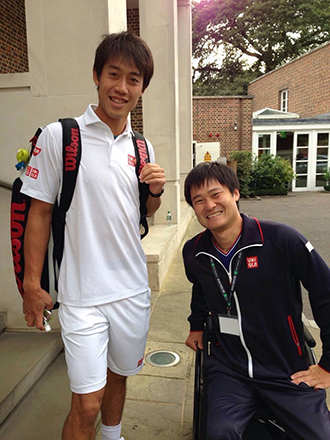
Although Kunieda was keenly aware of the divide between mainstream sports and para sports, he continued to grow without allowing himself to be defined by that distinction. In 2003, he won the NEC All Japan Wheelchair Tennis Masters, and the following year made his Paralympic debut in Athens. In 2006, he became the first Asian player to reach No. 1 in the world rankings, continuing to demonstrate an extraordinary record of achievement. How has the divide between mainstream tennis and wheelchair tennis changed over the years?
"I felt the divide began to disappear when the four Grand Slam tournaments started holding mainstream and wheelchair tennis events at the same time. I was thrilled to find myself sharing the locker rooms and restaurants at these tournaments with players like Roger Federer, my idol, and Kei Nishikori. The level of media coverage was also on a completely different scale from tournaments dedicated solely to wheelchair tennis. I think this was when wheelchair tennis began to gain recognition and take root among the general public and within the tennis community."
As the level of play continued to rise, wheelchair tennis evolved, just like mainstream tennis, into a sport that draws spectators in and moves them emotionally. Little by little, but steadily, mainstream tennis and wheelchair tennis were becoming one sport: tennis. Kunieda also had the following to say about NEC's longstanding support for wheelchair tennis:
"NEC has supported wheelchair tennis for many years, but its contribution goes far beyond what the word 'sponsor' can convey. Its continued support for the sport helped create a stable environment in which tournaments could be held regularly, giving athletes the confidence and security they needed to pursue their goals on the world stage. I feel that this support enabled me to continue taking on the challenge of competing internationally. To be honest, there were times in the past when I felt that some organizations supported us simply because wheelchair tennis was a para sport. Today, however, there are more opportunities for people to appreciate the high level of competition and the excitement of the sport itself. Behind this change are companies like NEC that have believed in and supported wheelchair tennis over many years. They have supported athletes in taking on challenges; those challenges have attracted new fans, increased the value of the sport, and inspired the next generation. I believe NEC's greatest contribution has been helping to create this virtuous cycle."
Wheelchair tennis has inspired people from all walks of life, transcending the presence or absence of a disability, and has given them the courage to take on challenges and the inspiration to dream. In this respect, the sport embodies the Purpose of the NEC Group: creating a society where everyone has the chance to reach their full potential.
Wheelchair tennis: Passing the torch to the next generation
Continuing to support the dreams of athletes who aspire to compete on the world stage
In recent years, it seems that more and more young players are taking up wheelchair tennis after watching Japanese athletes compete at the highest level around the world. Many of these aspiring athletes dream of one day becoming top competitors on the global stage themselves. Kunieda, who is also involved in coaching junior players, says that "the skill level of the junior generation has improved tremendously."
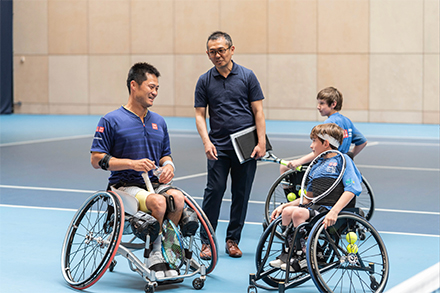
"In addition to having access to all kinds of equipment and training opportunities, players nowadays live in an era where they can easily learn by watching videos of the world's best players. They are also growing up in an environment where they can be exposed to high-level tennis from an early age. However, skill alone is not enough to excel at the world-class level. Players need to venture abroad, go up against a wide range of competitors, and grow as athletes by developing the ability to think for themselves and adapt to new and changing environments. Looking back at my own experiences competing abroad, I feel that I grew significantly not only as a tennis player but also as a person. I really encourage today's players to broaden their horizons and not be afraid to go out into the world."
As Kunieda stated, significant progress has been made in wheelchair tennis, making it easier for young players to embrace the sport. More and more companies are also supporting the sport and its athletes, resulting in an increase in the number of tournaments and improvements to the playing environment, including competitive wheelchairs and other equipment.
Over the past 50 years, wheelchair tennis has grown into a global sport. This history has been built by the athletes who believed in the sport's potential and relentlessly embraced new challenges, as well as the countless people inspired by their efforts.
Going forward, wheelchair tennis will continue to evolve as it is passed down to future generations. NEC is truly proud to have been a part of that history and to have continually supported wheelchair tennis athletes in their endeavors for 35 years, and will continue to champion their stories of perseverance.

What did you think of this article?
To help us plan future "No Borders for Dreams" initiatives and our wheelchair tennis sponsorship activities, please take about a minute to fill out this survey.
 Take the survey (about 1 minute)