
Global Site
Breadcrumb navigation

Broadening the Circle of Athletes Eager to Embrace New Challenges
No Borders for Dreams Vol.5
NEC and Its Support of Wheelchair Tennis

In pursuit of realizing a society where everyone can dream and take on challenges, NEC has been supporting wheelchair tennis for over 30 years.
In the “No Borders for Dreams” series, together with Shingo Kunieda, we explore the appeal of wheelchair tennis and the people who dedicate themselves to challenging the limits.
Through these stories of taking on challenges, we hope to inspire everyone to pursue their own dreams.
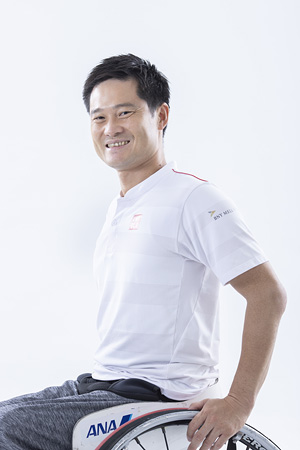
Shingo Kunieda
Born in Kashiwa, Chiba Prefecture, Japan, in 1984.
Kunieda discovered wheelchair tennis at the age of 11 and won a doubles gold medal at his first Paralympic Games in Athens in 2004. He went on to win singles gold medals at the Beijing, London, and Tokyo Paralympic Games.
Kunieda discovered wheelchair tennis at the age of 11 and won a doubles gold medal at his first Paralympic Games in Athens in 2004. He went on to win singles gold medals at the Beijing, London, and Tokyo Paralympic Games.
In Volume 5 of this series, we highlight NEC's commitment to donating competition wheelchairs and explore how these efforts are empowering aspiring athletes to embrace new challenges.
Supporting athletes at every stage of their personal journeys
Throughout the more than 30 years that NEC has supported wheelchair tennis, the sport has experienced significant growth, with iconic players such as Shingo Kunieda emerging and capturing the hearts of many.
The desire to support athletes from behind the scenes while keeping them in the spotlight is what has led NEC to donate competition wheelchairs.
What are competition wheelchairs?
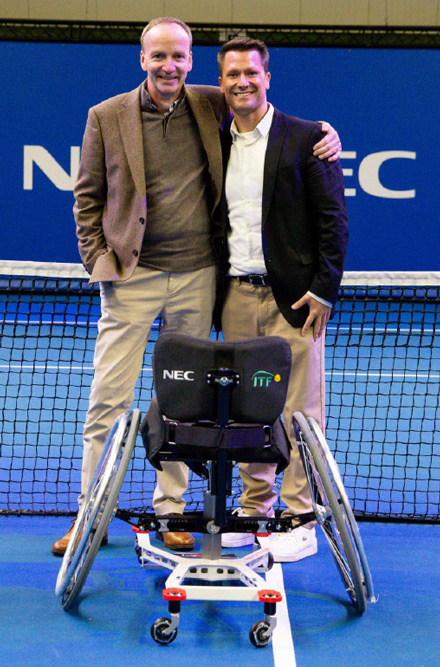
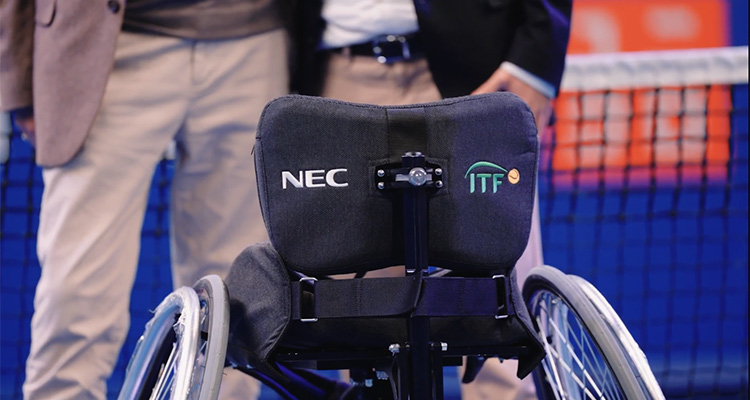
As part of its ongoing support of the sport, NEC donates competition wheelchairs to the International Tennis Federation (ITF). The goal of these donations is to expose more people to the sport and to create an environment where athletes can take on new challenges.
Competition wheelchairs are as essential to wheelchair tennis players as their rackets. They are integral partners in enhancing speed, maneuverability, and overall quality of play. Unlike conventional wheelchairs, they must be lightweight, easy to maneuver, and customized to fit the athlete's body. Therefore, competition wheelchairs are by no means easy for newcomers to the sport or young players to obtain.
What do competition wheelchairs mean to wheelchair tennis players, and what sets them apart from ordinary wheelchairs? Wheelchair tennis legend Shingo Kunieda had this to say.
"I first tried a competition wheelchair when I started playing wheelchair tennis at age 11, and I vividly remember being impressed by how effortlessly it turned. The biggest difference is that the wheels are angled outward in a V-shape, which drastically changes the feel of turning. Simply put, ordinary wheelchairs are best likened to being for 'walking,' while competition wheelchairs are for 'running.'"
Unfortunately, obtaining competition wheelchairs can be difficult. According to Kunieda, this becomes a hurdle that must be overcome by those hoping to get involved in the sport.
"As with any parasport, the biggest obstacle faced when first starting out is purchasing a competition wheelchair. In addition to being expensive, they must be made to order, which takes time."
For these reasons, while competition wheelchairs are essential for athletes seeking to take on new challenges, they can also be obstacles for those new to the sport.
Expanding access to the sport through the donation of competition wheelchairs
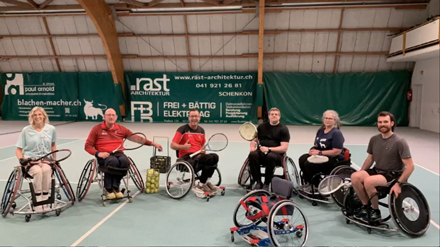
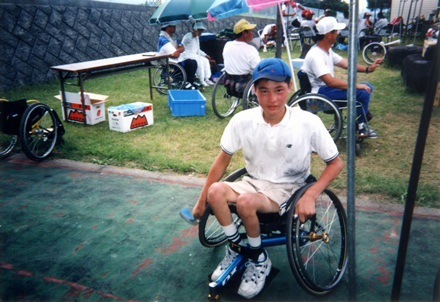
Kunieda says access to competition wheelchairs means a lot to newcomers to the sport, explaining, "Accessibility allows them to give wheelchair tennis a try when they feel inspired to do so. Fostering an environment where aspiring athletes can readily take up the sport is crucial to its growth."
Having played for around a year using a competition wheelchair on a trial basis, Kunieda says he knows firsthand how a competition wheelchair can be lifechanging, emphasizing, "What makes this even more significant is that one person can inspire the next generation, sparking a chain reaction."
Another aim of providing competition wheelchairs to the ITF has been to broaden access for those new to the sport. The donated competition wheelchairs are provided to not only specific players but also tennis associations around the globe, thus contributing to the creation of an environment where a far greater number of people, including junior players and novices, can participate in the sport.
The competition wheelchairs that NEC donates are also designed to easily accommodate adjustments, enabling them to be used by multiple players with differing physiques and playing styles.
Real changes are also taking place inside the organizations to which these donations are made. In Switzerland, the donated competition wheelchairs were utilized at a camp that hosted around 50 players, reducing waiting times and increasing the overall time participants could spend playing on the court. As a result, even more participants had the opportunity to experience the joy of the sport.
Meanwhile, in the Netherlands, the donated competition wheelchairs are being used for several youth development programs, playing a major role in supporting players from the very beginning of their journey until they begin competing at a higher level. These programs include "Fun Days" where children try out wheelchair tennis for the first time, development training for junior players, and fittings for players before they purchase their own competition wheelchairs.
The donation of competition wheelchairs is also an investment in the future. Even a single competition wheelchair can inspire individuals to give wheelchair tennis a try, ultimately shaping the next generation of wheelchair tennis players. This initiative is therefore helping to lay the groundwork for the future of wheelchair tennis.
Video: Broadening the circle of athletes eager to embrace new challenges through the donation of competition wheelchairs
Creating an environment that paves the way for athletes to take on their next challenge
The sport of wheelchair tennis originated in the United States of America and has since then flourished, driven by the success of players from around the world. Currently, it is expanding to Asia, South America, and other regions.
Representative of this trend is the fact that the NEC Wheelchair Singles Masters was held in Asia (Huzhou, China) for the first time in its thirty-year history in 2025.
NEC has sponsored this season-ending event since 1994, in which the top eight players of the year in the men's, women's, and quad categories compete. As a new generation of athletes emerges, players like Tokito Oda are carving out a presence for themselves on the world stage. In the video below, Oda and other players who competed at the Asian debut of the NEC Wheelchair Singles Masters speak about the significance of this event.
Video: Interview with athletes at the Asian debut of the NEC Wheelchair Singles Masters
Hosting this event in Asia clearly shows that athletes from around the world are coming together to compete on a growing playing field. The opportunity to play in a new region brings the world closer to players, empowering the next generation.
Underlying the growth of wheelchair tennis are not only the athletes themselves but also the many people supporting them. Over the years, NEC has played its part in creating this environment. Going forward, each new challenge is sure to open the door to even greater possibilities.