
Global Site
Breadcrumb navigation

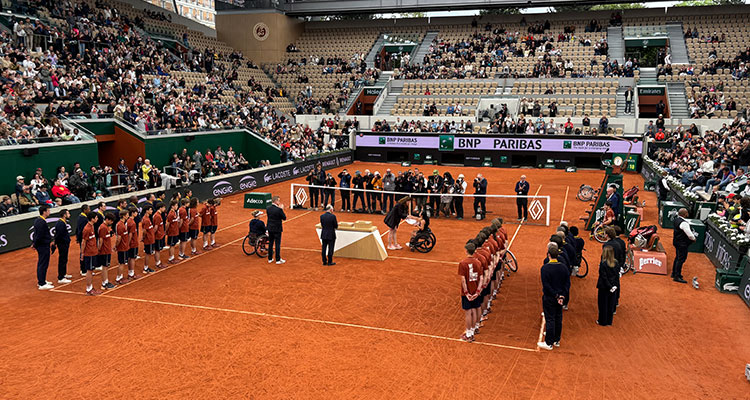
Grand Slam Tournament Report
No Borders for Dreams Vol.2
“Challenges” and “Inclusion” Through the Eyes of NEC Group Employees

In pursuit of realizing a society where everyone can dream and take on challenges, NEC has been supporting wheelchair tennis for over 30 years.
In the “No Borders for Dreams” series, together with Shingo Kunieda, we explore the appeal of wheelchair tennis and the people who dedicate themselves to challenging the limits.
Through these stories of taking on challenges, we hope to inspire everyone to pursue their own dreams.
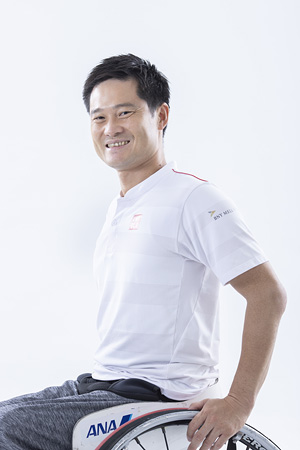
Shingo Kunieda
Born in Kashiwa, Chiba Prefecture, Japan, in 1984.
Kunieda discovered wheelchair tennis at the age of 11 and won a doubles gold medal at his first Paralympic Games in Athens in 2004. He went on to win singles gold medals at the Beijing, London, and Tokyo Paralympic Games.
Kunieda discovered wheelchair tennis at the age of 11 and won a doubles gold medal at his first Paralympic Games in Athens in 2004. He went on to win singles gold medals at the Beijing, London, and Tokyo Paralympic Games.
In Volume 2 of this series, we share first-hand accounts from NEC Group employees who attended two of professional tennis’s Grand Slam tournaments—the Wimbledon Championships (The Championships, Wimbledon) and the French Open (Roland-Garros).
“Wheelchair Tennis” at Grand Slam Tournaments

For professional tennis players, the Grand Slam tournaments (the Australian Open, French Open, Wimbledon, and U.S. Open) are truly “dream stages.” Wimbledon, the oldest of the four, began in 1877 and originally featured only men's singles. After many years, wheelchair tennis was first held alongside a Grand Slam tournament at the 2002 Australian Open, and men's and women's singles events were introduced at Wimbledon in 2016. Today, men's and women's singles and doubles wheelchair events are held at all four Grand Slam tournaments.
Seeing the world’s top wheelchair tennis players compete at the same venues and during the same periods as non-disabled players has powerfully demonstrated their skill and presence to tennis fans around the world, and to society at large.
This has been achieved through the persistent efforts and “challenges” of players and many others involved. Organizers have improved the environment of each tournament, conveyed the sport’s appeal to spectators and the media, and overcome challenges such as transportation issues and securing practice time, resulting in the gradual establishment of a more equal competitive environment.
Wheelchair tennis at Grand Slam tournaments carries an energy that cannot be fully conveyed through television alone. In this feature, we share the atmosphere felt firsthand by NEC Group employees at multiple tournament venues.
Wimbledon 2025 – The Challenges of Players at the Holy Ground of Tennis
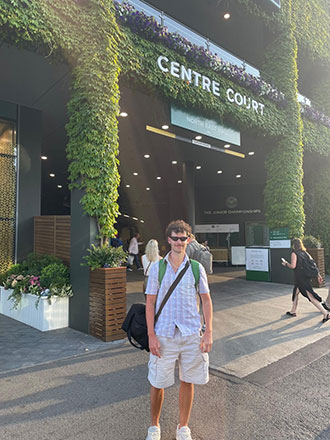
In July 2025, three NEC Europe employees, Elizabeth Brown, Edward Bumbry, and Ai Kawabe, visited Wimbledon, known worldwide as the “holy ground of tennis.” For Elizabeth, who grew up as a tennis fan in Ireland, Wimbledon had long been a special place, deeply rooted in her heart as the “highlight of summer” since childhood.
Among the Grand Slam tournaments, Wimbledon is the only one held on grass courts. While watching the players perform so dynamically on grass, all three were deeply moved.
“Seeing the players’ determination and talent right in front of me, it was easy to see how each of them had overcome the challenges to appear on this stage. It was incredibly moving.” (Elizabeth)
“It was great to be able to visit again this year. I feel a strong connection between the tournament’s support for wheelchair tennis and NEC’s commitment to creating a society where everyone can play an active role, as expressed in the NEC Way value ‘Encourage Openness. Stimulate the Growth of All.’” (Edward)
“When I first watched wheelchair tennis, I was deeply impressed by the players’ athleticism and dedication. Since then, every time I come to the venue, the high level of play and the excitement remain unchanged, and I feel newly inspired each time.” (Ai)
Ai also describes Wimbledon as a place that offers an experience beyond just tennis. She notes that enjoying court tours, picnics, and immersing oneself in the atmosphere of the entire venue are also part of its appeal.
The scent of the grass, the challenges faced by the players, and the energy of the crowd—all of these together told the story of why Wimbledon is called a “special stage.”
Roland-Garros - Another Kind of Power Drawn Out by the Red Clay
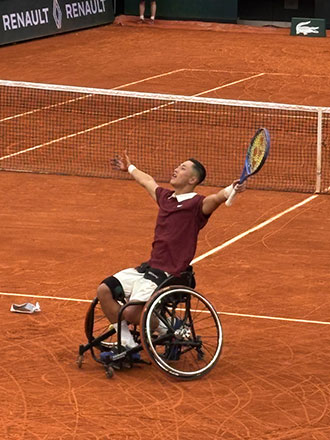
Employees of NEC France attended wheelchair tennis matches at Roland-Garros (the French Open). In contrast to the grass courts of Wimbledon, the tournament is played on red clay. They described the venue as filled with an energetic atmosphere, created by the unique rhythm of the ball bouncing on clay and the passionate cheers of the spectators.
One employee who watched the matches shared the following:
“I was deeply captivated by the players as they moved freely around the court with smooth mobility, delivering precise shots and sophisticated tactics. Their unwavering patience and fighting spirit were evident in their play, and I felt a deep emotional intensity. Wheelchair tennis goes beyond being just a sport, it changes how we view physical ability and allows us to truly feel the strength and unshakeable mental toughness of these athletes.”
Another employee spoke about the demanding nature of the competition:
“Tennis is already physically demanding, but playing in a wheelchair raises the level of difficulty to an entirely new dimension. The players’ motivation and mental strength are truly remarkable, and I feel genuinely inspired.”
At Roland-Garros, the close proximity between players and spectators allows the scent of the clay and the heat of the competition to be felt directly. Even within the same sport of wheelchair tennis, the venue offers a distinct appeal and intensity, different from that of Wimbledon.
Experiencing the Grand Slams: The Power Behind the NEC Group’s Spirit to Take on Challenges and Create Growth
By witnessing the challenges faced by athletes at two Grand Slam tournaments, the employees who attended said they were once again reminded of the significance of NEC’s more than 30 years of support for wheelchair tennis.
Some employees commented:
“The level of competition and excitement surpass our expectations every time we attend. We want more people to know how incredible this sport is.”
Others shared their pride saying, “We are proud that the NEC Group continues to be involved in a sport that has yet to receive the attention it deserves,” and “Being engaged in initiatives that expand accessibility and support the challenges of talented athletes is truly motivating.”
Their words reflect how NEC’s ongoing support for wheelchair tennis fosters a sense of pride among employees and encourages a shared mindset of taking on challenges. NEC will continue to value this positive cycle and work to extend its impact across society.
Moments that Move the Heart: A Conversation with Shingo Kunieda

As a player, the cheers of the crowd can ignite one’s competitive spirit; as a spectator, the power of the play can be overwhelming. Kunieda says that wheelchair tennis has a unique ability to move people in both ways.
— During your playing career, was there a moment when the cheers of the crowd gave you a real boost and significantly changed the flow of a match or your mindset? Are there any scenes or episodes that left a strong impression?
It was when I competed at Wimbledon for the first time, in 2006. At the time, wheelchair tennis was held only as a doubles event, but the final was played in front of a full crowd, on a court that probably seated around 2,000 people. Until then, I had only played on nearly empty courts, so I vividly remember how moved I was by that atmosphere. I went on to win the tournament, but as match point approached, I found myself thinking that I wanted to keep playing there just a little longer. After that experience, one of my goals became to play in front of full stands in Japan as well. Wanting to deliver high-level play that audiences could truly enjoy became a core motivation that supported my entire athletic career.
— What do you think is the appeal of watching wheelchair tennis? What are some highlights or ways of enjoying the sport that would encourage general spectators to come to the court.
The appeal of wheelchair tennis is that it can be enjoyed both as tennis and as a sport with its own unique characteristics. For those familiar with tennis, the techniques and tactics, such as serves, forehands, and backhands, can be appreciated just as they are in the conventional game. At the same time, it can also be seen as a different sport, because traditional footwork is replaced by “chair work,” which involves maneuvering the wheelchair. This requires extremely precise control and technique. One of the most exciting moments, sometimes even more thrilling than in regular tennis, is when a player reaches a ball that seems impossible to get to. I encourage everyone to experience that intensity firsthand by watching a match live.