Global Site
Breadcrumb navigation

What Kind of Sport Is Wheelchair Tennis?
No Borders for Dreams Vol.1
Discovering Its Appeal and Evolution

In pursuit of realizing a society where everyone can dream and take on challenges, NEC has been supporting wheelchair tennis for over 30 years.
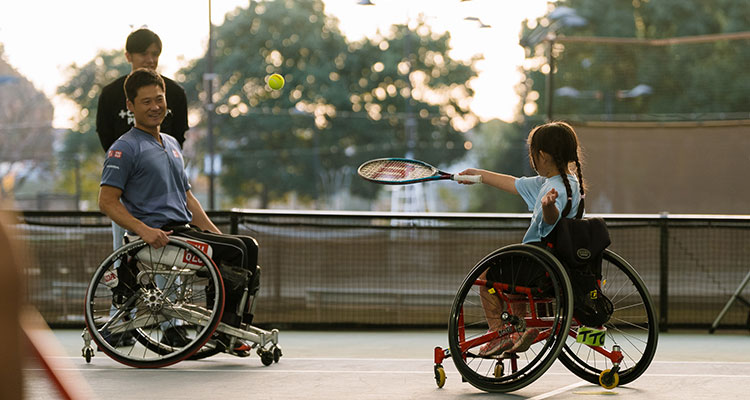
In the “No Borders for Dreams” series, together with Shingo Kunieda, we explore the appeal of wheelchair tennis and the people who dedicate themselves to challenging the limits.
Through these stories of taking on challenges, we hope to inspire everyone to pursue their own dreams.
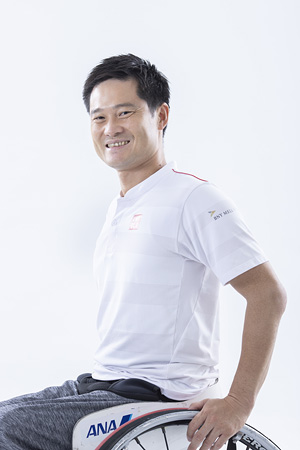
Shingo Kunieda
Born in Kashiwa, Chiba Prefecture, Japan, in 1984.
Kunieda discovered wheelchair tennis at the age of 11 and won a doubles gold medal at his first Paralympic Games in Athens in 2004. He went on to win singles gold medals at the Beijing, London, and Tokyo Paralympic Games.
Kunieda discovered wheelchair tennis at the age of 11 and won a doubles gold medal at his first Paralympic Games in Athens in 2004. He went on to win singles gold medals at the Beijing, London, and Tokyo Paralympic Games.
In the first volume of this series, we will introduce the appeal of wheelchair tennis and the significance of NEC’s ongoing support for the sport.
The Appeal of Wheelchair Tennis

What comes to mind when you hear “wheelchair tennis”?
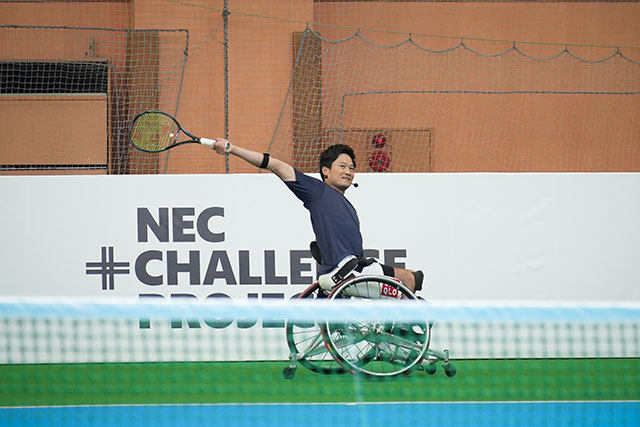
Most people probably haven’t watched a match or don’t know the rules. But if you ever watch professional wheelchair tennis, you will be captivated by its dynamic play. One major feature of wheelchair tennis is that its rules are almost identical to those of conventional tennis. The only difference is that returning the ball after two bounces is allowed.
The evolution of wheelchairs for competitive sports has been remarkable, and the athletes’ movements are incredibly agile. However, that’s not all. What has driven the sport to evolve this far is the athletes’ own fitness levels and techniques, their tireless efforts to refine their tactics, and the strength of their resolve to pursue victory. The powerful drive volleys and smashes unleashed while executing sharp wheelchair turns embody the unique dynamism of wheelchair tennis.
This aligns with the tennis style Shingo Kunieda has pursued for years, leading the wheelchair tennis world. “We can’t sidestep, so we turn in our wheelchairs, and sometimes use the court more expansively than non-disabled players. The real thrill of wheelchair tennis is surprising people by reaching balls they never thought possible. I’ve adopted a style that involves moving forward to attack, like serve-and-volley. I believe this has broadened the game, making it more diverse and faster-paced, resulting in tennis that’s truly enjoyable to watch.”
NEC and Wheelchair Tennis
Wheelchair tennis is now held alongside the general divisions at Grand Slam tournaments (the four major championships), the pinnacle of the professional tennis world. Professional tennis is a major global sport. The fact that wheelchair tennis can be played on the same stage is one reason it stands out among parasports. While inclusive efforts exist in marathons, cycling, and swimming, tennis is arguably the most advanced at present.
Building that stage required the efforts and dedication of many athletes, as well as ongoing support from businesses and organizations. NEC has been one of the central players in this effort. In 1992, NEC began sponsoring a wheelchair tennis tour organized by the International Tennis Federation (ITF). For over 30 years, starting with the “NEC Wheelchair Singles Masters,” NEC has supported the development of wheelchair tennis through domestic and international tournaments, guided by the commitment to create a society where everyone, regardless of disability, can reach their full potential.
This ongoing support has significantly contributed to improving the competitive environment and raising international recognition, earning high praise from the ITF and players alike, who affirm that “without NEC’s support, wheelchair tennis as it exists today wouldn’t be possible.”

— Shingo Kunieda
Shingo Kunieda’s “Challenge” and the “Evolution” of Wheelchair Tennis

Mr. Kunieda shared:
“The relationship between NEC and wheelchair tennis is truly deep. Even when I first competed internationally as a high school student, there was an NEC banner behind the court. I remember feeling genuinely reassured, knowing that a company from my home country was supporting wheelchair tennis worldwide.”
Kunieda has sown the seeds of his own “challenges” on the foundation NEC has built over many years.
At that time, there were almost no athletes competing professionally in the world of parasports. Even Kunieda, who was already ranked number one in the world, said the reality was that “the harder I worked, the poorer I became.”
“I wanted to show that I could make a living with just one racket. I felt that if I didn’t, the next generation of young people would stop playing this sport,” he said, blazing his own trail to becoming a pro.
“I believe that becoming a pro let me leave my mark on the Paralympic world. I was able to pave a solid path for others to follow.” Guided by those words, the next-generation of players, such as Tokito Oda and Yui Kamiji, are expanding that path further and bringing it to full bloom.
NEC’s support, Shingo Kunieda blazing a trail, and the next generation continuing to evolve—these steps have shaped Japan into a powerhouse of wheelchair tennis.
The “NEC Wheelchair Singles Masters” was held for the first time in China in 2025. Wheelchair tennis, born in the United States and nurtured throughout Japan and Europe, is now poised to evolve further on the global stage.